Coldcard shock, Warren warning, IMF on stablecoins: a week the custody debate reopened
Santiment flagged 2.27 million new Bitcoin wallets as a Coldcard incident forced holders to rethink self-custody, while the IMF warned local stablecoins could push users toward digital dollars and Senator Elizabeth Warren drew a fresh line on industry-written crypto rules.
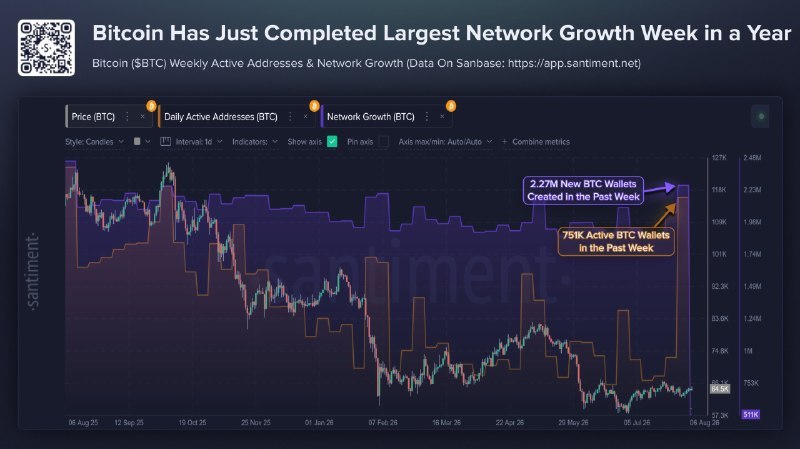
On 9 August 2026, the on-chain analytics firm Santiment counted 2.27 million new Bitcoin wallets and 751,000 active wallets, attributing the burst to users moving funds and rethinking custody after what Cointelegraph labelled the "Coldcard chaos." The number landed the same morning Senator Elizabeth Warren's most recent remarks on US crypto legislation were still being recirculated, and forty-eight hours after the IMF argued that local stablecoins could push more users toward digital dollars rather than away from them.
Read together, the three signals sketch a single picture. The plumbing of self-custody is being stress-tested, the policy frontier around dollar-pegged tokens is moving faster than the legislative frontier around crypto markets, and the industry's own attempts to draft the rules of the road are running into a familiar objection from the Senate's most persistent crypto critic. None of these threads is new. What is new is the timing.
Wallets on the move
Santiment's 2.27 million new-wallet figure, flagged by Cointelegraph at 13:33 UTC on 9 August, is the kind of number that gets quoted without context. New wallets can mean adoption. They can also mean migration: a user who splits one balance across three addresses, a holder who rotates keys after a scare, a trader who moves from a custodial venue into a hardware device. Cointelegraph's framing tied the spike directly to "the Coldcard chaos," an event whose specifics the available source items do not detail further.
The interpretive question matters. Monexus analysis: a wallet-creation spike during an active security scare is closer to a defensive reaction than an adoption event, and is likely to mean more keys, more backups, more friction at the user end. Active addresses at 751,000 are a steadier signal of engagement, but the comparison class is what gives the number meaning, and the cited posts do not specify the prior-period baseline against which Santiment measured the jump.
What the cited material does establish is a behavioural pattern under stress. When users doubt their storage layer, they do not, in the main, leave the asset class; they reorganise within it.
The Warren line, sharpened
On 7 August, Cointelegraph carried Senator Elizabeth Warren's statement that the United States needs crypto legislation, but not legislation "written by the crypto industry to protect and advance the crypto industry." The phrasing tracks Warren's long-running argument that bills drafted with significant industry input amount to self-regulation in legislative clothing. It also prefigures the next round of markup fights: stablecoin frameworks, market-structure bills, and any renewed push to define who counts as a broker.
Monexus assessment: the quote is more useful as a marker of red lines than as a policy blueprint. It signals that the Democratic wing of the Senate is unlikely to accept bills whose consumer-protection floor looks thin, and it tightens the Overton window for industry-authored drafts regardless of which party holds the gavel. The reading that should be watched is whether Warren's framing becomes a veto threat or a negotiating position; the cited posts do not specify which of those her office currently intends.
The IMF, stablecoins, and the dollar's gravitational field
The most consequential of the three signals arrived first. On 8 August, Cointelegraph relayed an IMF insight arguing that local stablecoins could push more users toward digital dollars, not away from them. The reasoning is structural rather than rhetorical: a stablecoin pegged to a strong reserve currency tends, in stress, to migrate toward whatever dollar-equivalent liquidity is deepest, and that is usually the US dollar.
This is the part of the debate the industry usually fudges. Local-currency stablecoins are presented as monetary sovereignty tools; the IMF's frame is that they are dollar-adjacent instruments whose issuers inherit the US monetary policy cycle whether they want to or not. Monexus analysis: if the IMF read is even roughly right, the political case for issuing a non-dollar stablecoin is harder than it looks, because the asset behaves like a dollar-denominated liability in all the scenarios a policymaker cares about. The cited posts do not specify which jurisdictions the IMF is pointing at, nor whether the Fund is endorsing or warning against the trend; the headline frames it as an insight, not a recommendation.
A week the custody debate reopened
Taken together, the three threads point to a single underlying shift: the operational questions of crypto, who holds the keys, which token clears at par, who writes the rulebook, have moved ahead of the rhetorical questions. The wallets moved first. The IMF's framing landed next. Warren's red line capped the week.
Monexus finds that the practical signal for the next several weeks is not in any one of these threads but in whether they cohere. A custody scare that pushes users toward hardware wallets without changing the underlying asset's risk surface produces churn, not reform. A dollar-gravity reading of stablecoins that is acknowledged but not acted on produces a regulatory vacuum the market fills by default. A Senate position that rejects industry-drafted bills without offering a counter-text produces stalemate.
The most useful date to watch is the next time all three clocks tick at once: a custody event, an IMF paper, and a Senate markup, all within a single news cycle. That is when the policy frame and the operational frame stop being separable.
Desk note: Monexus framed the week as a custody shock overlapping with two distinct policy signals, the IMF's dollar-gravity reading of stablecoins and Senator Warren's red line on industry-written rules, rather than as three unrelated headlines. The wire treatment separated them; this publication treats them as one picture.
Wire provenance
This editorial synthesis draws on the following public wire/social posts:
- https://t.me/Cointelegraph/71522
- https://t.me/cointelegraph/71521
- https://t.me/Cointelegraph/71502
- https://t.me/cointelegraph/71497