Tehran's Hormuz framing puts the Strait at the centre of a global-economic threat
A sequence of statements attributed to IRGC spokesman Brigadier General Mohebi reframes Hormuz disruption as a global-economic threat. The framing matters more than the threat itself.
A sequence of seven posts on the Al-Alam Arabic Telegram channel on 10 August 2026 carries remarks attributed to Islamic Revolutionary Guard Corps spokesman Brigadier General Mohebi, and the sequencing itself is part of the story. The first item, timestamped 12:17 UTC, opens on the battlefield: "We fought a war with one of the most powerful countries in the world and this war had different arenas." The next post, dated 12:18 UTC, calls the same conflict "a war to shape perception supported by military measures." By 12:20 UTC, three further posts in the thread have moved the argument from combat to chokepoint to commodity chain: "The threats related to Hormuz are not just a regional issue because an important part of the energy that the world needs passes through it," followed by warnings that "a disturbance in this path could affect financial markets, food supply chains and industries," and a closing line that "the effects on the global economy and global energy security must be taken into account." The cited posts do not specify the audience composition, the venue, or the trigger event for the remarks.
Monexus analysis: the operative move in the sequence is the choice of vocabulary, and specifically the deliberate widening of scope from a regional contest to a global-economic variable. The Strait of Hormuz, on this reading, is being marketed less as a piece of Iranian geography than as an instrument that touches every balance sheet that touches energy.
The Strait as a global-economic variable
The geographic claim in the thread is structurally simple and broadly uncontested in open-source energy reporting: a narrow maritime corridor separates Iran from the Arabian Peninsula, and a meaningful share of seaborne oil and liquefied natural gas transits it. Mohebi's contribution is not to dispute that geography but to attach a global price tag to it in real time. "An important part of the energy that the world needs passes through it," the post reads, and the framing does the rest.
The cited posts do not specify what triggered the warning or whether it reflects a change in Iranian posture. What is new, on this reading, is not the underlying map but the source making the map publicly legible at this moment. The Strait has long featured in Western energy desks' chokepoint modelling and in Tehran's own strategic literature; the IRGC is now stating that hinge status in a Telegram thread that travels quickly into non-regional feeds. A nuance worth holding: any actual closure of the corridor would also punish Iran, which exports through the same waterway. The threat is therefore best read as a deterrent signal calibrated to a specific audience rather than as a forecast.
"Cost transfer" as doctrine
The most quietly significant line in the sequence came at 12:20 UTC. "In the last war, part of the costs and damages of the war were transferred to the opposing party's front," Mohebi is quoted as saying, describing what he portrayed as a managed diffusion of harm. One minute earlier, in the prior post, he had stated that "in many previous wars, America tried to prevent the damage resulting from the war from spreading into its territories." Read together, the two posts form a single argument: that the conflict Mohebi labels "the 12-day war" damaged Israeli and US positions more than Iranian ones, and that Tehran is now marketing that asymmetry as a deterrent asset.
The available source items do not specify independent verification of the cost-transfer claim, and this article has not independently established its empirical accuracy. The label "12-day war" is Mohebi's own characterisation in the cited posts; readers should treat the dating, duration and casualty profile as contested rather than settled. The structural pattern, by contrast, is familiar: states routinely claim that strategic depth allows them to externalise the cost of conflict. The IRGC is now attaching that pattern to an energy-corridor argument with explicit downstream targets.
The war as perception operation
The post timestamped 12:18 UTC describes the June conflict as "a war to shape perception supported by military measures." That is a candid admission, and an unusual one for an official briefing. It tells the audience that the IRGC's own readout of the conflict treats the information environment as the primary theatre, with kinetic action as the supporting instrument. The implication for Hormuz is direct: a credible threat of disruption to the chokepoint is itself a perception operation, a way to capitalise on the war's outcome without re-entering combat.
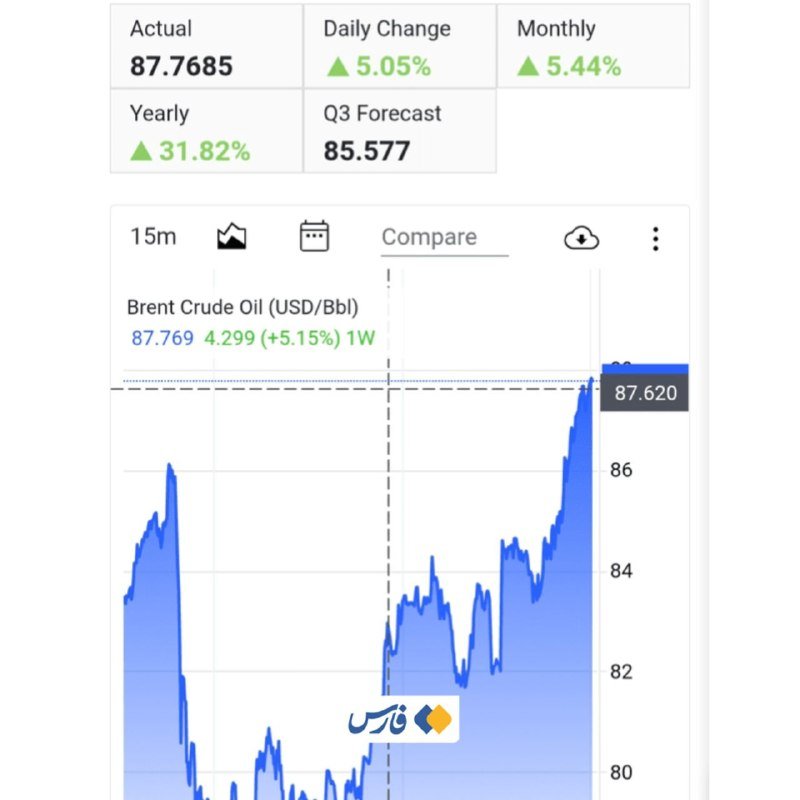
The structural pattern worth naming in plain prose is that the Strait of Hormuz is being recast from a piece of physical geography into a financial asset. The IRGC's signalling becomes part of the price discovery mechanism for a portion of global risk premium, regardless of whether traffic is actually impeded. Past cycles, the ones energy desks have already priced, saw tanker-insurance and freight rates move on exactly this kind of rhetorical choreography. The same playbook appears to be in motion again.
What the framing does, and what it doesn't
If Tehran's aim is to deter strikes by raising the cost calculus, the Hormuz frame is doing useful work. If the aim is to extract concessions on sanctions, the same frame offers leverage without escalation. If the aim is to position Iran as a structural node in any future global-energy arrangement, the frame is doing that too. These are not mutually exclusive, and the cited reporting does not let us rank them. The source items do not specify whether the IRGC's framing reflects a unified strategic decision or a spokesperson's improvisation, and that distinction matters for anyone pricing the next 30 days.
The counter-read is also visible. Critics of the Islamic Republic inside and outside the region will read Mohebi's remarks as straightforward coercion, a reminder that the IRGC's institutional interest in self-preservation outranks whatever Iran's negotiators bring to the table. They may also be right that the threats are empty. What the cited evidence rules out is the comfortable middle position, the read that this is theatre without consequence. The IRGC is naming specific downstream variables, financial markets, food supply chains, industries, precisely because it wants those variables to react.
The stakes, named plainly
The losers if the framing holds are the importers who cannot quickly diversify away from Hormuz-supplied barrels and the consumers who pay the pass-through. The winners are the actors best able to absorb a sustained risk premium, which is to say, the energy majors with deep balance sheets, the petrostate exporters with adjacent seaborne capacity, and the financial institutions positioned to clear the volatility. That is the market the IRGC is now talking to. Whether the audience is listening, and how loudly, is the next data point worth watching, and the one not in the cited reporting.
Desk note: The wire cycle around this IRGC statement is dominated by Iranian state-adjacent channels. Monexus framed it as a doctrinal framing exercise rather than a tactical threat, flagged the absence of independent verification of the cost-transfer claim rather than paraphrasing it as fact, treated the "12-day war" label as Mohebi's characterisation rather than as an established dating, and noted that the cited posts do not specify the venue, audience, or trigger event for the remarks.
Wire provenance
This editorial synthesis draws on the following public wire/social posts:
- https://t.me/alalamarabic/493687
- https://t.me/alalamarabic/493688
- https://t.me/alalamarabic/493691
- https://t.me/alalamarabic/493692
- https://t.me/alalamarabic/493693
- https://t.me/alalamarabic/493694
- https://t.me/alalamarabic/493695