Trump asserts US 'totally controls' the Strait of Hormuz, then concedes Iran 'can cause problems'; markets sell off
At around 01:00 UTC on 12 August 2026 a video clip of President Donald Trump circulated on X and Telegram, in which he says the US 'totally controls' the Strait of Hormuz, followed by a separate framing from Iran's Fars News International that Trump conceded Iran 'can cause problems' there; Reuters had already attributed a US equity sell-off to 'Iran's Strait of Hormuz stance'.
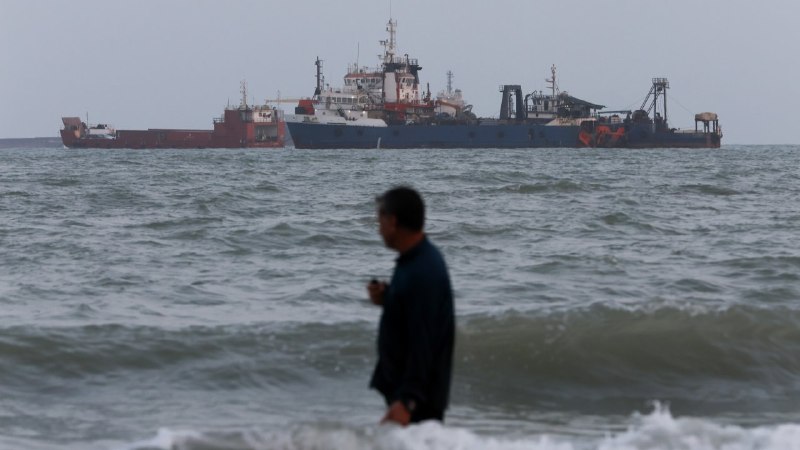
At roughly 01:02 UTC on 12 August 2026, the open-source intelligence account Disclose.tv posted a video clip to X and Telegram in which a man identified in the post as President Donald Trump says: 'Iran is going fine, going just absolutely fine. We totally control the Strait of Hormuz. We have control over it; nobody else, only us' (Disclose.tv on X, 12 Aug 2026 01:02 UTC; Disclose.tv on Telegram, 12 Aug 2026 01:02 UTC). Within minutes, the same clip circulated through the open-source intelligence channel osintlive and the Middle East Spectator account, which carried the line in the form 'We have total control over the Strait of Hormuz. We have total control. We own it' (osintlive, 12 Aug 2026 01:20 UTC; Middle East Spectator, 12 Aug 2026 01:45 UTC). About forty minutes later, Reuters's markets desk posted a wrap attributing a US equity sell-off to 'investor concerns over Iran's Strait of Hormuz stance', with tech stocks leading declines and 'alternative asset managers' rising on AI-related partnerships (Reuters on X, 12 Aug 2026 00:55 UTC).
The exchange, taken as a whole, is the sharpest rhetorical event around the strait in the current US-Iran episode. The Reuters wrap predates the Disclose.tv post by minutes in this thread's timestamp record, which suggests the markets read was responding to remarks or framing that circulated earlier in the same window; this article does not assert the exact sequencing. What the cited posts do show, plainly, is that two readings of the same American posture are now in circulation at the same time.
What the cited posts contain
The Disclose.tv video clip is the most direct piece of evidence in the thread. The president is shown saying, verbatim in the on-screen caption and the post text: 'Iran is going fine, going just absolutely fine. We totally control the Strait of Hormuz. We have control over it; nobody else, only us' (Disclose.tv on X, 12 Aug 2026 01:02 UTC). Middle East Spectator's English-language relay sharpens the line to 'We have total control over the Strait of Hormuz. We have total control. We own it' (Middle East Spectator, 12 Aug 2026 01:45 UTC).
Fars News International, the English outlet of Iran's state-aligned Fars news agency, summarised a separate portion of the same remarks in this form: 'Trump: Iran can cause problems in the Strait of Hormuz,' with the additional gloss that 'while repeating the claim of control over the Strait of Hormuz, the US President said that he does not trust Iran' (Fars News International, 12 Aug 2026 01:35 UTC). Read against the Disclose.tv clip, Fars is not inventing content so much as selecting a different clause from the same set of remarks and presenting it as the operative one.
The source items do not specify the venue in which the remarks were made, whether they were scripted or off-the-cuff, or whether the White House has issued any follow-up clarifier. They likewise do not specify whether Iran's foreign ministry or the Islamic Revolutionary Guard Corps has issued an on-record response in the same window. Monexus has not independently established those facts in this draft.
How the market read it
Reuters's markets wrap, posted to X at 00:55 UTC on 12 August 2026, is unusual in one respect: it ties a foreign-policy remark directly to a session's price action rather than burying the geopolitics inside a generic risk-off line. The wrap names 'Iran's Strait of Hormuz stance' as a weight on US equities, with tech stocks leading the move and 'alternative asset managers' rising on AI-related partnerships (Reuters on X, 12 Aug 2026 00:55 UTC).
That sequencing matters. The Reuters post is timestamped earlier than the Disclose.tv clip in the record this article is built on; the most natural reading is that the markets desk was reacting to earlier remarks or framing in the same news cycle, but the cited posts do not contain those earlier remarks and Monexus does not assert their content here. What the Reuters post does establish, on its own, is that 'Iran's Strait of Hormuz stance' was treated by a major wire's markets desk as a session-defining headline rather than as background colour. The marginal trader is not pricing American naval power; the marginal trader is pricing the probability that a presidential remark about a chokepoint translates, on the other side, into an Iranian move that forces insurance, rerouting or ceasefire premiums.
Monexus assessment: two clauses, one news cycle
Read together, the Disclose.tv clip and the Fars News summary describe the same posture from two different angles. The Disclose.tv clip foregrounds 'we totally control' and 'nobody else, only us'. The Fars News summary foregrounds 'Iran can cause problems' and the president's stated lack of trust in Iran. Each side has selected the clause that flatters its preferred narrative.
Monexus analysis: the two clauses sit more comfortably together than either side admits. A US naval presence in the Gulf is real and longstanding, and the United States Fifth Fleet has, in past episodes, transited and operated in the Strait of Hormuz. That presence does not, on its own, constitute unilateral physical dominion over a chokepoint that abuts Iranian territory, and Iran's geography, littoral forces, anti-ship missile batteries along its coast, naval fast boats and mine-laying capability have, in prior episodes, been sufficient to disrupt traffic at the strait for hours to days at a time. The Disclose.tv clip and the Fars summary, taken together, are most consistent with a posture in which both sides recognise that the corridor is governed by mutual vulnerability rather than by control. The contradictory readings being pushed into the same news cycle are each, separately, a partial picture; together they are closer to the whole.
The honest read is that neither framing is wrong on its own terms, and that the contradiction itself is the news. A presidential rhetoric that frames the strait as 'owned' while admitting, in the same cycle, that the targeted state retains a capacity to impose costs is the kind of ambiguity markets do not like, and Reuters's wrap is the cleanest public evidence that they did not like it on 12 August 2026 (Reuters on X, 12 Aug 2026 00:55 UTC).
What is unsettled, and what to watch
The cited posts do not specify the venue of the remarks, whether they were scripted or off-the-cuff, or whether the White House has issued any follow-up clarifier; Monexus has not independently established those facts in this draft. They do not specify whether Iran's foreign ministry or the IRGC has issued an on-record response in the same window; this article does not assert that such a response is absent, only that the cited posts do not record one.
What to watch over the next 24 to 48 hours is concrete: any Iranian readout from the foreign ministry or the IRGC Navy; any change in declared US naval posture in the Fifth Fleet area of operations; any movement in war-risk insurance premiums for Hormuz transits, which is the cleanest real-time signal of whether traders are treating the remark as rhetoric or as a leading indicator; and any follow-on price action in crude benchmarks when Asian markets open. If those signals harden in the direction of the second clause, the market read of the remark will settle around the vulnerability reading. If they do not, the 'total control' line will be remembered as the cycle's boilerplate, and the news will move on.
Desk note: The wires in this window, Reuters included, led on the market read and left the geography to inference. Monexus has chosen to surface both clauses of the cited remarks side by side, and to flag that the contradiction inside a single news cycle is the newsworthy object, not either clause alone. Where the Reuters wrap's timestamp precedes the Disclose.tv clip's in this thread's record, this article treats that as an unresolved sequencing question rather than as a contradiction.
Wire provenance
This editorial synthesis draws on the following public wire/social posts:
- https://x.com/disclosetv/status/2087343841787412969
- https://t.me/disclosetv/21701
- https://t.me/osintlive/563573
- https://t.me/FarsNewsInt/258794
- https://t.me/Middle_East_Spectator/35853
- https://x.com/Reuters/status/2087342049418682633