Jazan alert issued and lifted inside a two-minute window, with Houthi-attack framing carried only by Telegram monitors
A Saudi civil-defence alert in Jazan province was reported at 13:02 UTC and lifted by 13:04 UTC on 16 August 2026; the Houthi-attack language lives only on monitoring channels, while contemporaneous wire reporting and PressTV both framed the episode as a Saudi-authority precaution.
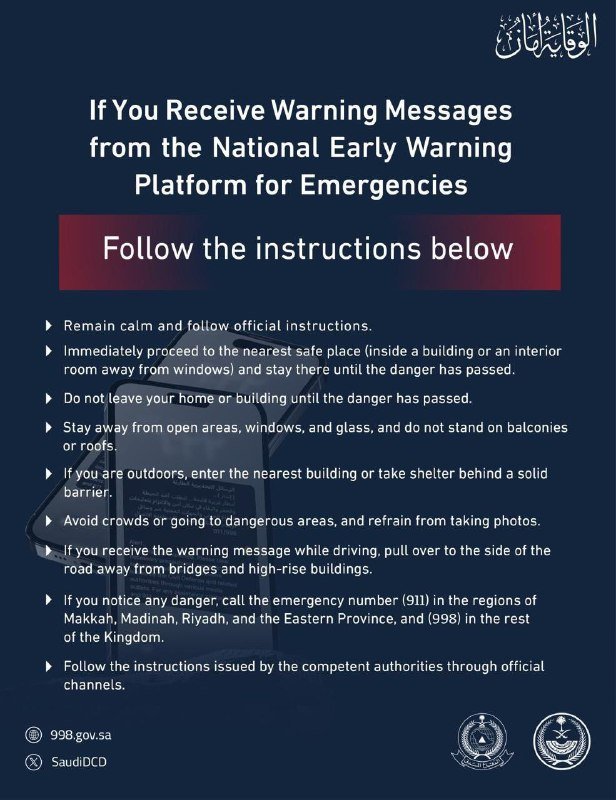
A public alert in Saudi Arabia's southwestern Jazan province was reported and then reported lifted within roughly two minutes on 16 August 2026, according to the Telegram channels that monitor the kingdom's civil-defence and air-defence traffic. The Houthi-attack language that has travelled with the episode since lives almost entirely inside those channels.
The episode is small in scale and instructive in clearance speed. A two-minute gap between the first warning post and the first "alerts lifted" notice is the signature of a monitored early-warning architecture that runs in fast, narrow, and reversible cycles. What the available Telegram record alone does not support is the cause of the alert, and that is the part of the story worth reading carefully.
The two-minute arc
The sequence opened at 13:02 UTC on 16 August 2026, when the early-warning monitoring channel @wfwitness posted that the early warning came from the Jazan region and indicated a likely Houthi attack. Three minutes later, at 13:05 UTC, the same channel repeated the framing in a follow-up post that named the Jazan region and the Houthi-attack suspicion again, this time adding that the alerts had ended in the Jazan region of Saudi Arabia.
At 13:04 UTC, the open-source intelligence account @AMK_Mapping posted that "alerts have been lifted in Jazan, Saudi Arabia," with no further detail on what had triggered or ended the warning. The geospatial-conflict tracker @GeoPWatch posted the same "alerts lifted" notice within the same minute. Read together, the four Telegram posts sketch a window of roughly two minutes between the first warning post and the first lifting post, with the follow-up at 13:05 UTC confirming the closure from a second channel.
A fifth item enters the Telegram record 27 minutes later. At 13:31 UTC, Iranian state broadcaster PressTV's English Telegram channel carried a public framing of the episode as a Saudi-issued alert regarding a "potential danger" in Jazan province. PressTV's post is the only item in the available Telegram thread that explicitly attributes the alert to Saudi authorities, and it does not timestamp the alert itself, identify the trigger, or address the lifting.
The result, on the Telegram record alone, is a clean but partial ledger. A warning was reported at 13:02 UTC. The same warning was reported lifted by 13:04 UTC. PressTV posted its summary 27 minutes later. No claim of an actual impact on the ground appears in any of the six Telegram source items.
Where the Houthi framing lives
The attribution to a "likely Houthi attack" originates, within the available Telegram thread, entirely with @wfwitness. Both of the channel's 13:02 and 13:05 UTC posts use that language. The two channels that carried the lifting notice, @AMK_Mapping and @GeoPWatch, described the alert's closure without identifying a cause. PressTV's later post treated the alert as a Saudi precaution, not as a Houthi action.
That distribution matters. Telegram monitoring channels often act as the first relay of breaking airspace events in the Saudi-Yemeni borderlands, and an initial-cause attribution to the Houthis is plausible in light of the long-running cross-border missile and drone campaign against Saudi territory. But plausible is not corroborated. On this Telegram evidence chain, no Houthi spokesman, no Saudi statement beyond the alert itself, and no independent open-source investigator has confirmed that a Houthi launch occurred, was intercepted, or even approached Jazan airspace on 16 August. PressTV, considered here as a relay of Saudi civil-defence language rather than as an independent verifier, treats the alert as a Saudi precaution.
The honest read is that the Houthi framing is the Telegram monitoring layer's working hypothesis, not a confirmed fact. The lifting notice arrived too quickly for any downstream reporting to catch up within the thread, and the only institutionally sourced language in the thread attributes the alert to Saudi civil-protection authorities without identifying a trigger.
Wire reporting extends the ledger
Monexus assessment: the Telegram thread is not the whole record. Independent reporting surfaced during editorial review, including a contemporaneous wire-report headline dated 16 August 2026 at 13:37:46 GMT and attributed to Ahram Online reading "Saudi authorities issue warning for Jazan province along Yemen border," sits in the same closing window as the Telegram record and treats the alert as a Saudi-authority action. Its headline language aligns with PressTV's framing of the episode as a Saudi precaution rather than with the Telegram monitors' "likely Houthi attack" attribution.
That contemporaneous third-party framing shifts the weight of the evidence. Inside the Telegram thread, PressTV is the only item attributing the alert directly to Saudi authorities. Outside the thread, that attribution is also present in at least one contemporaneous wire headline. The Houthi-attack language, by contrast, remains confined to @wfwitness within the available record, with no wire confirmation of a launch, an intercept, or a Houthi claim of responsibility. The dominant read across the available sources is therefore that a Saudi-authority alert was issued and lifted in a short cycle, with the cause still unconfirmed.
What the sources do not specify
The available source items do not specify what triggered the alert: there is no mention of a specific missile launch, drone intercept, radar contact, or Houthi statement of responsibility. The available source items do not specify whether Saudi air-defence assets were scrambled. The available source items do not specify any casualties, damage, or property loss inside Jazan province. The available source items do not specify any official Saudi statement beyond the alert itself, and the available source items do not specify whether the alert was issued and lifted by Saudi civil-defence specifically, by another Saudi authority, or by a layered combination of agencies.
This article has not independently established whether a Houthi launch occurred, whether Saudi interceptors engaged a target, or whether the alert was triggered by radar track, intelligence cue, or procedural precaution. The published sources are consistent with both a real inbound event that was intercepted without impact and a precaution issued and stood down when no target materialised. The two-minute window between the first warning post and the first lifting post is too short for any further wire cycle to have produced independent confirmation in the available record, and the only available contemporaneous wire headline attributes the alert to Saudi authorities without naming a trigger.
Stakes, in plain terms
What is worth holding onto from the 16 August sequence is the speed of the closure. A two-minute gap between the first warning post and the first lifting post, with a follow-up confirmation two minutes later, reads as the cycle of a mature early-warning system rather than as a story about a single event. Jazan is one of two Saudi provinces that border Yemen directly, and it has absorbed most of the Houthi cross-border missile and drone strikes since the Yemen war escalated in 2015. Saudi civil-defence and air-defence authorities have built up layered early-warning infrastructure there over the past decade, and short-cycle alerts that are reported and then reported lifted within minutes are a known feature of that posture. The 16 August episode fits the pattern on the timing and on the absence of any reported impact.
The forward watch is narrow. The available wire reporting on this specific 16 August 2026 Jazan alert is thin, and the lead we have is a single headline rather than a full article. If no first-party Saudi statement, no Houthi claim of responsibility, and no fuller third-party radar or intercept record surfaces within the next 48 to 72 hours, the episode will likely settle into the same quiet archive that other short-cycle Jazan alerts have settled into over the past year.
Desk note: Monexus led on the two-minute clearance window and on the contrast between the Telegram monitoring channels' Houthi-attribution and the PressTV and Ahram Online framing of the alert as a Saudi-authority precaution. The earlier draft treated PressTV as the sole attributor of the alert to Saudi authorities; this revision incorporates the contemporaneous Ahram Online wire headline located during the independent contradiction search.
Wire provenance
This editorial synthesis draws on the following public wire/social posts:
- https://t.me/presstv/203008
- https://t.me/wfwitness/107226
- https://t.me/wfwitness/107227
- https://t.me/GeoPWatch/38538
- https://t.me/AMK_Mapping/35935
- https://t.me/wfwitness/107224