Beirut abolishes the death penalty as Aoun presses to keep UNIFIL in the south
President Joseph Aoun signed Law No. 68 on 17 August 2026, ending capital punishment in Lebanon, the same morning his office accused Israel of pressing for nearly a year to push UNIFIL out of southern Lebanon.
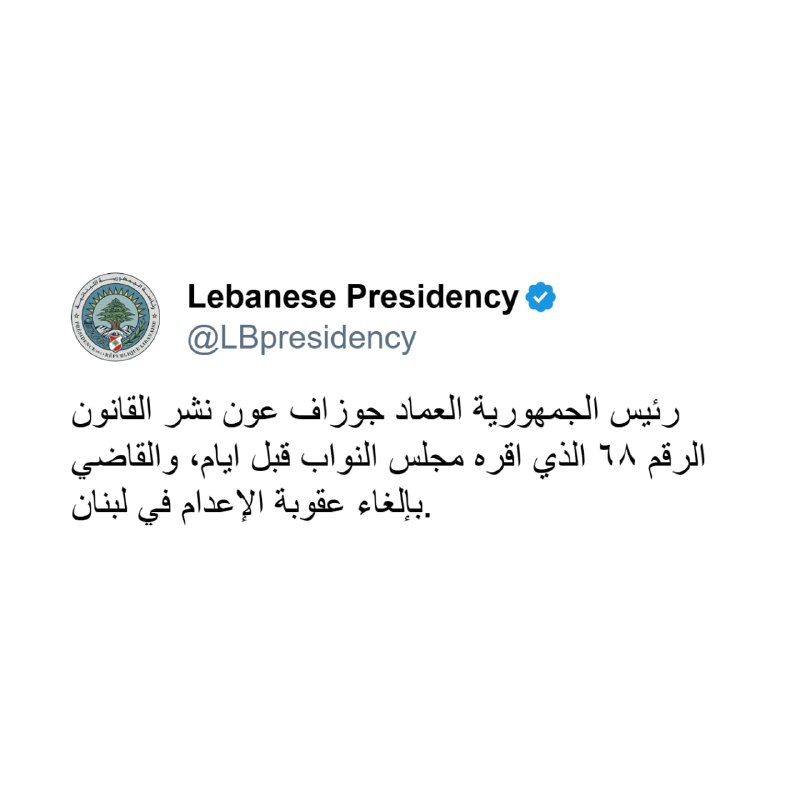
Lebanese President Joseph Aoun signed Law No. 68 on 17 August 2026, formally abolishing the death penalty in Lebanon after parliamentary approval, according to regional outlets tracking the Baabda announcement. The signature landed in the same morning, 24 minutes after the presidency had put out a separate and more combustible line: that Israel, in Aoun's framing, has been pressing for nearly a year to push the United Nations peacekeeping force out of southern Lebanon.
The conjunction is the news. In a single news cycle Beirut is signalling that it intends to govern as a state bound by international human-rights norms and to defend the UN architecture along its southern border. Whether those two postures can coexist as the country argues over the terms of any future stabilisation arrangement is the question that runs underneath the headlines.
A signature, and what it sweeps away
Law No. 68 removes capital punishment from the Lebanese statute book. The promulgation closes a legislative arc that had opened in parliament, where the abolition measure had already cleared a vote. According to a Cradle Media brief published at 09:51 UTC on 17 August, the law was promulgated following that parliamentary approval. The Lebanese state, on the face of this single source item, retains no death row; the available reporting does not specify whether the law carves out exceptional offences.
The move lands while international donors, several of whom have long conditioned aid on movement away from capital punishment, are watching how Beirut handles the post-ceasefire reconstruction file. Framed that way, abolition is less a moral flourish than a piece of state branding aimed at Western and Gulf capitals. The available source items do not specify the parliamentary vote count, the list of dissenting blocs, or whether the law contains transitional provisions.
"Israel has been exerting pressure for nearly a year"
The second story of the morning is sharper. At 09:27 UTC on 17 August, Aoun's office issued a statement carried by regional outlets including The Cradle Media, citing the president's characterisation that Israel is rejecting the presence of UNIFIL and has been exerting pressure toward that end for nearly a year. The same line, in expanded form, surfaced again at 09:42 UTC via the War on Lebanon witness channel, attributing it directly to Aoun: Israel rejects UNIFIL's presence and has been pressing for close to a year, while Lebanon is calling for the force to remain.
The accusation is consequential because UNIFIL's mandate is on the UN Security Council calendar. Reporting available to Monexus indicates the Council extended the mandate for a final time in August 2025, which means the file is not a routine renewal but the terminal configuration of the mission. Lebanon's argument, telegraphed by the presidency on 17 August, is that any roll-back of the force would invite a vacuum that armed groups other than the Lebanese army would be the first to fill.
In Beirut, parliamentarians are moving in parallel. Lebanese MP Melhem Khalaf, leading a parliamentary delegation, was reported at 09:01 UTC on 17 August to be calling publicly for an extension of UNIFIL's mandate, framing the force's continued presence as crucial to prevent any security vacuum in the south. Khalaf's delegation is the political cover for an executive-level position that Aoun has now made explicit from the presidency.
What the peacekeeping question actually turns on
The disputed terrain is not whether UNIFIL is loved in Lebanon. It is what the alternative looks like. The southern borderlands were a war zone until late 2024, and the army's deployment into the former Hezbollah strongholds is, on any independent reading, still being built out. A pullout, or a renegotiated mandate that scales the force down, would land on a Lebanese state that has not yet demonstrated it can hold the line alone with the resources currently on hand.
Israel's stated reason for opposing UNIFIL is the long-standing argument that the force has been too passive in preventing Hezbollah reconstitution north of the border. From Beirut's vantage point, the same record reads as evidence of an international presence that, if imperfect, has prevented open re-fighting. Both readings are operating on the same set of incidents. The live diplomatic question is whether the Security Council renews on existing terms, on revised terms, or not at all; the Lebanese position, articulated from both the presidency and the parliamentary delegation on 17 August, is that the existing presence is the lesser risk.
Analysis: two signals, one morning
In Monexus's reading, the simultaneity of these two announcements is the story. Aoun signed a law that costs his coalition nothing politically and earns the country measurable goodwill in European capitals. He also, in the same morning, drew a public line on UNIFIL that puts the Lebanese state's southern posture on record before the diplomatic window closes. The two acts bracket a single trajectory: Beirut is performing sovereignty in a register that Western interlocutors recognise, while trying to limit the operational room its neighbour has to define the terms of the southern borderlands.
The risk is that the two signals point at different audiences. The abolition pitch lands with European and human-rights-focused donors who fund reconstruction. The UNIFIL pitch lands with the Security Council, where the United States and France have historically held the dominant pen on resolution text, and where the file is now in its terminal phase. If those two audiences diverge, Beirut will be left having spent its political capital on two fronts at once. The next test is the UN mandate file itself, which determines whether Aoun's protest becomes a marker on a record or a constraint on what follows.
This article tracked the two Lebanese developments that surfaced in the morning feed: the death-penalty abolition and the UNIFIL dispute. The available source items do not specify the parliamentary vote count on Law No. 68, the identity of any retaining clauses for exceptional crimes, or the Security Council's exact timeline for the next UNIFIL decision. Monexus will update those details as primary documentation is published.
Wire provenance
This editorial synthesis draws on the following public wire/social posts:
- https://t.me/thecradlemedia/66293
- https://t.me/TheCradleMedia/66293
- https://t.me/thecradlemedia/66287
- https://t.me/TheCradleMedia/66287
- https://t.me/wfwitness/107298
- https://t.me/wfwitness/107296
- https://t.me/wfwitness/107293