Barrack flags Israel-Syria-Turkey deconfliction track, says Turkey was not warned before Israeli airbase strikes
US Special Envoy for Syria Tom Barrack told Reuters on 18 August 2026 that Washington is working on a deconfliction mechanism involving Israel, Syria and Turkey, and that Turkey was not warned before Israel's recent strikes on a Syrian airbase.
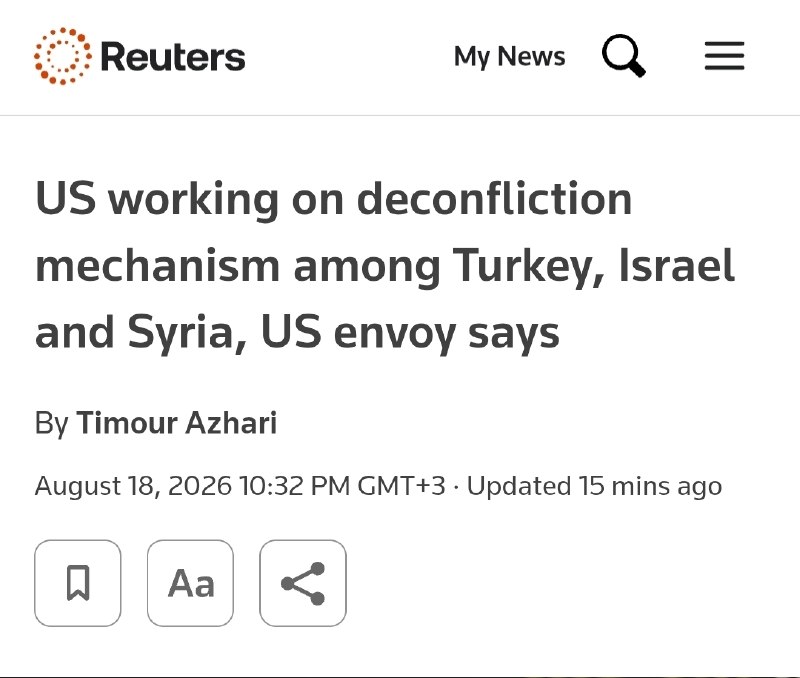
On the evening of 18 August 2026, US Special Envoy for Syria Tom Barrack told Reuters that Washington is working on a mechanism intended to prevent friction among Israel, Syria and Turkey. Barrack also said Turkey was not warned before Israel's recent strikes on a Syrian airbase. The remarks were relayed through several English-language Telegram channels within minutes, with items posted at 19:35, 19:38, 19:54 and 20:01 UTC.
The relays carry more than a procedural summary. They place before a public audience, in Barrack's own attributed words, a small set of consequential statements: that a three-party deconfliction arrangement is being worked on; that Turkey was not warned; that Turkey could have reasonably prepared its own response if it had been warned; and that "discretion prevented the situation from deteriorating further," in the phrase relayed through the English-language abuali channel. The available items do not provide a full Reuters transcript, but they do specify the strike location as Idlib, according to that same relay, and the Turkish observation that aircraft involved flew north toward Turkish territory.
What the relays actually say
The Telegram items are short, attributed to Reuters via Barrack, and consistent across four separate posts. The English-language abuali relay states the strikes hit Idlib and quotes Barrack as saying: "Fortunately, discretion prevented the situation from deteriorating further." The osintlive relay describes the strikes as targeting a Syrian airbase, reflecting, in the relay's framing, the perception that Turkey may increase its presence at that location. The GeoPolitical Watch relays repeat Barrack's central point that Turkey was not warned and could have reasonably prepared its own response.
The terminology matters. Deconfliction implies an effort to keep actors from colliding, but the available reports do not specify the mechanism's participants' obligations, its geographic scope, its decision-making rules or whether it has begun operating. The relays also do not specify the date of the strikes, the number of aircraft involved, the ordnance used, or the exact airbase struck beyond the Idlib reference carried by the English-language abuali item. What the record does establish, through repeated relays attributed to Barrack, is that the United States is discussing a three-party deconfliction track while acknowledging a failure to warn Turkey before the strikes described in the source material.
There is also a distinction between an announced diplomatic effort and an operational control arrangement. The source items do not identify a hotline, a joint coordination centre, agreed flight corridors or a timeline for implementation. A public statement about working on a mechanism may signal diplomatic activity, but it does not by itself demonstrate that the parties have agreed on a shared warning system or a common set of rules. Barrack's "discretion" line, as relayed, reads as a comment on how escalation was avoided rather than as a description of any standing protocol.
The strikes, as relayed
The relays treat the strikes as Israeli action, attributed through Barrack's remarks rather than through Israeli confirmation in the available items. The English-language abuali relay places the strike location in Idlib. The osintlive relay describes the target as a Syrian airbase and frames the Turkish concern around the perception that Ankara may increase its presence there. None of the relays identifies the specific airbase by name beyond the Idlib reference, and the available source items do not include an Israeli military statement accepting or contesting responsibility for the strikes.
For Turkey, the reported episode is about a basic security question: whether a military action near its interests will be telegraphed before it occurs. Barrack's statement, as relayed, acknowledges that Turkey lacked advance warning and that Ankara might have prepared a response if it had received notice. The relays do not specify what response Turkey considered or whether any Turkish action was taken. They do show, in Barrack's attributed words, why a warning gap could be politically damaging in Ankara and why a deconfliction mechanism might be presented as the remedy.
The alternative interpretation is that the remarks are procedural rather than apologetic. Barrack may be explaining why the United States is now trying to build a communication channel, without conceding that the Israeli strikes were illegitimate or that Turkey is entitled to a veto over them. The source items do not include a Turkish government statement, an Israeli government statement or a detailed explanation of Washington's legal or political position. They relay Barrack's framing only, and they do so through second-hand channels rather than through the original Reuters wire.
Monexus analysis: a three-party test of US convening power
The structural significance of Barrack's remarks lies in the number and character of the actors involved. The United States is attempting to address friction among Israel, Syria and Turkey, three governments whose interests may not align on every issue connected to Syrian territory. The source items do not provide a history of their positions or a description of their military deployments. They do establish that Washington is publicly discussing a shared deconfliction track rather than presenting the issue as a purely bilateral US conversation.
Monexus analysis: that makes the proposed mechanism a test of American convening power. Washington can put the issue on a diplomatic agenda, but it cannot make communication reliable merely by announcing that a mechanism is being worked on. The reported failure to warn Turkey before the Idlib strikes shows the cost of a gap between high-level diplomacy and operational notification. Barrack's "discretion" line, as relayed, is an acknowledgment that the gap did not produce an open clash this time, not a guarantee that the next gap will be similarly contained. The same episode also gives the United States a concrete reason to seek clearer lines of contact, although the available evidence does not show whether those lines would constrain Israeli action or simply improve Ankara's ability to anticipate it.
The source record is narrow, and the relays should not be mistaken for a complete account of the underlying event. They attribute the central statements to Barrack, but they do not provide the original Reuters interview or independent technical details about the Idlib strike. A Turkish official account could alter the assessment, particularly over what warning was given, to whom it was given and what response was considered. An Israeli statement would be necessary to establish how Jerusalem understands the proposed channel and whether it accepts any limits on future operations. A Syrian account would be needed to establish how Damascus views a mechanism affecting activity on Syrian territory. The available source items do not specify whether any of those governments has commented on Barrack's remarks, beyond the relays themselves.
What to watch next
The most useful next signal would be a description of the mechanism's actual design. If it produces advance notice, agreed communication channels or a procedure for managing incidents, the reported effort would move beyond diplomatic signalling. If it remains a general reference to deconfliction, it would show that the United States recognises the problem but has not yet supplied the operational details needed to judge its effectiveness.
A Turkish government response would be especially revealing because the relays identify Ankara as the actor that was not warned. An Israeli statement would be necessary to establish how Jerusalem understands the proposed channel and whether it accepts any limits on future operations. A Syrian account would be needed to establish how Damascus views a mechanism affecting activity on Syrian territory. The relays available on 18 August 2026 do not specify whether any of those governments has commented.
The stakes are immediate but bounded by the available evidence. If the parties can establish reliable notice, the episode could become a case for practical crisis management rather than escalation. If they cannot, the same gap could recur around future incidents in Idlib or elsewhere on Syrian territory. The central fact on 18 August 2026 is therefore modest but consequential: Barrack has put deconfliction among Israel, Syria and Turkey on the public agenda, has named Idlib as the location of the strikes described in the relays, has acknowledged that Turkey was not warned, and has suggested in the relayed quote that discretion, rather than procedure, prevented the situation from deteriorating further.
Desk note
The wire relays carry Barrack's procedural account and his "discretion" quote through second-hand Telegram channels. Monexus has kept the assessment narrow: a proposed three-party deconfliction track, an acknowledged warning gap before strikes described as hitting Idlib, and a relayed acknowledgement that escalation was avoided by discretion rather than by a standing mechanism. The piece does not assert that a binding agreement exists or that any of the three governments has publicly accepted the proposal on the record.
Wire provenance
This editorial synthesis draws on the following public wire/social posts:
- https://t.me/englishabuali/77963
- https://t.me/osintlive/565151
- https://t.me/osintlive/565149
- https://t.me/GeoPWatch/38595
- https://t.me/GeoPWatch/38594