Kenya's Sh203 billion illicit alcohol market, and the only number anyone is willing to put on it
The Star Kenya's Sh203 billion estimate of Kenya's illicit alcohol trade is the first hard number attached to an economy the state cannot easily measure. What surrounds the figure is almost all interpretation.
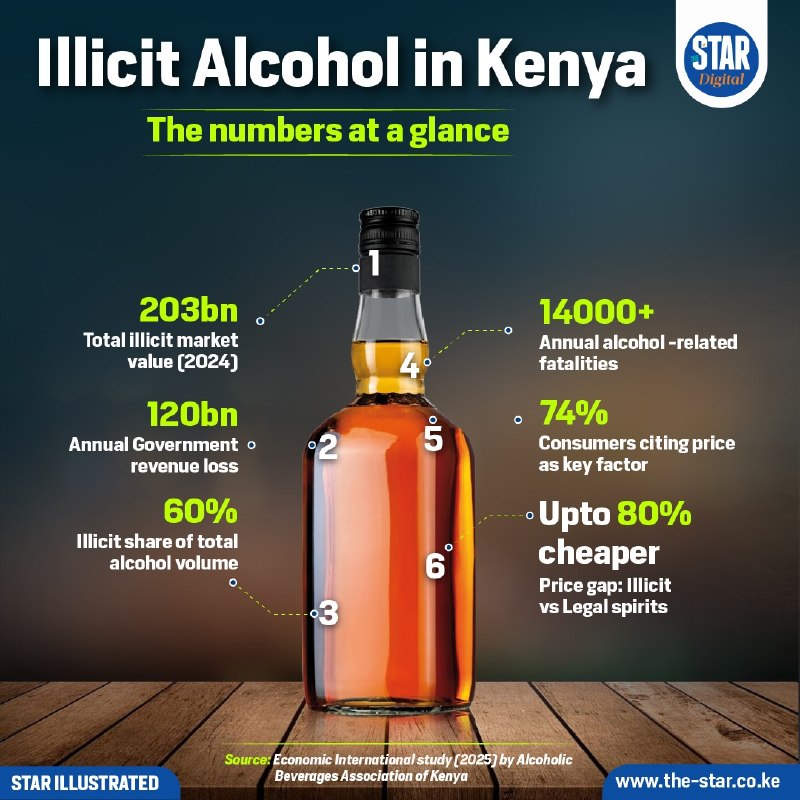
Kenya's illicit alcohol trade is worth an estimated Sh203 billion, a figure The Star Kenya's data desk published on 18 August 2026 as a single headline statistic and little visible methodology behind it. The number is large enough to function as a parallel excise authority operating outside the reach of the Kenya Revenue Authority. The accompanying reporting says only that the trade carries an "economic and social impact" of that scale. Everything else in the public conversation around this figure is interpretation layered on top of an estimate.
That is itself the story. The legal alcohol industry in Kenya is taxed, surveyed and politically contested. The illegal one, by definition, is measured only in fragments. What the Sh203 billion figure changes is that a newsroom has now committed a number to the trade. The rest of this article reads that number against what the available reporting does, and does not, let us say about it.
What the figure is and what it is not
The Star Kenya's number is an estimate of total trade, not profit. That distinction matters for any comparison to the legal market, where turnover, excise take and VAT remittance are all separately captured. The reporting reviewed here does not specify whether the Sh203 billion refers to retail value, wholesale value or producer price. It does not specify whether it includes traditional brews, counterfeit industrially produced spirits, or both. It does not specify the reference year.
This is what Monexus analysis: a Sh203 billion figure attached to an economy that resists measurement will be quoted widely and interrogated rarely. The honest framing is to treat the number as a directional anchor, useful for thinking about scale and inadequate for thinking about composition.
The reading that survives contact with the source is conservative. Kenya has an illicit alcohol market that, by the only estimate currently on the public record, is large enough to merit serious attention. The figure should be cited with that caveat attached.
What the figure is being used to argue
The legal alcohol industry, in Kenya as elsewhere, has long framed the illegal trade as parasitic on the excise regime the legal producers pay into. The counter-argument, more often heard in county budget offices and development-economics circles than in Nairobi press briefings, is that legal pricing has priced the bottom of the market out. Demand at that price point, on this reading, does not disappear; it moves sideways into untaxed product. The Sh203 billion is consistent with either story.
The Treasury reading would be that this is foregone revenue, recoverable through enforcement, tax administration and licensing reform. The public-health reading would be that this is foregone safety, the volume of product moving outside any quality-control regime. The development reading would be that this is a tax base the state cannot reach because the consumers it serves cannot afford the alternative. All three readings can be true at once, and the available reporting does not adjudicate between them.
What the source does not establish
The Star Kenya thread reviewed for this article states the Sh203 billion figure and refers to its "economic and social impact". It does not specify:
- the year the estimate refers to;
- the methodology used to derive it;
- the share of the figure attributable to traditional brews versus counterfeit industrially produced spirits;
- the geographic distribution across counties or across the urban-rural split;
- the share, if any, that crosses the borders with Uganda or Tanzania;
- whether the figure is rising, falling, or holding steady against prior years.
None of these omissions is a reason to disregard the estimate. They are a reason to be specific about what it does and does not show. A Sh203 billion market could be expanding, contracting or static. The legal industry's complaint that the illegal trade is taking share is consistent with a rising figure. The state's intermittent enforcement sweeps are consistent with a shrinking one. Both narratives can be true at once, and on the available evidence they probably are.
Where the figure sits in Kenya's wider informal economy
The most useful comparison on the desk's record is to Kenya's fuel market. Daily Nation reported on 18 August 2026 that diesel and petroleum consumption in Kenya rose in the first half of 2026 despite sharp increases in pump prices, a pattern the paper attributes to the inability of consumers and operators to absorb the price pass-through quickly. The structural parallel is suggestive: in both the fuel and the alcohol markets, demand proved less price-elastic than the headline price move would predict, and in both markets the gap between headline and effective consumer price is where untaxed supply moves.
The point is not that the two markets are equivalent. The point is that Kenya has at least two visible informal-economy stories in the same news cycle, and the policy frame is similar in each: a regulatory regime that is dense on the legal side, episodic on the informal side, and under-equipped to measure what falls between the two.
Desk note: Monexus framed this as a story about the politics of a number, not about the underlying trade. The Sh203 billion figure is the only verifiable claim in the source set; the analysis is bounded by what that figure does and does not establish, and what remains for someone else to measure.
Wire provenance
This editorial synthesis draws on the following public wire/social posts:
- https://t.me/TheStarKenya/37482
- https://nation.africa/kenya/business/fuel-consumption-defies-despite-steep-price-increments--5561598
- https://t.me/DailyNation/143519
- https://nation.africa/kenya/news/gender/from-wangari-maathai-to-nyiva-mwendwa-the-women-who-changed-kenya-5561692
- https://t.me/DailyNation/143522
- https://t.me/TheStarKenya/37482
- https://nation.africa/kenya/business/fuel-consumption-defies-despite-steep-price-increments--5561598
- https://t.me/DailyNation/143519
- https://nation.africa/kenya/news/gender/from-wangari-maathai-to-nyiva-mwendwa-the-women-who-changed-kenya-5561692
- https://t.me/DailyNation/143522