Syria opens the door to the IAEA, but the guarantees remain unresolved
Damascus says it has granted the IAEA access to the Deir Ezzor nuclear site for the first time in more than 18 years, while insisting that any nuclear material would remain under Syrian control subject to international guarantees. The arrangement opens a dormant channel of inspection in the same news cycle Turkey cited Israeli strikes on a Syrian airbase, identified by regional reporting as Abu al-Duhur.
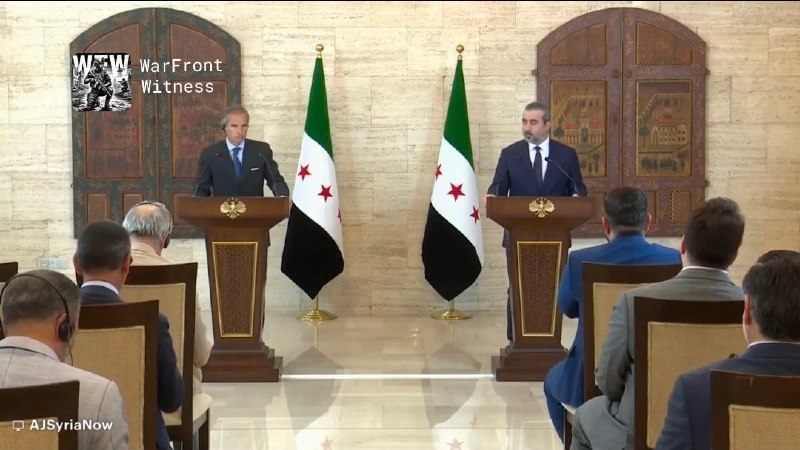
At a joint appearance in Damascus on 18 August 2026, Syrian Foreign Minister Asaad al-Shaybani said the government had granted the International Atomic Energy Agency access to the Deir Ezzor nuclear site for the first time in over 18 years. The announcement reopens a line of international scrutiny around a site that has sat outside the routine diplomatic traffic of Syria's long-running nuclear dispute.
The access offer came with a condition embedded in the government's position. Reporting carried by Open Source Intel from the press conference said nuclear material at the site would remain in Syria's possession, subject to guarantees from the IAEA. Al-Shaybani also said Damascus was pursuing diplomacy to discourage further Israeli attacks. The sequence matters: the government is offering verification without surrendering control, while the surrounding security environment is becoming more dangerous rather than less.
The immediate question is therefore not whether the IAEA can visit. It is what its inspectors will be able to establish, what guarantees Syria is prepared to accept, and whether renewed contact can survive the pressure exerted by competing military and diplomatic claims, all of which converged on a single news cycle.
A door opens, on terms set by Damascus
The access-grant headline was carried by WFWitness, which reported that al-Shaybani announced the IAEA access during a joint press conference with IAEA Director General Rafael Grossi. The Shaam Network framed the same event as a joint announcement by al-Shaibani and Grossi of progress in nuclear cooperation, with Syria "ending the legacy of the former regime and moving towards peaceful uses." Open Source Intel, by contrast, carried al-Shaybani's conditional language about possession and guarantees, not the headline access announcement.
That separation matters. The headline is WFWitness's, and the conditions attached to it are Open Source Intel's. Reading the two together produces a more accurate picture than either alone. Damascus has decided to allow inspectors back into a site that has been sealed off from international monitoring for nearly two decades, but it has done so while spelling out what will not be conceded.
That framing is not incidental. Access to a nuclear site is useful only if it produces information that outsiders can trust. Damascus appears to understand this, but its proposed ownership condition narrows the scope of any bargain. The material would remain in Syrian hands, with IAEA guarantees providing the stated assurance. The available source items do not specify the form of those guarantees, the duration of any arrangement, or whether the agency's inspection mandate would include independent verification beyond access to the material itself.
The distinction is important. Physical access is not the same as a complete inspection regime. Nor is a political assurance automatically equivalent to a technical safeguard. Until the terms are published, the announcement is best read as a diplomatic opening, not as a settled settlement.
The channel itself also needs care. The principal reports are relayed through Telegram posts and the Shaam Network outlet, with material attributed to Syrian Foreign Ministry statements and to the joint appearance with Grossi. The supplied items support the announcement and the stated positions, but they do not provide the underlying inspection agreement or a detailed account of the site's condition. The confidence level should therefore attach to what was announced, not to conclusions about what the IAEA has found.
Diplomacy meets the strike question
The Deir Ezzor announcement arrived as Turkey's Foreign Ministry condemned what it described as an overnight Israeli strike on a base in Syria. According to the reports relayed by Open Source Intel, the Turkish foreign minister called on the international community to hold Israel accountable for actions Turkey said violated international law.
Regional and wire reporting identified the target by name. Daily Sabah characterised the strike as hitting a Syrian airbase, with its headline specifically identifying it as Abu al-Duhur air base. That specification sits outside the Telegram items in the Monexus source set, but it is consistent with the Turkish framing carried by Open Source Intel and it materially narrows what the diplomatic complaint concerns. Monexus analysis: the stronger reading is that the strike and the IAEA announcement are connected by sequencing rather than coincidence, with Damascus using the access offer to court external cover at the moment its airspace is being hit.
The Turkish intervention adds a second diplomatic track to a story about nuclear access. Ankara is not described in the supplied material as a party to the proposed Syrian-IAEA arrangement. Its immediate concern, as relayed through the same Telegram channel, is the reported strike and the rules governing force across borders. Damascus, by contrast, is using the IAEA meeting to argue for peaceful cooperation while warning that attacks continue.
There is a plausible alternative reading of the overlap. The access decision may be a substantive attempt to revive international engagement after a long interruption, independent of the strike dispute. On that reading, the proximity of the two stories reflects a busy diplomatic day in Damascus rather than a direct exchange. The stronger reading is that the sequencing is deliberate. Syria is coupling a limited transparency measure with a request for external pressure against further attacks, making the political setting part of the substance of the offer.
That does not make the announcement merely a publicity exercise. The IAEA's involvement could provide a channel for technical communication even if it cannot resolve the security dispute. But an inspection opening pursued under the shadow of a contested military strike is structurally weaker than one supported by a durable ceasefire or a broader security understanding. Verification is easier when access is treated as a shared obligation rather than as a concession extracted in a confrontation.
A narrow bargain under regional pressure
The central bargain is narrow: Syria says it will permit access, but not transfer ownership of nuclear material, provided the IAEA supplies guarantees. This gives Damascus a way to present cooperation as consistent with sovereignty while giving the agency a reason to engage. It also leaves the most difficult questions unanswered.
The first is technical authority. The source items do not specify whether the IAEA would be able to inspect, sample, seal, monitor, or otherwise verify the material under the proposed terms. The second is duration. No timeline for access is provided in the available reports. The third is enforcement. The reports do not say what would happen if Syria and the agency disagreed over the guarantees or if access were interrupted.
Those omissions are not evidence that the arrangement will fail. They are reasons to avoid treating the announcement as a finished inspection regime. The distinction is especially important because the surrounding dispute concerns alleged violations of international law, according to Turkey's formulation. An IAEA mission may reduce uncertainty about nuclear material, but it cannot by itself determine responsibility for a military strike or substitute for a political settlement on attacks in Syria.
Monexus assessment: the arrangement's immediate value lies in creating a procedural foothold. Its strategic value depends on whether the IAEA can turn a politically framed access offer into a technically specified, repeatable and independently verifiable inspection practice. Without that conversion, the measure is likely to remain a signal of Syrian intent rather than a durable restraint on nuclear risk.
What the guarantees must settle
The next test is not a ceremonial second visit. It is whether the Syrian government and the IAEA define the practical meaning of "access" and "guarantees." The supplied reports do not provide that definition, so the public record on the technical text remains incomplete. The first-party statements that will matter most are those specifying the mandate, the material covered, the frequency of visits, the reporting chain and the consequences of non-compliance.
The diplomatic stakes are concrete. Syria wants international engagement without surrendering control over a sensitive site, and it wants diplomatic pressure on Israel. Turkey wants the strike on what regional reporting identifies as Abu al-Duhur air base placed within a framework of international accountability. The IAEA needs terms that allow its personnel to do their work rather than witness a politically staged handover. Israeli security concerns, as relayed through Syria's accusation at the press conference, are not addressed by the supplied source items beyond al-Shaybani's claim that attacks continue.
The open question is whether the new channel can survive the dispute that prompted it. If the IAEA receives a specific mandate and Syria provides verifiable cooperation, access could lower the temperature around a dormant nuclear question. If guarantees remain undefined, or if the site is again caught up in military escalation, the same announcement may produce visibility without control. The measure's credibility will be set less by the language of reopening than by the technical documents and repeated access that follow.
How Monexus framed this versus the wire: the access-grant headline is attributed to WFWitness, with Open Source Intel reserved for the conditions Damascus attached. The strike target is treated as identified by regional reporting (Daily Sabah names Abu al-Duhur air base), but the Telegram items relayed by Open Source Intel describe it generically and the article does not present the named target as a sourced fact within its own citation set.
Wire provenance
This editorial synthesis draws on the following public wire/social posts:
- https://t.me/osintlive/565070
- https://t.me/osintlive/565069
- https://t.me/osintlive/565068
- https://t.me/osintlive/565058
- https://t.me/wfwitness/107420
- https://shaam.org/3HVa8p
- https://t.me/ShaamNetwork/100628