Trump labels Strait of Hormuz 'US territory' as Geneva accord remains unsigned and blockade holds
The Middle East Eye live tracker on 18 August 2026 carried Trump's territorial claim over the Strait of Hormuz and a reported threat to bomb Oman, while a Geneva accord signing remained scheduled rather than confirmed.
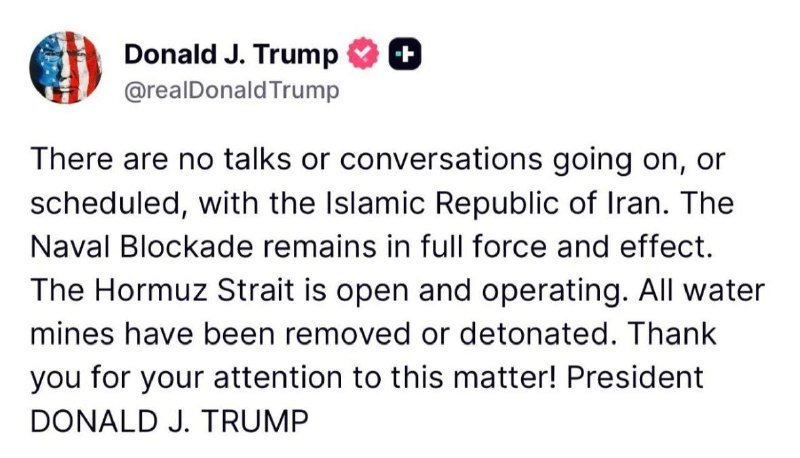
At 14:12 UTC on 18 August 2026, US President Donald Trump told reporters that there were no conversations taking place with Iran and none were scheduled, and that the US naval blockade of the Strait of Hormuz remained in full force and effect. Ninety minutes later, the same running feed carried his claim that the waterway is "US territory" and an Iranian framing that Israel is the biggest obstacle to negotiations. Middle East Eye's live tracker for the day is built around a Geneva accord signing "set for Friday" in Geneva, in the conditional tense, not a confirmation that the document was signed on 18 August itself. The day's wire is therefore a record of mixed signals, not of a completed diplomatic event.
A blockade still in force, a territorial claim over a corridor through which a significant share of internationally traded petroleum moves, and a reported threat against a Gulf state that was pursuing its own track with Tehran, are the facts on the table. What the situation is not, on the cited evidence, is a closed deal that left the blockade in place by oversight. The Geneva ceremony may yet produce a signed document; the sources reviewed here do not establish that it has.
A day of competing statements
The Middle East Eye live tracker, last updated at 15:44 UTC on 18 August, runs the territorial claim and the Iran-Israel framing in the same feed entry that frames the Geneva accord as a Friday signing to come. A separate Middle East Eye item at 14:12 UTC puts Trump's "no conversations scheduled" quote on the wire alongside the assertion that the blockade continues. The two items are not contradictory as a pair; they are contradictory only against any reading that treats 18 August as the day a deal was already done. The available source items do not specify that the Geneva accord was signed on 18 August 2026; the headline language refers to the signing being set for Friday in Geneva, and the running tracker does not record a completed signing in the cited window.
The Iranian state-affiliated IR Iran Military channel posted on Telegram at 15:33 UTC that Trump wants Iran's enriched uranium and "this is the only thing he's getting". Read against Trump's own statement that the blockade continues, the framing asserts that any Geneva document that does not return enriched material will not, in Tehran's telling, relieve US pressure on Iranian shipping. The Middle East Eye feed also records Iran's position that Israel is the biggest obstacle to negotiations, presented as Iran's framing of the negotiating environment, not as an Iranian statement about how the Geneva document will be bounded.
Oman, the mediator Washington is publicly warning
The Cradle's Telegram channel reported at 15:23 UTC, citing two regional officials speaking to the Associated Press, that Trump's threat to bomb Oman was triggered by Muscat's effort to reach a deal with Iran to jointly manage ship traffic through the Strait of Hormuz. The Cradle article reports the threat and the trigger; it does not characterise the joint management proposal as an arrangement Washington wants to prevent, and the available source items do not specify that such a characterisation has been made on the record.
What the report does establish is the targeting of a Gulf state for pursuing a mediation track on a waterway the United States now describes as its own. The signal is aimed at a wider audience: any Gulf capital that reads the Geneva track as a licence to act as a sovereign broker on Hormuz is being told, in the same press cycle, that the cost of doing so will be borne in threats rather than deference. The Cradle report does not contain an Iranian foreign ministry statement on the Omani proposal, and this article has not independently established Iran's position on the Omani proposal beyond what is paraphrased in The Cradle's reporting.
What the blockade language actually carries
The Epoch Times' Telegram channel, posting at 15:15 UTC on 18 August, quoted Trump as saying the US naval blockade remained in effect and the Strait of Hormuz remained open. The two statements sit together but describe different conditions. A naval blockade, in international-law terms, is a declared measure barring vessels of a target state from entering or leaving identified ports or coasts; here, the United States has chosen to describe its operation against Iranian shipping in blockade language while asserting that the waterway itself remains open to other traffic.
Monexus analysis: by adopting blockade terminology while continuing to describe the strait as open, the administration is telegraphing to oil markets that flows will be selective rather than stopped, and to Iran's commercial counterparties that the legal regime governing any captured vessel is whatever the United States says it is on the day of capture. The cited material does not contain an Iranian foreign ministry response to the blockade language, nor a State Department legal characterisation of the operation, and this article has not independently established either.
What the picture does and does not show
On the wire at 18 August 2026, the cited material establishes a territorial claim over the strait, a continuing blockade, a reported threat against Oman tied to its mediation track with Tehran, and a Geneva accord signing that was scheduled for Friday in Geneva rather than confirmed as completed in the cited window. The coherent reading is that the United States is signalling it intends to retain operational control over Hormuz through the period in which any Geneva document is being negotiated, and that any third-party arrangement that manages traffic without US sign-off will be treated as a violation.
The most plausible alternative reading is that the Geneva ceremony is real, the blockade is being wound down in practice even as the rhetoric is being ratcheted up, and the territorial claim is the kind of maximalist statement that negotiators make as they try to lock in a final settlement. That reading depends on the blockade easing in the coming days, and the cited material does not support that expectation. The State Department's formal legal characterisation of the blockade, and Iran's published position on the Oman proposal, are not contained in the cited source items; this article has not independently established either.
If the present trajectory holds, Iranian crude exports continue to depend on Washington's permission, which in practice means continued enforcement against third-country tankers and pressure on shipping insurers and Asian refiners that have absorbed most of Iran's remaining oil. Gulf states that have built bypass port and pipeline capacity gain value as routes for any traffic the US blockade refuses to clear. Oman in particular is being told that the cost of acting as mediator will be borne in threats rather than deference. Over a one-to-three-year horizon, the relevant question is not whether the nuclear file is closed but who writes the rules for the strait, and that question is being answered now, in Geneva and in the same press cycle as a territorial claim.
Middle East Eye's running tracker and The Cradle's reporting from regional officials speaking to the Associated Press give this picture more shape than any single wire dispatch. Whether the Geneva accord was signed on 18 August 2026, what Iran's foreign ministry has said on the Oman proposal, and how the State Department has formally characterised the blockade, are not contained in the cited material; this article has not independently established any of them.
Wire provenance
This editorial synthesis draws on the following public wire/social posts:
- https://www.middleeasteye.net/live/live-us-and-iran-confirm-peace-accord-signing-set-friday-geneva
- https://x.com/MiddleEastEye/status/2089740205687234684
- https://x.com/MiddleEastEye/status/2089717009919422685
- https://t.me/IRIran_Military/9674
- https://t.me/thecradlemedia/66388
- https://t.me/epochtimes/138331
- https://www.middleeasteye.net/live/live-us-and-iran-confirm-peace-accord-signing-set-friday-geneva
- https://x.com/MiddleEastEye/status/2089740205687234684
- https://x.com/MiddleEastEye/status/2089717009919422685
- https://t.me/IRIran_Military/9674
- https://t.me/thecradlemedia/66388
- https://t.me/epochtimes/138331