Trump says no Iran talks are scheduled as pressure campaign runs into a harder Tehran line
A Reuters readout on 18 August 2026 has Trump flatly denying any scheduled talks with Iran, while Tehran signals that only coercion will move its position and analysts warn the pressure strategy carries a long fuse.
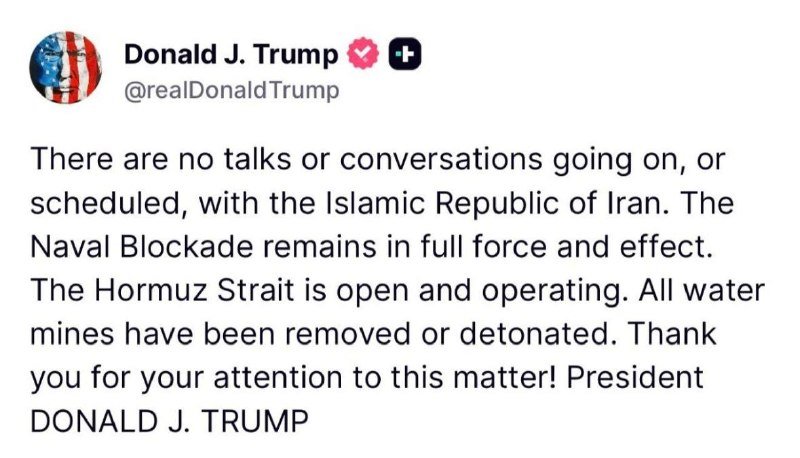
At 13:50 UTC on 18 August 2026, Reuters moved a short, declarative line from Donald Trump: no talks are taking place with Iran and none are scheduled. The denial landed in a day already thick with competing signals about what the administration's Iran posture actually is, and it pulled the public framing in a colder direction just as Tehran sharpened its own.
The Reuters readout, posted to X at 13:50 UTC, is the most concrete statement of the US position on the record from this thread. It is also a denial of what several commentators had assumed was a working channel. The open-source channel OSINTdefender, in a 12:05 UTC post the same day, framed the Trump administration's approach as a "low-key" application of economic pressure aimed at forcing Iran to concede, with a caveat that the strategy may come at a high cost in terms of prolonged conflict and instability. That framing implies an offstage negotiation is the intended endpoint, even as the President publicly says none exists. The contradiction is the story this article is built around.
The denial on the record
Trump's remark, as carried by Reuters, leaves no diplomatic wriggle room. No talks are happening. None are scheduled. That is the whole sentence. It puts the administration's stated posture on this file unambiguously into the "no engagement" bucket, at least as a matter of public record. Whether private channels exist is a separate question, and one the supplied sources do not address.
What the open-source commentary does is fill in the surrounding context. OSINTdefender's 12:05 UTC read treats the administration as pursuing economic pressure without a sitting negotiating table, and warns that the approach carries a long fuse. In that reading, the pressure tools are familiar from previous US-Iran cycles: sanctions enforcement, secondary sanctions on third-country buyers of Iranian crude, the threat of UN snapback, coordination with Gulf neighbours on energy market stability. None of those levers require a meeting. Each of them, however, has a lag between announcement and effect, and each raises the cost of the status quo for Iranian civilians without necessarily changing the calculus of the Islamic Republic's decision-makers. That is the gap a denial of talks leaves open.
Tehran's line on the same day
At 12:42 UTC on 18 August 2026, Mohammad Marandi posted on X a link to a live YouTube broadcast in which he framed the issue bluntly. The United States, in his telling, has always shown that it is unwilling and never had the intention to abide by agreements with Iran. Iran, he said, has no option but to force the regime to. The phrasing is adversarial, and the public posting of the line on X, alongside a live YouTube broadcast, is the closest thing the thread offers to a Tehran counter-frame on the same day as Trump's denial.
The supplied sources do not specify Marandi's institutional role. The thread evidence records only that he is the author of the X post and the speaker in the YouTube live. Any further characterisation of his standing inside the Iranian system is not entailed by the available items. What the thread does support is that, on the same day as the Trump denial, a vocal Tehran-aligned commentator used a public broadcast to argue that the United States cannot be relied on to honour deals and that pressure is the only language worth speaking. That is the Tehran-side read on offer from these sources.
What the OSINT community adds
OSINTdefender's contribution, posted at 12:05 UTC, is a structural caveat rather than a news item. The channel argues that a "low-key" squeeze can theoretically extract concessions, but warns that the strategy "may come at a high cost in terms of prolonged conflict and instability." Reading is interpretation, and the supplied post is one open-source channel's read rather than a verified account. The frame the channel offers is nonetheless useful: the easy phase of a pressure campaign is the announcement, the hard phase is the waiting, and waiting has its own price in energy markets, in shipping insurance through the Strait of Hormuz, and in the posture of Iranian-aligned networks in Iraq, Syria, Lebanon and Yemen.
Monexus analysis: the most natural reading of the three signals together (Trump's denial at 13:50 UTC, Marandi's broadcast at 12:42 UTC, the OSINTdefender framing at 12:05 UTC) is that both sides are positioning publicly for an extended stalemate rather than a near-term settlement. The US side wants concessions without the political cost of a deal. The Iranian-aligned commentary, as represented in the thread, wants to demonstrate that concessions cannot be extracted by pressure alone, because that is the lesson Tehran-aligned voices say they have learned from every previous round. This Monexus reading treats both signals as signalling, not as evidence of what is being negotiated privately.
What remains contested
The sources disagree about almost everything except the bare fact that there are no scheduled talks. Reuters reports the President's denial verbatim. Marandi denies that the United States has ever intended to abide by agreements, which is a longer, more structural claim that goes well beyond the current round and that relies on his framing rather than on independent corroboration. OSINTdefender reads the administration's posture as a deliberate "low-key" strategy, which is one open-source channel's interpretation rather than a statement of fact.
The available items do not specify whether a backchannel exists in any form, whether third-party intermediaries are active, what specific sanctions measures are queued for the next enforcement window, or what Marandi's formal standing is inside the Iranian system. Each of those gaps is a place where a single well-sourced report could move the story overnight. Until then, the public record from 18 August 2026 is a denial from Washington and a hardening line from Tehran-aligned commentary, with an open-source caveat that the pressure campaign carries costs of its own.
Two near-term markers are worth watching. First, any US Treasury action against Iranian oil buyers in the coming weeks, which would test whether the "low-key" framing is operational rather than rhetorical. Second, any Iranian retaliatory move through a regional network that is timed to a US domestic-political calendar, which would test whether Tehran's reading of American resolve has changed. The most likely scenario over the next quarter, on the evidence of this thread, is continued drift: pressure, counter-pressure, and a diplomatic posture that publicly denies talks while privately leaving the option open. The risk case, again on this thread's evidence, is that one side concludes the other has miscalculated and tests that conclusion with a move neither has publicly prepared for.
Desk note: Monexus led with the Reuters wire denial as the dated, verifiable hook, then paired it with the Iranian-side commentary via Marandi and the OSINT community's structural caveat. The wire line on its own would read as a US-policy update; the three-signal frame shows that the absence of scheduled talks is itself a contested position, not a settled one. The thread did not specify Marandi's institutional role or any amplification pattern for his broadcast beyond the single X post and YouTube link, so the article avoids attributing either.
Wire provenance
This editorial synthesis draws on the following public wire/social posts:
- https://reut.rs/4zljGDm
- https://x.com/Reuters/status/2089711481747042474
- https://www.youtube.com/live/nzwqpgpyAfo?is=gwFh06b6nNX928Pr
- https://x.com/s_m_marandi/status/2089694372799340673
- https://t.me/osintdefender/19880
- https://t.me/OSINTdefender/19880