Russian missile barrage strikes Kyiv in late-evening salvo, Ukrainian channels log impact reports
Eight impact alerts appeared on Ukrainian open-source channels between 20:59 and 21:12 UTC on 19 August 2026, and a military correspondent put the overflight count at up to twenty rockets.
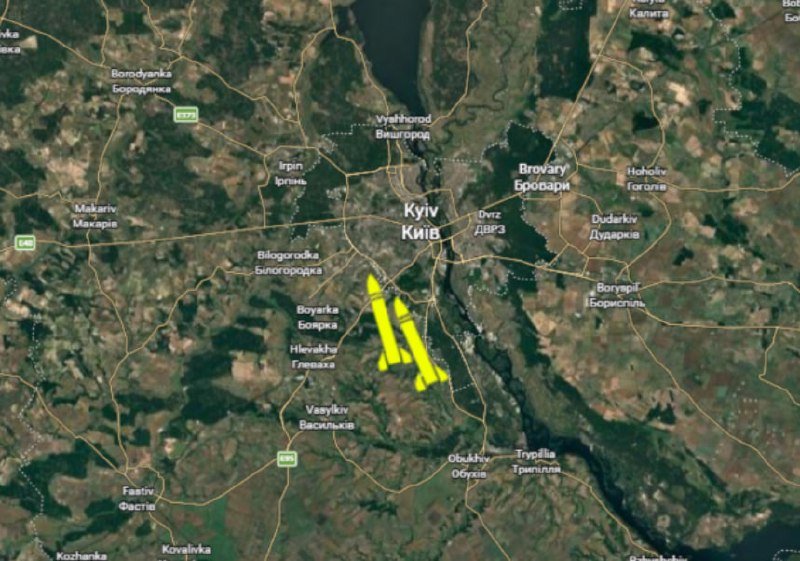
At 20:59 UTC on 19 August 2026, the open-source mapping channel AMK_Mapping posted its first alert of the evening: "2 impacts in Kyiv." Over the next thirteen minutes the same channel would log six further strike events across the Ukrainian capital, and a military correspondent would put the rocket count at "up to 20." By 22:36 UTC, Ukrainian Telegram commentator Vanek Nikolaev was reporting that shortages of interceptor calibres were being flown urgently toward the capital.
The pattern is by now a familiar feature of wartime reporting from Ukraine: a salvo enters Ukrainian airspace, air-defence crews engage, and impact reports accumulate on civilian Telegram feeds before official tallies are published. The 19 August episode is the latest iteration. The Ukrainian open-source record moves faster than any wire, and this article reads the evening through that record alone, because no other sources are in the input set.
What the open-source feed shows
The chronological sequence, drawn from the Telegram items available to Monexus, runs as follows. AMK_Mapping posted "2 impacts in Kyiv" at 20:59 UTC, then "2 impacts in eastern Kyiv" at 21:01 UTC, followed by "1 impact in Kyiv" at 21:04 UTC. At 21:07 UTC the same channel flagged "2 missiles, flying to northern Kyiv." One minute later, at 21:08 UTC, military correspondent Oleksiy Tsaplienko wrote that "up to 20 rockets flew over Kyiv and its surroundings." AMK_Mapping then posted "1 impact in Kyiv" at 21:10 UTC and "1 impact in western Kyiv" at 21:12 UTC. The Nikolaev resupply note landed at 22:36 UTC.
The available items do not specify the missile types involved, the targets struck, debris locations or casualty figures. The mapping channel logs impacts and missiles in flight by district and direction; it does not publish damage assessments. The Tsaplienko post is a running count of projectiles, not a strike characterisation.
The air-defence squeeze
Nikolaev's resupply note is the more politically telling item in the input set. Ukraine's interceptor stockpile has been a recurring feature of wartime reporting throughout 2026; Patriot and IRIS-T systems are understood to burn through rounds faster than Western suppliers can replace them, and Kyiv has spent much of the year publicly lobbying for additional batteries and accelerated deliveries. A post about calibres being flown toward Kyiv fits that pattern without resolving it. The available sources do not specify which system is short, which airframe is delivering, or whether the shortfall is acute or routine.
The structural read is straightforward. Missile barrages on Kyiv are no longer singular events that move markets or shift political coalitions in Western capitals. They are a baseline condition. What changes the calculus is sustainment: whether Ukraine's air-defence crews can continue to engage salvoes of this density at the current expenditure rate, and whether Western partners can replenish fast enough to keep the intercept rate above the threshold at which infrastructure damage becomes politically intolerable inside Ukraine.
The Ukrainian-only information feed
What the input set shows is an information asymmetry in the immediate aftermath. Ukrainian channels produced eight discrete alerts in roughly thirteen minutes. The input set contains no items from Russian state media, Russian Ministry of Defence briefings, or Russian-aligned milblogger channels that address this salvo. Monexus is not in a position to characterise the broader Russian information environment on the basis of an input ledger composed entirely of Ukrainian open-source channels; the article's claim is narrower, and it is this: the Telegram items available to Monexus for the evening of 19 August 2026 are all drawn from the Ukrainian reporting side.
Monexus analysis: a feed composed entirely of Ukrainian open-source channels will, by construction, present the strike through a Ukrainian lens. The impact coordinates are credible because they cluster geographically in ways consistent with a single salvo across multiple districts. The political framing is also Ukrainian by construction. A Russian-aligned counter-narrative, when it appears in the broader media environment, will likely emphasise Ukrainian air-defence activity over Ukrainian airspace, or downscale the salvo count. Neither framing would be wrong; both would be partial. This article does not adjudicate between them, because the inputs do not include the Russian-side material.
What to watch
Two markers will clarify the picture once additional reporting lands. First, the Kyiv City Military Administration's morning briefing on 20 August, which typically consolidates overnight strike data, debris locations and casualty figures. Second, the Air Force of Ukraine's daily sortie count, which has become the most reliable public indicator of interception rates since spring 2026. If the intercept rate on this salvo matched the running average, the political temperature in Kyiv will stay elevated but manageable; if it fell sharply, the air-defence squeeze Nikolaev flagged becomes the lead story rather than the subtext.
The open-source record will keep producing timestamps. The question is whether the systems underneath them keep pace.
Monexus framed this strike through the Ukrainian open-source mapping feed and military-correspondent channels that publish impact data in near real time; the input set did not contain Russian-side items, and the article flags that sourcing constraint rather than making claims about the broader Russian information environment.
Wire provenance
This editorial synthesis draws on the following public wire/social posts:
- https://t.me/vanek_nikolaev/42382
- https://t.me/AMK_Mapping/36128
- https://t.me/AMK_Mapping/36125
- https://t.me/Tsaplienko/97593
- https://t.me/AMK_Mapping/36122
- https://t.me/AMK_Mapping/36119
- https://t.me/AMK_Mapping/36110
- https://t.me/AMK_Mapping/36103