Kyiv hit overnight by multi-wave Russian ballistic and hypersonic strikes
Multiple waves of Russian ballistic and hypersonic missiles struck Kyiv overnight into 19 August 2026, with preliminary reports of people trapped in a shelter and large fires burning across the capital.
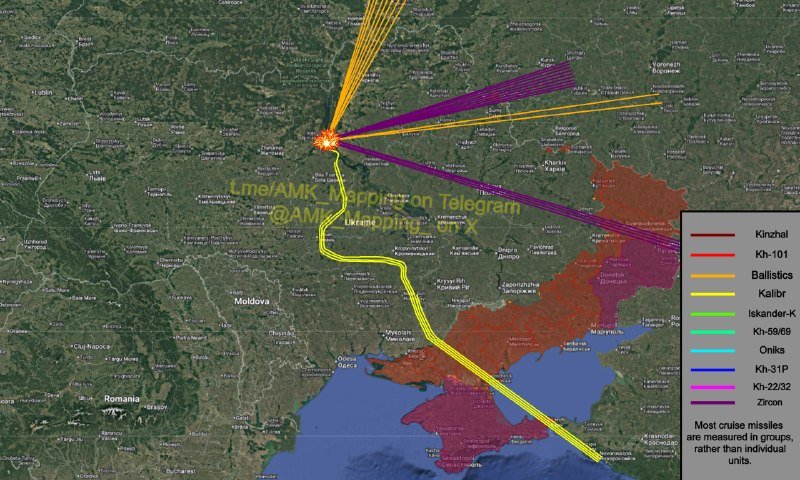
Multiple waves of Russian ballistic and hypersonic missiles hit Kyiv in the early hours of 19 August 2026, with residents quoted by Telegram channel Clash Report describing the salvo as "endless" and, in their account, among the loudest of the war. Preliminary reports from Kyiv Post indicated that people are trapped inside a shelter in one of the city's districts, and emergency services are working at the scene.
The attack reads as a calibrated escalation rather than a one-off bombardment. Open-source mapping channels identified Iskander-M and Zircon munitions among the weapons used, a pairing that combines a road-mobile short-range ballistic system with a ship- or submarine-launched cruise missile publicly claimed by Moscow to be capable of hypersonic speeds. Separate close-up footage circulated the same night showed two missiles striking the same location in what the channels labelled a double-tap, a tactic intended to hit first responders arriving at the initial impact. Large fires were visible across the capital after the impacts, according to AMK Mapping.
A double-tap, on camera
The most documented moment of the night was a Russian strike using two missiles on a single location in Kyiv. Intel Slava published close-up footage showing a Russian double-tap with two Iskander-M/KN-23 tactical ballistic missiles striking the same site. AMK Mapping separately posted close-up footage showing the impact of two Russian KN-23 ballistic missiles in Kyiv. Kyiv Post's preliminary read noted that people remained trapped in a shelter in one of the capital's districts, with emergency crews en route. The available source items do not specify which district or how many people are involved.
The double-tap pattern has been a recurring Russian signature in this war, designed to catch medics, firefighters and bystanders in the second wave. Its visibility on open-source channels within hours of the strike suggests Ukrainian information teams are now treating the documentation of such patterns as part of the response itself. Monexus analysis: each confirmed double-tap serves a second-order political function, supplying Kyiv and its allies with imagery that sustains the case for continued air-defence resupply.
What residents said
Clash Report characterised the overnight attack as a massive salvo of ballistic and hypersonic missiles arriving in multiple waves, and counted at least 15 to 16 missiles tracked toward Kyiv. The channel also relayed residents' descriptions of the explosions as "endless" and, by their account, among the loudest of the war. The available source items do not specify how many missiles were intercepted, nor the share that reached ground.
The distinction matters: the "endless" and "loudest" framing is a resident characterisation reported by Clash Report, not an editorial verdict by the channel itself. Eyewitness accounts of duration and intensity shape the political reading in Kyiv regardless of interception rates. A loud, prolonged barrage, even with most missiles shot down, raises the political cost of any future pause in air-defence resupply and tightens the window for Western decision-makers weighing additional surface-to-air systems. Monexus assessment: the loudness of an attack is itself part of its effect.
The Iskander-Zircon mix
The pairing of Iskander-M short-range ballistic missiles and Zircon hypersonic cruise missiles is the technical story of the night. Iskander-M is a road-mobile, solid-fuel system with a range of several hundred kilometres, capable of carrying conventional or nuclear warheads; it has been the workhorse of Russian precision strikes on Ukrainian infrastructure since the early months of the full-scale invasion. Zircon, by contrast, is a sea-launched cruise missile publicly claimed by Moscow to be capable of speeds above Mach 8. AMK Mapping explicitly identified both weapons types among the munitions used in the strikes that produced the large fires visible across Kyiv.
The mixed salvo signals that Russian planners chose to expend some of the more limited and prestige-laden stocks in this particular wave rather than hold them in reserve. Hypersonic-class munitions are expensive and difficult to replace under sanctions and export-control regimes. Firing them at urban targets, rather than at hardened military nodes, is a statement about priorities: degrading civilian morale and demonstrating reach now matters more than conserving inventory for later. The available source items do not specify how many Zircons were fired, nor whether any were intercepted by Patriot or SAMP/T batteries deployed around Kyiv.
What remains contested
The source material is consistent on the event itself: a heavy, multi-wave Russian missile attack on Kyiv in the early hours of 19 August 2026, featuring Iskander-M, KN-23 and Zircon munitions, a documented double-tap on a single location, large fires across the capital, and reports of people trapped in a shelter. The available source items do not specify casualty figures, the number of missiles intercepted, the districts hit, or the operational status of Ukrainian air-defence batteries in the hours after the strike.
The 15 to 16 missile count carried by Clash Report is a tracking figure for the inbound wave, not a post-interception tally, and a final number of warheads that reached ground cannot be derived from the cited posts. Ukrainian air-force and General Staff briefings, which typically publish interception rates within hours of a salvo, were not part of the source material reviewed for this piece. Monexus analysis: until those numbers surface, the most defensible reading is that the strike was a deliberate, mixed salvo intended to saturate air defences, hit rescuers a second time, and impose a psychological cost on the capital, rather than a tactical strike aimed at a single military target.
Desk note: Monexus framed this as a Ukrainian-source-led report of an attack on the invaded capital, with Russian-aligned channels cited only for the technical identification of the weapons used. The "endless" and "loudest of the war" characterisation is reported as residents' words relayed by Clash Report, not as the channel's own verdict. The 15 to 16 missile figure is presented as Clash Report's tracking of inbound missiles, not as a confirmed count of warheads that reached ground. Where the source material thinned, on interception rates, casualty counts and the specific district affected, that absence is named in the article rather than filled in.
Wire provenance
This editorial synthesis draws on the following public wire/social posts:
- https://t.me/Kyivpost_official/38804
- https://t.me/intelslava/92839
- https://t.me/AMK_Mapping/36137
- https://t.me/AMK_Mapping/36134
- https://t.me/ClashReport/93033