Imran Khan leaves Adiala for an Islamabad hospital. The politics of the move matter more than the medicine.
Pakistan's jailed former prime minister was transferred from Adiala to a private hospital in Islamabad on 20 August 2026 under a Supreme Court order, ending a standoff that had fused the medical and political crises around Pakistan's most consequential inmate for more than three years.
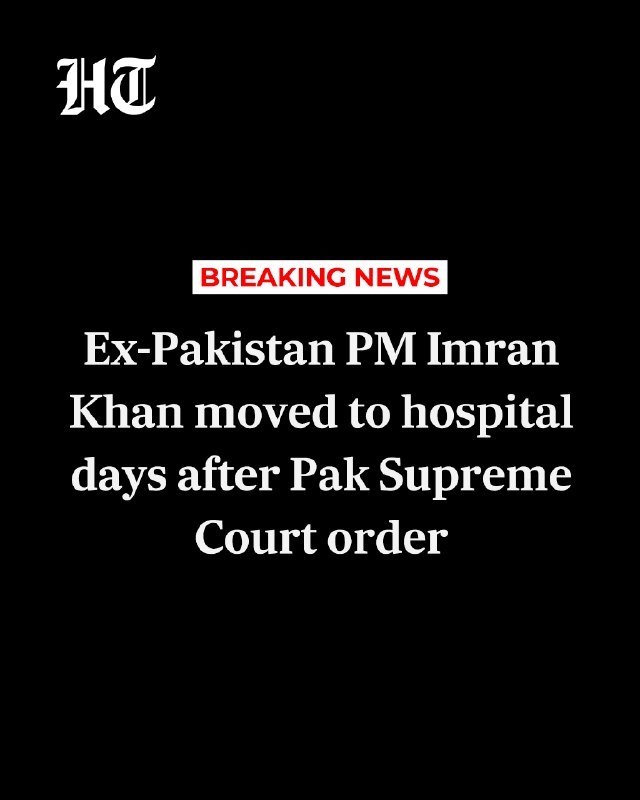
Imran Khan was transferred from Adiala prison to a private hospital in Islamabad on 20 August 2026, according to his Pakistan Tehreek-e-Insaf (PTI) party, ending a standoff that had fused the medical and political crises around Pakistan's most consequential inmate for more than three years. Reuters reported the move on 20 August, citing the party; Deutsche Welle framed it as the culmination of a deterioration in health, by PTI's account, that had been visible for months. The framing inside Pakistan is not whether Khan is ill, but who controls the moment he is well again.
What changes on the ground is small and specific. Khan remains a prisoner, the cases against him remain active, and the security perimeter around him is intact. What changes is the optics of a 73-year-old former prime minister receiving treatment in a private facility rather than inside a prison hospital, and the political space that opens for negotiations between the military-backed government in Islamabad and a party that still commands the largest organised following in the country.
The move, and the order behind it
Reuters, citing PTI, said Khan was transferred to a hospital "after court order", and multiple independent outlets have identified that court as the Supreme Court of Pakistan. The Supreme Court's instruction, issued on 18 August 2026, directed Khan's transfer within a tight window; the actual move was carried out on 20 August. Deutsche Welle reported that the former prime minister's health had deteriorated during more than three years in prison since his removal from office in 2022, the duration that makes the medical case politically combustible. The Guardian's read was the most explicit: the transfer "may signal attempt to improve relations between military-backed government and ex-leader's party", a phrase that puts the politics ahead of the medicine by design. Iranian state-aligned Telegram channels, Fars News and Press TV, confirmed the destination as a private hospital in Islamabad, useful as cross-checking on the basic fact of the transfer rather than as a stand-alone source for Pakistani political analysis.
The bench that issued the order matters. A directive from the Supreme Court rather than from a subordinate court raises the political cost of non-compliance by the executive, narrows the room for a quiet reversal, and binds the interior ministry's handling of the prisoner to a visible judicial record. The hospital move is the first procedural act in months that the same bench has put on the public docket; the order itself is part of the story, not the choreography around it.
What PTI is asking for, and what it is offering
A hospital is not a pardon. PTI's near-term ask, as telegraphed by spokespeople in recent weeks, is a stay on proceedings or a transfer to a facility of the family's choosing. The longer-term ask, less publicly stated, is space: the right to organise, to fundraise, to contest the next general election under conditions that the party accepts as legitimate. The government's offer, decoded from the surgical calm of the official statements, is medical cover without political cover. A hospital in Islamabad is a gift that costs the treasury little and forces PTI to choose between accepting partial relief and continuing a street campaign that has, by every independent measure, lost momentum since the violence of late 2024.
The government has also pushed back in court. Independent reporting describes the federal government filing review petitions against the Supreme Court order, characterising the directive as discriminatory and seeking modification; the available source items do not specify the precise grounds pleaded. That legal posture sits awkwardly beside the compliant execution of the transfer itself. The hospital move closes the most visible grievance without conceding a single underlying legal claim, and the executive's courtroom resistance makes the political ceiling on the gesture explicit. Pakistani opposition politics is fluent in this kind of exchange.
Why the military is content, for now
The hospital transfer lands at a moment of relative quiet on the security file. The TTP insurgency on the northwestern border has ebbed from its 2022 peak. The Afghan border has stabilised, after a fashion, under the Taliban government in Kabul. The economy is still sick, but the acute phase of the balance-of-payments crisis that forced an IMF programme in 2023 has eased. The military's priority is not Khan's freedom but Khan's manageability. A hospitalised former prime minister is easier to manage than a martyr.
That calculation carries an assumption: that the hospital is a controlled environment, with phone access denied, with visits curated, with medical bulletins routed through the interior ministry. Independent reporting names the destination as Shifa International Hospital in Islamabad. If any of those conditions slips, the politics flip. The most plausible trigger for a new crisis is not a court ruling but a leaked photograph, a recorded phone call, or a sudden deterioration that the family narrates into a different story than the government.
The frame that holds, and the one that doesn't
The dominant Western wire frame, visible in the Reuters and Guardian coverage, is that the transfer is a confidence-building gesture from a government that needs to lower the political temperature before a fiscal or political calendar event. The structural reading is that institutional Pakistan has used the medical file as a pressure-release valve, opening just enough under judicial pressure to keep the streets quiet without changing any of the underlying legal architecture, and that the executive's parallel court challenge marks the outer edge of what the state is willing to give. The frame that does not hold is the maximally optimistic one: that a hospital move is the first step toward a deal, a release, a reconstitution of mainline politics. There is no public evidence for that in the cited thread, and the source items do not specify any terms beyond the transfer itself.
What remains genuinely uncertain is the medical condition. PTI says deterioration; the government has, in court filings characterised by independent outlets as contesting the order on discrimination grounds, pushed back on the framing of urgency as well as on the substance. The lead physician has not been named in the cited thread, and the published source items do not specify the medical bulletin schedule. The legal status of the underlying cases is not affected by relocation. The next inflection point is the first official medical bulletin, which will be read as a political document regardless of clinical content, and the Supreme Court's disposition of the government's review petitions, which will reveal whether the judicial arm is willing to police the boundaries of the gesture it has already authorised.
A patient is a fact. A prisoner is a fact. The space between them is where Pakistani politics now lives, and the hospital door that opened on 20 August 2026 does not close that question so much as move it indoors, under the eye of a bench that has put itself on the record. This article led on the Reuters and Guardian wire reporting of the 20 August 2026 transfer, with Deutsche Welle's account of the deterioration timeline and the Iranian state-aligned Telegram channels used only to confirm the hospital destination. Where the source items do not specify a detail (the lead physician, the precise grounds of the review petitions, the medical bulletin schedule), the article has said so rather than infer.
Wire provenance
This editorial synthesis draws on the following public wire/social posts:
- https://reut.rs/4gj5xOh
- https://www.dw.com/en/pakistan-former-pm-khan-moved-to-private-hospital/a-78451553?maca=en-rss-en-all-1573-rdf
- https://www.theguardian.com/world/2026/aug/20/imran-khan-hospital-pakistan
- https://t.me/FarsNewsInt/259431
- https://t.me/presstv/203576