Panama Canal to thin daily transits from 3 September as El Niño pulls reservoir levels down
The Panama Canal Authority will cut daily ship transits starting 3 September, citing El Niño-driven drought. Carriers are passing the cost on, with one figure cited at roughly $1,000 per container.
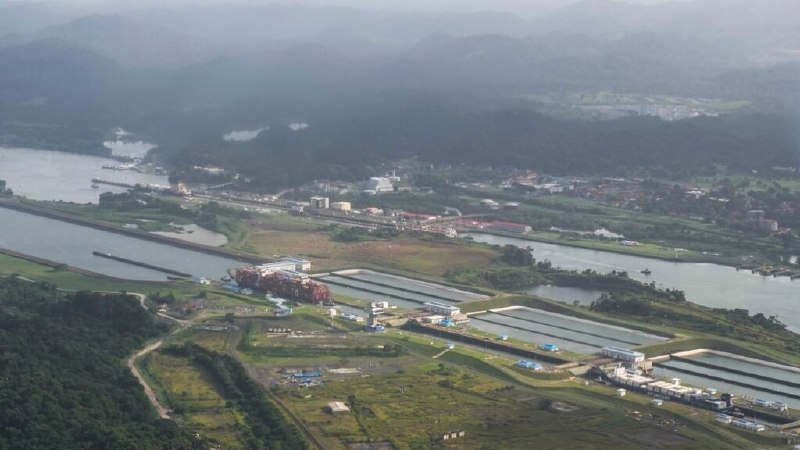
The Panama Canal Authority said on Thursday that daily ship transits will be cut starting 3 September as a severe El Niño-driven drought depletes the freshwater reservoir needed to operate the waterway, per a France 24 wire dated 20 August 2026. The Authority's English-language announcement, carried by France 24's English service at 22:58 UTC, frames the cut as a response to a precipitation deficit over the isthmus; the French-language sister post at 22:39 UTC used near-identical language, attributing the move to a drop in precipitation linked to El Niño. A short X post from the @Polymarket account at 22:23 UTC repeated the announcement in headline form.
The Authority has not only moved on transit volume. Per a Disclose TV Telegram post at 22:20 UTC, the canal is also limiting cargo capacity twice in the coming weeks to lighten ships, citing low water levels due to the same El Niño drought, with less freight moving per vessel as a consequence. Carriers are already pricing the disruption into their offers, per the same Disclose TV summary, with one cited figure at roughly $1,000 per container. The Disclose TV post does not name the specific trade lane on which that surcharge is being applied; the available source items do not specify a particular route.
This is a rationing decision as much as a hydrology decision. When water levels fall, the Authority has a familiar ladder of levers to pull: draft restrictions that force ships to ride higher in the lock chambers, slot and transit ceilings, fresh-water-saving lock protocols, and finally outright booking limits. The two-lever sequence the source items describe (draft-lightening first, then a daily-transit ceiling from 3 September) is consistent with that escalation ladder rather than an emergency collapse, though the available source items do not specify the Authority's full multi-week curtailment timetable, and Monexus has not independently established one. Both readings can be true at once: the Authority is signalling that precipitation has not yet recovered enough to halt the escalation, but it is also signalling that it has not exhausted its lighter levers either.
What the cap actually changes
A daily-transit ceiling is the canal's bluntest operational dial, because it sits at the meeting point of two physical limits the Authority cannot negotiate around: the freshwater the lock system can surrender per cycle, and the number of lock cycles the chambers can complete in 24 hours. The France 24 wire specifies the cadence: from 3 September, the cap falls; the same wire notes a further cut is slated for 15 September. The Authority is therefore telegraphing a two-step tightening rather than a single step, and the second step will land before the calendar reaches the autumn equinox. The Authority's preferred first moves in low-water episodes have historically been draft restrictions, and that this round has reached the transit-cap dial suggests the hydrology is forcing the Authority's hand rather than the Authority choosing the cap instrument for its own sake.
There is also a question the source items do not resolve, and which the Authority will eventually have to answer on the record: whether the cap from 15 September is the floor or simply the next step. El Niño episodes have historically persisted into the northern hemisphere winter, and the source items do not specify how the Authority would respond to a further precipitation shortfall. Monexus analysis: the September cap is best read as the next move in a recurring cycle, but the absence of a stated end-date is itself the signal that the Authority is not yet confident the water will come back on its preferred timetable.
Who pays first
Per the Disclose TV post, carriers are already passing the cost onto shippers, with one cited figure at roughly $1,000 per container, and the post expressly links the surcharge environment to the reality that carriers are moving less freight per vessel because of the lower drafts. Container lines, grain shippers and LNG operators are the segments whose schedules have the least slack to absorb an unexpected canal transit delay, and a missed canal slot is harder to recover on a tight liner alliance than on a less time-sensitive bulk voyage. The available source items do not specify which trade lane the cited $1,000 per-container figure is being applied on, and Monexus has not independently established that. The headline constraint is that the freight market is being told to clear the constraint through price rather than through volume.
A cap that the market absorbs as higher spot rates is, in effect, a cap whose cost falls disproportionately on the shippers least able to plan around it: smaller importers, agricultural buyers operating on thin margins, and any cargo whose per-day carrying cost is a meaningful share of its value. The polymarket-tracked X post simply restated the announcement; the available source items do not specify particular rate moves or vessel queues, and Monexus has not independently established them. The question is how steep the surcharge curve gets before shippers start to reroute, rather than whether the curve has a slope.
The hydrology underneath
The proximate cause is El Niño, the recurring Pacific Ocean warming pattern that suppresses rainfall over the isthmus and pushes the canal basin toward deficit. El Niño is not new, and neither are canal restrictions; the Authority has cycled through this playbook repeatedly over the past decade, though the available source items do not specify a particular prior episode and Monexus has not independently established one. The longer-running question is structural: even in non-drought years, the canal's freshwater system is being squeezed by population growth along the corridor and by a vessel mix that has grown more water-hungry since the locks were last modernised. The September cap is best read as the latest move in a recurring cycle, but the cycle's baseline is shifting, and the headroom the Authority used to have for moderate years is narrower than it was a decade ago. This publication's assessment: the move is a hydrology signal wrapped in an operations decision, and the Authority's framing of it as drought-driven is consistent with what an El Niño pattern in this part of the Pacific would produce.
There is also a counter-read worth naming plainly. Canal restrictions are, in part, a rationing problem as well as a hydrology problem. Operators retain discretion over how aggressively to throttle transits and over which segments bear the cuts, and the Authority's choice to move first on cargo capacity before tightening the slot ceiling suggests a calibrated response rather than a collapse. The available source items do not specify how much of the constraint is hydrological floor and how much is operational conservatism, and this article has not independently established the split. Both readings can be true at once.
Stakes and what to watch
The next data points that will move markets are the Authority's own hydrology updates on the canal's reservoir system, any further indication from carriers of rerouting decisions on trans-Pacific and US Gulf trades, and any further tightening of the slot ceiling if El Niño persists into the northern hemisphere winter. If the cap is deep enough to push container lines to add capacity via the Suez or Cape routes, the secondary impact lands in Mediterranean and Northwest European port congestion rather than on the isthmus itself. If the Pacific flips toward neutral or La Niña, the cap becomes a story about how fast the water comes back rather than how much longer it falls. For shippers, the operational signal is simpler than the climate signal: the canal is signalling that the easy water is gone for now, and the surcharges already in the market are the first price of that signal.
Desk note: Monexus framed this as a rationing-meets-hydrology story, leaning on the France 24 wire for the operational sequence and on the Disclose TV summary for the cargo-capacity moves and the per-container surcharge figure. The piece labels the structural reads as analysis in place; it stops short of pinning down a specific surcharge trade lane or vessel queue because the available source items do not contain those specifics.
Wire provenance
This editorial synthesis draws on the following public wire/social posts:
- https://www.france24.com/en/americas/20260820-panama-canal-to-cut-daily-ship-traffic-as-drought-worsens-from-el-nino
- https://t.me/france24_en/18300
- https://t.me/france24_fr/22717
- https://t.me/disclosetv/21743
- https://x.com/Polymarket/status/2090565497875988543