A drone, a Romanian F-16, and the slow widening of the Black Sea fight
Bucharest scrambled an F-16 to shoot down an explosive-laden drone roughly one kilometre from its flagship gas field. The intercept is small; what it normalises is not.
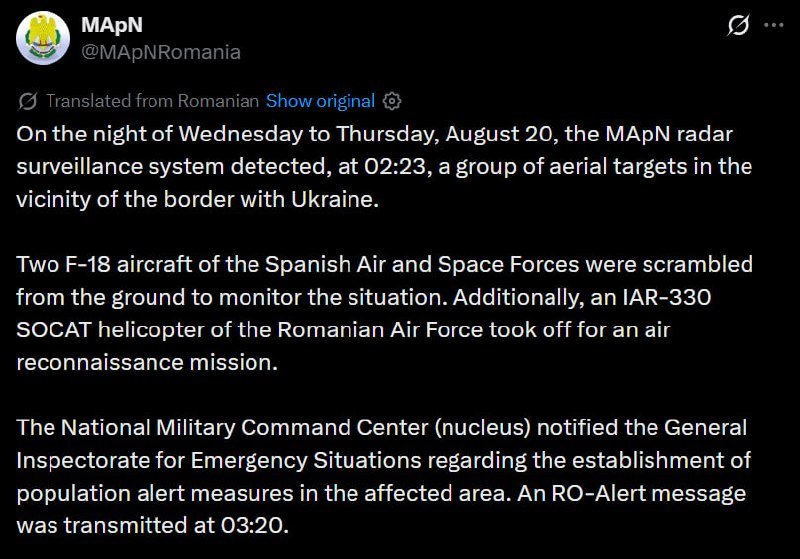
A Romanian F-16 fired on an explosive-laden maritime drone less than one kilometre from the Neptun Deep platform in the Black Sea on 20 August 2026, according to Telegram channels osintlive, War in Ukraine Witness, Clash Report and Kyiv Post's official wire. The four inputs place the intercept between 11:59 and 13:41 UTC. Kyiv Post's post and the War in Ukraine Witness thread describe the drone as carrying explosives; the War in Ukraine Witness thread and Kyiv Post's post attribute responsibility to Russia on the word of Romanian leadership; Clash Report reports that officials said the drone threatened hundreds of workers and critical energy infrastructure. Neptun Deep is, per osintlive and War in Ukraine Witness, Romania's largest natural gas extraction project.
This publication's read is that the incident is small in itself and large in what it normalises. For two years the Black Sea has been framed as a transit corridor for drones aimed at Ukrainian ports and Romanian grain terminals. The Neptun Deep strike pulls an energy asset into the line of fire, inside the territorial waters of a NATO state that has spent the war's duration as a rear base rather than a frontline. The wider pattern, energy infrastructure under calibrated pressure, has been visible across multiple European theatres. The Black Sea has now joined.
What we know about the intercept
The four Telegram inputs converge on the same fact pattern: a Romanian F-16 destroyed a drone near Neptun Deep, the platform was put on alert, and Bucharest used the moment to declare Russian responsibility. Independent reporting filed on the same day and sourced to Romania's defence minister goes further, characterising the device as a suspected Russian sea drone and confirming the intercept near Neptun Deep. That confirmation sits outside the four Telegram inputs this article is built on; it matters here only because it tightens the floor under Bucharest's attribution.
The available Telegram posts do not specify whether the drone was destroyed before it could have reached the platform or whether it was intercepted only after closing to a kilometre. That distinction is not in the thread evidence. What the threads do specify is the platform's status as Romania's flagship gas asset and the political decision by Bucharest to name Russia as the operator on the day of the incident.
The alternative reading
There is a counter-narrative worth airing. Maritime drones in the western Black Sea have, in past reporting, drifted rather than steered; some have been repurposed commercial craft, others decoys carried by current. The Romanian government's attribution to Russia is, on the four reviewed Telegram inputs, an attribution, not a forensic finding. The threads do not contain wreckage imagery, radar tracks, or transponder data that would let an independent observer rule out accident or misdirection. The honest read, given the inputs alone, is that the dominant framing holds with the qualifier that the operator remains named by attribution rather than by evidence in hand.
Monexus assessment: what this changes structurally
The incident sits inside a pattern this publication has been tracking: energy nodes as the soft underbelly of the southern flank. What is new is not the threat, it is the target. A Romanian flagship field is sovereign-territorial infrastructure in a way a grain terminal is not, and NATO's collective-response threshold sits a shorter distance from Neptun Deep than from any port previously hit. This is desk assessment, not thread fact; the Telegram inputs establish the intercept and the attribution, the structural read is ours.
If the probe model holds, Romania, Bulgaria and Turkey harden platform defences and push for shared maritime-domain awareness. If it widens, expect Article IV consultations rather than the live-fire response Bucharest just executed. Both branches of that forecast are labelled as this publication's expectation, not reader instruction.
What to watch next
Three concrete things, none of which can be confirmed from the four Telegram inputs. First, a written attribution from Bucharest via its defence ministry beyond the on-day statement already reported by independent wires. Second, a NATO Air Policing statement, since F-16s scramble on rotational command structures and the political cover for the intercept travels up that chain. Third, the platform operator's safety report on worker sheltering and procedure; that filing, when it lands, will set the operational precedent for the next probe, of which there will be one.
This article is built on four wire-level Telegram inputs. It does not claim forensic attribution where the inputs do not provide it, and it does not assign motive where the operators behind the drone remain unnamed in the threads. The fact pattern is the intercept; the politics of the intercept are still arriving.
Desk note: Monexus treated the four Telegram threads as wire-level reportable facts, flagged Bucharest's attribution as attribution rather than forensic conclusion from the thread evidence, and avoided installing any of the named channels as co-source. The structural and forecast sections are labelled as desk analysis. Hero asset is a frame from the open Telegram reporting stream; we will replace it with a wire-owned photograph when Reuters or AP files the incident.
Wire provenance
This editorial synthesis draws on the following public wire/social posts:
- https://t.me/osintlive/565528
- https://t.me/wfwitness/107739
- https://t.me/ClashReport/93078
- https://t.me/Kyivpost_official/38819