Trump declares "most crushing" economic operation against Iran after deal window closes
At 23:02 UTC on 19 August 2026, a Truth Social post attributed to US President Donald Trump asserted that Tehran had failed to take a deal that, in his telling, no American president had previously offered; within thirty-four minutes the same text had been rebroadcast across Telegram channels as "ECONOMIC D-DAY" and the "MOST CRUSHING" economic warfare, ending in a Spectator Index summary at 00:06 UTC on 20 August that called it the "MOST CRUSHING ECONOMIC OPERATION EVER TAKEN AGAINST ANY COUNTRY."
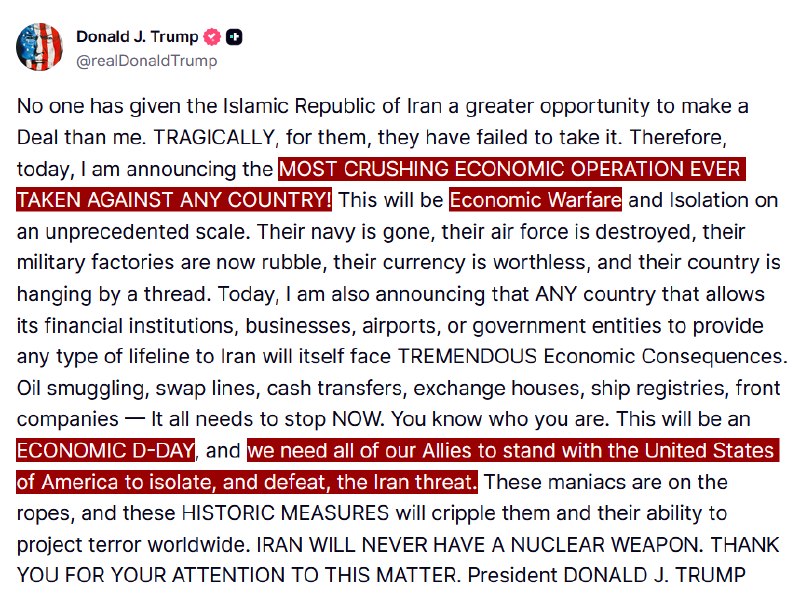
At 23:02 UTC on 19 August 2026, a post attributed to US President Donald Trump appeared on Truth Social and was first relayed by the Witness channel. The text, carried verbatim by Open Source Intel at 23:06 UTC and by Middle East Spectator at 23:12 UTC, declared that no American president had offered the Islamic Republic of Iran a greater opportunity to make a deal than he had, and that Iran had "TRAGICALLY" failed to take it. The post itself used the phrase "Therefore, today" and was followed, in the same relayed text, by what Trump termed "ECONOMIC D-DAY" and the "MOST CRUSHING" economic warfare, paired with a public call for US allies to stand with Washington. By 23:36 UTC, Status-6 (War & Military News) and Disclose.tv were circulating the same passage; by 00:06 UTC on 20 August, The Spectator Index had compressed it into a single headline: the "MOST CRUSHING ECONOMIC OPERATION EVER TAKEN AGAINST ANY COUNTRY."
The headline language is rhetorical, but the operational rails it points at are concrete. Monexus assessment: any US economic operation against Iran in this decade would, in the dominant reading, run on three rails simultaneously: oil export sanctions enforcement, financial-institution designations, and a diplomatic push for allied compliance on shipping, banking, and insurance. The playbook is not new. The signal is the escalation ladder, from "maximum pressure" toward what the post presents as a singular event, and the venue in which it was made: a Truth Social post, not a Treasury action.
The message, the medium, the moment
The text that travelled across aggregators between 23:02 and 23:12 UTC reads: "No one has given the Islamic Republic of Iran a greater opportunity to make a Deal than me. TRAGICALLY, for them, they have failed to take it. Therefore, today…" Middle East Spectator's relay of the same post shows the escalation language inside the original text rather than added by an editor downstream: Trump frames what he is announcing as "ECONOMIC D-DAY" and the "MOST CRUSHING" economic warfare, and calls on all US allies to align with the US. The Spectator Index, reposting at 00:06 UTC on 20 August, summarised the threat as the "MOST CRUSHING ECONOMIC OPERATION EVER TAKEN AGAINST ANY COUNTRY." That summary is editorial framing on top of Trump's own phrasing, not a separate quote.
The available source items do not specify which specific Iranian demand, counter-offer, or negotiation the post was responding to, or whether a deal was in fact on the table beyond Trump's own characterisation. The post asserts that an opportunity existed and that Tehran failed to take it; the thread evidence does not independently establish either side of that assertion. Every item in the cited material is a relay channel carrying Trump's text, not independent reporting on a diplomatic back-channel, and the certainty of any claim about who said what in which negotiating room is therefore lower than the certainty of the public post itself.
What the operation can actually do
Monexus assessment: a US economic offensive against Iran, in any plausible reading, would run through the choke points that have mattered in previous rounds. The first is oil: Iran's crude exports have been the pressure point of choice because they are observable on tankers and pricing screens, and because the marginal barrel moves through a thin network of intermediaries. The second is finance: Iran's access to the dollar-based financial system runs through a shrinking list of correspondent banks and an even thinner list of insurers willing to underwrite Iranian cargo. The third is the diplomatic perimeter: a US push for allied alignment on sanctions enforcement, particularly around the shipping lanes where Gulf-state cooperation has been the swing variable in past enforcement cycles. The available items do not specify which of these rails the post refers to, or whether the "economic D-Day" framing covers all three. The Telegram-relayed excerpts describe a broad declaration, not a sanctions package with item numbers. Until a Treasury action, an executive order, or an OFAC designation appears in the Federal Register, the operative fact is the threat, not the tool.
The counter-reading from the markets and the buyers
The structural counter-read, well established across previous rounds of pressure, is that oil markets do not respond durably to unilateral declarations. Each previous escalation has produced a temporary price spike and a longer-term adaptation: refineries that absorb discounted crude, tankers operating under flags of convenience, and banking workarounds that route around the dollar perimeter. The relevant question is not whether Iran loses barrels in the first week, but how fast it routes around the loss. The buyer's side complicates the picture further. Iranian crude has historically been a discounted-barrel asset for refiners in China and India, and Turkish buyers have been a persistent secondary market. The available source items do not document responses to the 19 August post from Beijing, New Delhi, or Ankara. Monexus assessment: a unilateral US designation that does not carry allied weight functions as a price-setting event rather than a volume-killing event, and the allied alignment Trump publicly demanded is the swing variable that determines which it becomes. European and Gulf responses to the post are not in the cited material.
What to watch next
Three windows open in the days ahead. First, Treasury and Commerce will need to publish the actual instrument: an executive order, an OFAC designation list, or a Bureau of Industry and Security rule. The text of that instrument, not the social-media post, is the operational fact. Second, the State Department will need to test the allied alignment Trump publicly demanded; European and Gulf responses to the post are not documented in the cited material. Third, oil futures will print their own verdict. The post landed during the Asian trading day; Brent and Dubai benchmarks in the 24 to 48 hours after will show whether the market read this as a supply event or a headline event. The thread of source material is uniformly relay material; the pipeline has not independently established how much of the diplomatic context behind the post is itself on the record elsewhere.
Desk note: Monexus framed this around the operational rails (oil, finance, allied alignment) rather than the rhetoric. Wire coverage of similar escalations has tended to front-load the threat language and undersell the buyer-side adaptation; we have tried to do the opposite, within the limits of a thread composed entirely of relay channels carrying Trump's own text. The "deal on offer" framing is treated here as Trump's own assertion, not as an established fact.
Wire provenance
This editorial synthesis draws on the following public wire/social posts:
- https://t.me/wfwitness/107661
- https://t.me/osintlive/565406
- https://t.me/Middle_East_Spectator/36004
- https://t.me/osintlive/565410
- https://t.me/osintlive/565411
- https://t.me/osintlive/565415