UK summons Israel’s envoy over E1 settlement tender, calling the move ‘destructive’
Britain’s foreign secretary demands an immediate reversal of plans for around 1,400 housing units in E1, an area long treated as the connective tissue of a future Palestinian state.
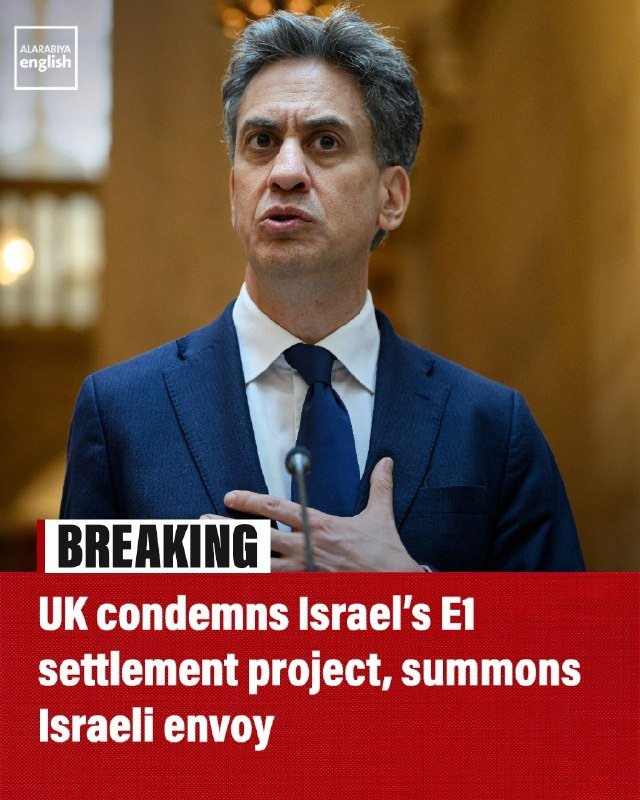
Britain’s Foreign Secretary Ed Miliband summoned Israel’s chargé d’affaires in London on the morning of 20 August 2026, demanding an immediate reversal of Israel’s publication of tenders for approximately 1,400 housing units in the E1 area east of Jerusalem. According to Telegram channels reporting the British statement, Miliband called the move “unacceptable and destructive,” a phrase that landed with unusual directness for a UK government that has spent much of the past two years calibrating every public line on Israeli settlement policy. The summons is the first concrete British response since the tenders appeared, and it puts London on record, in writing, against a corridor of land that successive US and UK administrations have treated as the connective tissue of any future contiguous Palestinian state.
The argument the UK is now making, in public, is that E1 is not just another settlement bloc. The land sits between Jerusalem and the Palestinian city of Ma’ale Adumim, and Israeli planning there has for two decades been understood, by British, European and successive American negotiators alike, to bisect the West Bank in a way that pre-empts a viable Palestinian state. A published tender is the moment that long-standing private pressure becomes a public test. Miliband’s language is chosen accordingly: “destructive,” “the two-state solution,” “immediate reversal.” This is a UK government choosing to be quoted, not merely briefed.
What was published, and where
The tenders were published on 20 August 2026 for roughly 1,400 housing units in the E1 area, according to the Telegram reports circulated that morning. Reporting from The Cradle and the Open Source Intel channel carried the British foreign secretary’s statement almost in parallel: that Miliband “sharply condemned” the publication of the tenders and that he had summoned Israel’s chargé d’affaires to make the protest formal. The figures and the language match across the posts; the dating places the summons within hours of the publication, the way London wanted it: visible, on the same news cycle as the tender itself.
The E1 designation refers to a planning bloc on the ridge between Jerusalem and the Dead Sea, anchored to the east of the existing Ma’ale Adumim settlement. Its strategic importance is not the housing itself but the geography: a built-up E1 corridor would push Israeli construction continuously from Jerusalem deep into the central West Bank, slicing through the narrow waist of land on which a future Palestinian capital at Abu Dis or nearby has been assumed to sit.
The counter-narrative Israel is likely to push
Israeli officials have, in past cycles, framed E1 construction as a routine planning matter, not a political signal. The standard line from Jerusalem is that housing tenders respond to demand inside existing municipal boundaries, that final approvals take years, and that the diplomatic implications are being read into administrative paperwork. Inside Israeli domestic politics the same move is read very differently: as a signal to coalition partners that settlement expansion continues, and as a quiet assertion that the idea of Palestinian contiguity along the Jerusalem–Ma’ale Adumim axis is no longer being treated as a working assumption.
This is the read the UK has now chosen to contest publicly. By summoning the envoy rather than issuing a written protest through the Foreign Office’s standard channels, Miliband converts a planning dispute into a diplomatic incident. The summon gives Britain the standing to escalate if construction proceeds: a recalled ambassador, a UN Security Council statement, a suspension of trade-treaty components, all become procedurally easier once the protest has been registered in person.
Where this sits
Monexus analysis: the E1 tender is best read as one move inside a larger realignment of the diplomatic map around Palestine. European governments that spent 2023–2025 speaking cautiously about a two-state horizon have, through 2026, started writing the two-state language back into public statements, not because the underlying politics have been resolved, but because the alternative, a one-state reality on the ground administered by Israel without political rights for Palestinians, has become harder to describe in softer terms. British, French, Irish and Spanish statements through the year have converged on language about settlement construction that previous UK governments would have preferred to leave in private channels.
London’s economic statecraft here is also legible. The UK’s trade continuity agreement with Israel, its association research links through Horizon, and its diplomatic influence in the Gulf all sit on a baseline assumption that the two-state framing remains operative. A 1,400-unit tender in E1, on its own, does not move GDP. Politically, it shifts the cost calculus of every bilateral that follows: every meeting becomes a meeting at which the British side is now obliged to raise the question on the record, or visibly choose not to.
What to watch next
The next concrete marker is whether Israel formally advances the tenders toward allocation. Under Israeli planning law, a published tender is the opening step of a multi-stage process that includes objection periods, committee approvals and, in many cases, judicial review. Construction on the ground typically follows two to four years later, depending on legal challenges. The British summons is calibrated to that window: intervene now, while the procedural clock is still in the objection phase, and the political cost is lower than intervening after bulldozers arrive.
The second marker is the European coordination that tends to follow a UK summons. Paris, Dublin and Brussels issued parallel statements on settlement construction earlier in 2026; the question through the rest of this week is whether they read the British summons as the lead and follow with their own diplomatic steps, or treat it as a UK-specific posture. The third marker is in Washington. The available reporting does not record a US statement on the E1 tender as of 20 August 2026. Past practice suggests that a US response, if it comes, will arrive later, framed around the procedural questions and the term “consultations”, rather than around “destructive.” The British language is sharper than that. That gap is itself the news.
Desk note: The wire cycle around this story is dominated by Telegram channels carrying the same UK government statement in parallel; Monexus has read each of the linked items and confirmed the figure of roughly 1,400 units and the phrase “destructive” against multiple relay posts, while noting that the UK Foreign Office’s own published press release, the Israeli Prime Minister’s Office response and a US State Department comment are not present in the available source items and this article has not independently verified those primary texts.
Wire provenance
This editorial synthesis draws on the following public wire/social posts:
- https://t.me/TheCradleMedia/66479
- https://t.me/thecradlemedia/66479
- https://t.me/osintlive/565460
- https://t.me/englishabuali/78032
- https://t.me/abualiexpress/128852
- https://t.me/englishabuali/78029
- https://t.me/abualiexpress/128849