Putin's two screens on August 21: an investment pitch and a security image the source footage undercuts
On 21 August 2026 the Kremlin pushed two messages in parallel: an economic pitch at a televised Council meeting, and a viral claim that Putin travels without security that the cited footage itself appears to contradict.
At a meeting of Russia's Council for Strategic Development and National Projects on 21 August 2026, President Vladimir Putin framed the next phase of the country's wartime economy as a matter of national will. The priority, he said, was launching a new investment cycle across industry, agriculture, services and housing, in remarks relayed the same day by TeleSUR English on X.
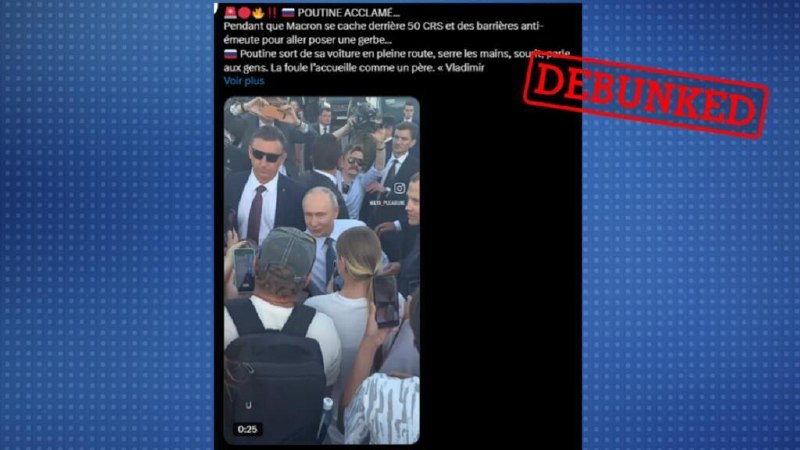
The economic line is familiar. The second story the Kremlin pushed the same afternoon is older, but also doing active work: a viral claim on pro-Russia social media that Putin travels without a security detail, an image France 24 reported on 21 August 2026 as being deployed to construct the picture of a leader beloved by his people.
Put side by side, the two stories share an editor. One is calibrated for a domestic audience already asked to hold the line on wartime spending; the other is calibrated for an external audience that consumes the war through short-form video. Read together, they describe a state managing the gap between the fiscal reality and the image it wants to circulate.
The investment pitch
The economic message is shaped for a wartime audience. According to TeleSUR English's write-up of the Council meeting, Putin identified a fresh investment cycle in industry, agriculture, services and housing as a national priority, language intended to signal that the state intends to keep directing capital even as defence spending absorbs an outsized share of the budget.
The framing matters because Russia's fiscal story of the last four years has been dominated by military outlays. To pivot the conversation toward construction sites, factories, farms and mortgage lending is to argue, in effect, that the wartime economy can also be a peace dividend. The available sources do not specify what share of the budget the new cycle will absorb, nor whether existing defence commitments are being redirected; they record only the chosen emphasis of the day.
Monexus assessment: the TeleSUR English item is a relay of Russian government language; it is presented in the cited text as government messaging rather than as independently verified reporting. That distinction does not invalidate the substance of what Putin said at the Council, but it does shape how a reader should weight the quotation.
The leader who walks alone
The second screen is older and more visual. France 24's 21 August 2026 piece, headlined "Does Putin travel without security?", catalogues a pro-Russia claim circulating on social media that Putin moves in public spaces without an entourage, a populist iconography aimed at audiences who consume the war through short-form video.
The contrast that the framing invites, as France 24 describes it, is with other world leaders who never appear in public without a security phalanx. France 24 reports that the pro-Russia accounts are using the claim to construct the image of Putin as a leader beloved by his people. France 24 does not assert the underlying proposition as fact. The cited piece records that the shared footage from Siberia shows Putin with a large security contingent present, which sits awkwardly with the pro-Russia framing the report is describing. France 24's contribution, on the evidence available, is to catalogue the claim and to flag the contradiction visible in the same footage.
Monexus assessment: the security framing thus depends less on a verifiable absence than on selective editing of footage that, in the version cited by France 24, plainly contains the contingent the framing says is not there. That gap between the claim and the underlying visual record is the story France 24 is actually reporting.
Two channels, partial overlap
The pairing is not a coincidence of news cycles. Russia has spent the better part of a decade building parallel information channels that target different audiences with overlapping messages. TeleSUR English's distribution of the Council remarks reaches a left-leaning, multipolar readership in Latin America and parts of Africa and Asia that is broadly sympathetic to Moscow's framing of the post-2014 international order; France 24's catalogue of the security claim reaches a Western, French- and English-language audience that is being asked to notice the framing in real time and discount it.
The two channels serve overlapping but not identical editorial functions. One transmits the message in essentially the form the Kremlin issued it; the other transmits a meta-message about how the Kremlin constructs its images. Read together, they describe a state that has learned to seed sympathetic outlets with content for relay, while counting on adversarial outlets to do the debunking work that, in turn, amplifies the original claim.
Monexus assessment: the two screens do not need each other to be plausible; their audiences are sorted in advance. The overlap is by design, and the channels are complementary rather than redundant.
What the day actually changes
On the merits, neither announcement is binding. Russia has talked about an investment cycle in industry, agriculture, services and housing before, and the available sources do not specify whether the fiscal mix has shifted. France 24's piece on the security claim does not establish that Putin has altered his protective detail; it records that the imagery is being staged for a particular audience and that the footage cited does not in fact support the claim.
What the day does is reset two conversations. Inside Russia, it relocates the public economic conversation from wartime sacrifice to peacetime investment, with the implicit promise that the war is a phase the economy can absorb rather than a permanent condition. Outside Russia, it circulates an image whose underlying footage, on the evidence cited, already contradicts the framing.
The honest reading is that neither screen tells the full story on its own. Read together, they describe a state trying to manage the gap between what it is doing and what it wants its citizens, and sympathetic foreign audiences, to believe it is doing. The day's most newsworthy detail is not the investment pitch, which Russia has signalled before, but the visible mismatch between the curated claim of a leader walking alone and the large security contingent visible in the same footage France 24 cites.
Desk note: Monexus framed the day's two Kremlin messages as a single rhetorical object, with economic content directed at a domestic audience and a security-image claim directed at sympathetic foreign networks. The economic claim is sourced to TeleSUR English's relay of Russian government language; the security claim is sourced to France 24's catalogue of pro-Russia networks' framing, including France 24's observation that the cited footage shows Putin with a large security contingent. The piece does not assert that Putin does or does not travel with security, and it does not treat the investment-cycle language as a confirmed fiscal programme. Where the analysis extends beyond the cited material, it is labelled in place as Monexus assessment.
Wire provenance
This editorial synthesis draws on the following public wire/social posts:
- https://www.france24.com/en/europe/20260821-does-putin-travel-without-security
- https://f24.my/C7ID.g
- https://t.me/france24_en/18311
- https://www.telesurenglish.net/putin-calls-for-new-investment-cycle-to-boost-russian-economy/
- https://x.com/TelesurEnglish/status/2090812198268334354
- https://x.com/TelesurEnglish/status/2090811158660104374
- https://www.france24.com/en/europe/20260821-does-putin-travel-without-security
- https://f24.my/C7ID.g
- https://t.me/france24_en/18311
- https://www.telesurenglish.net/putin-calls-for-new-investment-cycle-to-boost-russian-economy/
- https://x.com/TelesurEnglish/status/2090812198268334354
- https://x.com/TelesurEnglish/status/2090811158660104374