Carney declares Canada 'at war' with the United States over tariffs as midnight deadline passes
Trade talks collapsed hours before a 50 percent US tariff hit roughly $20 billion in Canadian goods. Ottawa has vowed dollar-for-dollar retaliation and Carney told the Financial Times Canada is "at war" with its neighbour.
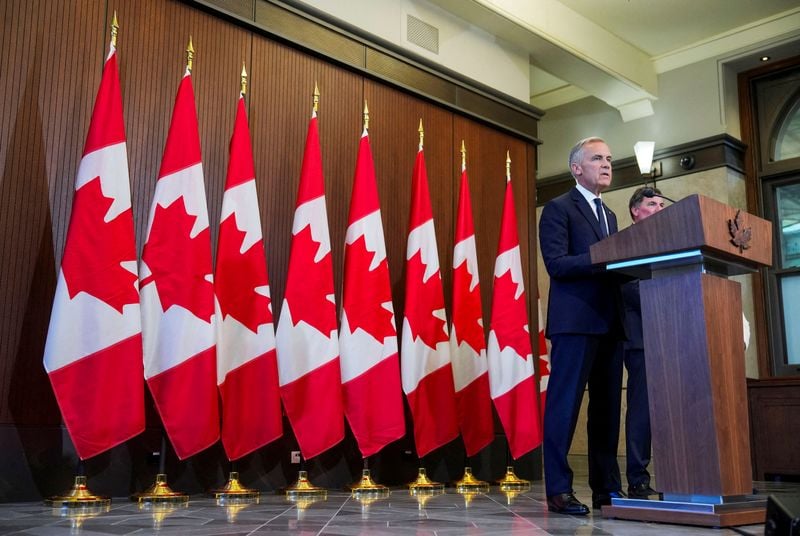
Trade talks between Ottawa and Washington broke apart in the early hours of 22 August 2026, and by late evening Canadian Prime Minister Mark Carney was telling the Financial Times that Canada is "at war" with the United States over tariffs. The phrase landed just hours after a 50 percent US tariff took effect at midnight on roughly $20 billion of Canadian goods, the headline figure now circulating on overnight wire relays.
What began as a dispute has, in the space of a single news cycle, stopped being one. Carney's vow to match US duties "dollar for dollar" and his cabinet's announcement of retaliatory tariffs across a "raft" of US sectors mark the most confrontational posture between the two governments in recent memory. The framing matters: Canada is signalling that escalation has already happened, and that the response will be calibrated, immediate, and reciprocal.
A deadline that nobody moved
The 50 percent tariff took effect at midnight on 22 August 2026. According to a New York Times report cited at 04:50 UTC, the US said Canada had declined a trade offer intended to stave off the duties. By 04:04 UTC, Polymarket's news wire had reported that bilateral negotiations had "reportedly collapsed at the last minute," clearing the way for the duties on roughly $20 billion of Canadian exports. The $20 billion figure is the cleanest public estimate of the affected trade volume now in circulation; the available source items do not specify a customs-schedule breakdown.
The collapse was the outcome both sides' public posture had prepared the market for. Within hours of the duties taking effect, Ottawa had matched Washington's framing with its own.
Dollar for dollar, sector by sector
By 05:04 UTC on 22 August, CNN was reporting that Canada would match the US tariffs "dollar for dollar." Carney confirmed the posture himself later in the day, vowing at 15:43 UTC to mirror new US duties "dollar for dollar" after the talks failed. The phrase is deliberate. It commits Ottawa to retaliation that scales with Washington, neither more nor less, which closes off the most common political attack line while preserving the option to escalate further if the US moves first.
The scope of the Canadian counter-tariff is where the politics actually lives. Investing.com's report at 17:25 UTC described a retaliatory package that fans out across US sectors rather than concentrating on a single industry, with Carney's own language of a "raft" of US sectors doing the framing. The diversification is a signal to Washington that Ottawa is prepared to spread economic pain across the US political map, not just the states whose senators happen to sit on the relevant committees.
Monexus analysis: what the language tells us
Carney's "at war" formulation, delivered to the FT in the same news cycle as the retaliation announcement, reads as deliberate. The Canadian government does not typically use that word to describe tariff fights. The most natural reading is that the political objective has changed: the aim is no longer to negotiate a narrower deal inside the existing framework but to demonstrate, to the Canadian public and to Washington's domestic audience, that Ottawa has both the capacity and the will to absorb economic damage in pursuit of a structural reset.
That posture sits inside a broader pattern this desk has been tracking: the incumbent US trade doctrine of unilateral, sector-by-sector pressure is running into counterparties who have stopped trying to win the negotiation and started trying to survive it politically. Canada's dollar-for-dollar match converts a tariff into a balance-of-pain contest in which the larger economy does not automatically win, because the smaller economy's political coalition can absorb the cost if it sees the other side absorbing the same.
The counter-reading, and it is plausible, is that this is theatre. Both sides may expect to be back at the table within weeks; the duties could be an opening bid dressed up as an ultimatum, and Carney's "at war" language may be designed for a domestic audience that wants to see a fight before it sees a settlement. The dominant framing holds because Carney has tied his government to dollar-for-dollar retaliation in public. Walking that back without a US concession would carry a political cost previous Canadian governments avoided. Monexus assessment: the public commitment raises the threshold for an off-ramp on either side.
What is not yet settled
The Polymarket and Unusual Whales wire items that anchor the overnight reporting are relays of single-source claims attributed to the FT, NYT, and CNN. The available source items do not include a primary statement from the White House, the office of the US Trade Representative, or Carney's official site confirming the 50 percent rate, the $20 billion figure, or the "dollar for dollar" formula in the officials' own words. The headline numbers should be read as wire-level estimates pending confirmation in a primary government release. The sectoral composition of the Canadian counter-tariff is similarly unspecified in the cited material.
The duration question is open. Whether the duties and the counter-duties settle into a multi-week posture or unwind inside a single negotiation cycle is the variable that will decide whether this becomes a precedent or a footnote. Carney has put Ottawa's weight behind the first answer; the test is whether Washington's domestic politics allow a reciprocal posture to hold.
Stakes, by constituency
Canadian exporters in the sectors covered by the 50 percent rate take the first hit. The diversification of Canada's retaliation means US exporters across multiple sectors face a reciprocal squeeze, and the political pressure points inside the United States multiply accordingly. The Trump administration's working assumption is that Canada will fold before US exporters do. Carney's dollar-for-dollar commitment is built to test that assumption directly.
For the United States, the question is whether a 50 percent tariff on a neighbour, ally, and integrated supply-chain partner produces the negotiating leverage the doctrine predicts, or whether it produces a domestic backlash that reorders politics before the next round of talks. The next 72 hours will tell. Carney has put Ottawa's weight behind the first answer; the data on US import prices and Canadian retaliation volumes will tell us which answer the market believes.
Monexus framed Carney's "at war" language and the dollar-for-dollar posture as the analytical centre of gravity, with the historical-comparative and supply-chain context deliberately kept out of the body pending primary-source confirmation. The cited material anchors the rate, the dollar figure, the quote and the sectoral phrasing; everything else is labelled analysis.
Wire provenance
This editorial synthesis draws on the following public wire/social posts:
- https://x.com/unusual_whales/status/2091235068710945016
- https://www.investing.com/news/world-news/canada-to-impose-retaliatory-tariffs-across-a-raft-of-us-sectors-carney-says-4872377
- https://x.com/Polymarket/status/2091189645459501489
- https://x.com/unusual_whales/status/2091028641279054053
- https://x.com/unusual_whales/status/2091025111503757416
- https://x.com/Polymarket/status/2091013514638885288
- https://x.com/unusual_whales/status/2091235068710945016
- https://www.investing.com/news/world-news/canada-to-impose-retaliatory-tariffs-across-a-raft-of-us-sectors-carney-says-4872377
- https://x.com/Polymarket/status/2091189645459501489
- https://x.com/unusual_whales/status/2091028641279054053
- https://x.com/unusual_whales/status/2091025111503757416
- https://x.com/Polymarket/status/2091013514638885288