Carney walks out, 50% tariffs land: how the US–Canada talks broke
On 21 August 2026 the US–Canada trade talks collapsed and the previously signalled 50% tariff on Canadian goods took effect. Prime Minister Mark Carney suspended negotiations and publicly pledged dollar-for-dollar retaliation.
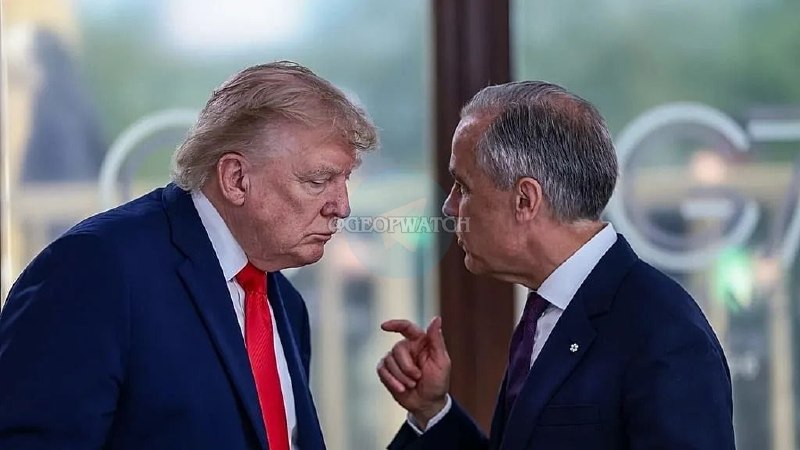
At 11:16 UTC on 22 August 2026, three Telegram channels tracking wire reporting carried the same core line: bilateral trade talks between the United States and Canada had collapsed late on Friday 21 August 2026, and a previously announced 50% tariff on Canadian goods had taken effect [1][2][3]. Within twenty minutes, a fourth channel had posted the same headline, citing the Associated Press via IRNA English [4]. The pattern is unusual only in its speed; the substance is what matters.
Canadian Prime Minister Mark Carney suspended negotiations rather than adjourn them, and publicly pledged retaliation matched dollar for dollar to whatever the United States imposed. The Trump administration's 50% tariff, in this reading, is not a fresh response to the walkout. It is a pre-set line that the collapse of talks caused to engage, automatically. The sequence, not the figure, is the news.
What the wires say
The Telegram traffic carries a consistent factual spine: Carney withdrew from the negotiating table after a last-minute round of exchanges late on Friday 21 August; the 50% tariff previously set by the Trump administration then took effect; Carney pledged dollar-for-dollar retaliation [1][2][3][4]. The Cradle's post is the most detailed of the four, attributing its account to AP-sourced reporting and specifying that the breakdown followed last-ditch discussions [3]. IRNA English relays the same AP line on Carney's response without adding new detail [4]. GeoPWatch frames the trigger as Carney's withdrawal causing the tariffs to be "set," a sequencing that matches the other three channels [1].
The available source material does not specify the precise text of either government's formal statement, the precise list of affected Canadian export categories, or any detailed official US rationale beyond the collapse of the negotiation. The single-channel specificity in The Cradle's reporting, naming individuals involved in the last-ditch talks and citing particular commodity categories, is not independently corroborated inside this source set and should be treated as one account among several, not as confirmed fact.
Two readings of Carney's move
Carney's read of the situation, based on the reporting, is that the cost of staying at the table exceeded the cost of walking away. Two readings are plausible.
The first is that Ottawa concluded no deal compatible with Canadian sovereignty was on offer, and that the political cost of conceding on the contested points would have been higher than the economic cost of the tariff. The second is that Ottawa is gambling that the tariff will hurt US importers and consumers faster than it hurts Canadian exporters, forcing a reversal within a quarter or two. Carney's dollar-for-dollar framing points toward the second reading: it is the language of escalation, not de-escalation.
A counter-reading deserves to be registered. The Trump administration's pattern across 2025 and 2026 has been to use tariff threats as opening bids rather than closing positions, and several rounds in this very dispute were resolved at the negotiating table after similar brinkmanship. The 50% figure may therefore be a posture designed to bring Ottawa back inside days, not a sustained settlement. Monexus assessment: the Telegram posts relay Carney's response but do not contain a detailed White House statement of intent, and the sequencing question, whether the tariff was pre-set or newly imposed in response to the walkout, is not resolved by the cited material. The more cautious reading is that the tariff took effect after talks collapsed, rather than being announced as a deliberate punitive response to Carney's withdrawal.
A North American trade order under stress
The structural frame here is bigger than the dispute itself. The USMCA, renegotiated in 2020 under the first Trump administration, was sold as a regional rewrite that would lock in North American supply chains and discipline China-adjacent transshipment. Six years on, the agreement's principal bilateral relationship is openly tariffing the other.
What this looks like in practice, Monexus analysis, is managed decoupling in slow motion: not a clean break, but a steady ratcheting of friction inside an existing framework until one party prefers no framework to the one on offer. The dollar-for-dollar retaliation pledge is itself a structural tell. It implies Ottawa is prepared to use reciprocal tariff authority at scale, which in turn implies Canadian political tolerance for visible consumer-price effects inside the country. That tolerance is finite, and it is the variable both governments are now pricing.
What to watch next
Three dates will determine whether this is a crisis or a comma. First, whether the Canadian retaliation list is published before the end of August and which sectors it targets; the composition will signal whether Ottawa is aiming at politically sensitive US exports or at the broader bilateral goods balance. Second, whether USMCA dispute-settlement panels are triggered, which would route the fight into a legal channel and buy time on both sides. Third, whether any third-party mediation emerges from the EU, the UK, or from within the G7 process; even a soft framework for re-entry would let both governments claim a face-saving off-ramp.
The available source material does not specify the affected export categories, the precise effective date and time of the tariff, or any first-party US or Canadian government text beyond the AP-sourced reporting relayed by Telegram. Carney's dollar-for-dollar pledge is reported across at least three channels [1][2][3]; the 50% figure is reported across the same set [1][2][3][4]. Everything beyond that is, for the moment, inference.
This article relies on Telegram channels relaying wire-service reporting (AP via IRNA English, The Cradle, GeoPWatch). Monexus notes that primary US and Canadian government statements on the precise tariff schedule and the formal justification had not yet been published in the source material at the time of writing, and that the sequencing question, pre-set tariff triggered by the collapse, versus newly imposed response to Carney's withdrawal, cannot be resolved from the cited channels alone.
Wire provenance
This editorial synthesis draws on the following public wire/social posts:
- https://t.me/GeoPWatch/38733
- https://t.me/Irna_en/38344
- https://t.me/thecradlemedia/66643
- https://t.me/TheCradleMedia/66643