Pentagon faces a thinning of the senior bench as Army Secretary Driscoll prepares to exit
The Wall Street Journal reports Army Secretary Dan Driscoll will step down by year-end after months of friction with Defense Secretary Pete Hegseth, deepening a civilian leadership gap at the Army at a sensitive budget moment.
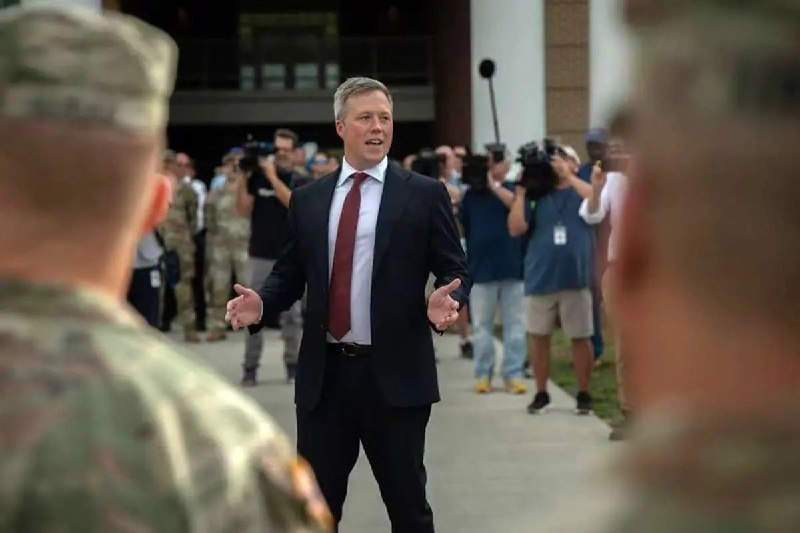
The Wall Street Journal reported on 21 August 2026 that US Army Secretary Dan Driscoll is expected to step down by the end of the year, or possibly sooner, after months of friction with Defense Secretary Pete Hegseth. The story surfaced across open-source intelligence channels within hours of publication, with the underlying Journal URL carried in the same relay chain. The exit, if confirmed on the timeline the Journal sketches, would land in a Pentagon news cycle that the cited items do not further characterise.
What the available source items establish, and what they do not, is the spine of this story. The Journal's account, as relayed, is tentative in language but firm in sourcing: people familiar with the matter, months of friction, a year-end horizon. The same relay that carries the Journal URL also notes that the Pentagon and Driscoll's representatives declined to comment, and that there has been no official confirmation of the departure. That caveat is material, and it sits at the centre of any honest read.
The story the Journal is telling
The Wall Street Journal's framing, as relayed by the Telegram channels OSINTLIVE and Clash Report, centres on a months-long personal and policy friction between Driscoll and Hegseth. The Journal, per the same relays, describes an accumulation rather than a single triggering event. The OSINTLIVE post citing OSINTDefender attributes the underlying account to the Wall Street Journal directly, with the original article URL carried in the same message thread. The Iranian state-aligned channels Al-Alam and Fars News run the same story in their own relays on the same day, both citing the Journal as the originating wire, both identifying Driscoll as Deputy Secretary of War in the wording of their Telegram posts. The US-origin relays, by contrast, identify him as Army Secretary; the cited items do not adjudicate the title discrepancy, and this article uses the title carried by the US-origin Journal relays.
The same OSINTLIVE/OSINTDefender item flags two first-party-adjacent facts that any serious read has to hold in view. The Pentagon and Driscoll's representatives declined to comment, and there has been no official confirmation of Driscoll's departure. The headline framing in the Fars News relay uses the verb "resigns" ("US Deputy Secretary of War Resigns"), while the WSJ-as-relayed framing in the US-origin channels uses "expected to step down." The difference is not stylistic. One language treats the move as fait accompli; the other treats it as a Journal-reported expectation that the principals involved will not, as of the cited reporting, confirm on the record.
The counter-read
A second reading of the same reporting is available, and the available source items do not adjudicate between them. The first reading treats Driscoll as a figure ground down by an abrasive principal, with the friction frame carrying real content. The second treats a year-end departure as a planned, orderly handover negotiated months in advance, with the "tension" framing serving as a face-saving narrative for both sides, and with the Pentagon's no-comment posture fitting a managed transition rather than a rupture. Both readings are consistent with the Journal's account as it has been relayed. Neither can be confirmed from the wire reporting alone; the difference between them is whether one believes the underlying disagreement was substantively about policy, substantively about personality, or some weighted combination.
What the cited reporting does specify is that Driscoll's plans, as of the Journal's reporting on 21 August 2026, were to leave by the end of the year "or sooner." That conditional matters. A year-end exit is a managed transition. A sooner exit, triggered by a fresh incident or a White House decision, would be something else entirely. The available source items do not specify which timeline is now operative. The Clash Report item notes only that his departure "would deepen a leadership gap in the Army," without committing to a date beyond year-end. The cited reporting does not establish that this would be a third personnel move in any defined window, nor does it characterise the size of the Army's senior civilian bench or the state of adjacent portfolios; those are framings this article does not adopt.
What the cited reporting does and does not support
A service secretary is not a ceremonial post. The Army secretary is the department's senior Senate-confirmed civilian, the principal interface with the Hill on authorisations and appropriations, and the figure who signs off on major acquisition and personnel decisions. That description of the role is structural, not source-specific. The structural consequence, Monexus analysis, is that a department running with acting or temporary leadership in adjacent portfolios absorbs another temporary arrangement on top, and that foreign defence ministries read the personnel pages of the Department of Defense the way central banks read the appointments page of the Federal Reserve. A confirmed, named, sitting interlocutor carries weight that an acting official does not, regardless of competence.
The cited source items do not specify which, if any, allied governments are currently renegotiating basing or industrial-cooperation agreements with the Army, nor do they establish that the Army is navigating recruitment shortfalls, a European rearmament cycle, or an FY 2027 budget fight on Capitol Hill. Those framings belong to wider reporting not contained in this source set, and this article does not import them. What the cited items do support is a narrower claim: that a Journal-reported expectation of a year-end exit, framed by the Journal in terms of months of friction with Hegseth, would, on the Clash Report relay's own wording, "deepen a leadership gap in the Army, which already lac[ks]" a confirmed bench across adjacent portfolios. The relay itself does not size that gap numerically.
The stakes and the next ninety days
Three signals will tell us, inside the next ninety days, whether the Journal's story is heading toward a managed exit or a disorderly one. First, whether the White House announces a successor promptly, with a clean Senate path, or whether the nomination drifts into the queue. Second, whether the Pentagon's internal communications apparatus treats Driscoll as a departing colleague with a planned handover, or as a figure already partially sidelined, and whether the no-comment posture of 21 August 2026 holds or breaks. Third, whether the next Army budget submission lands on Capitol Hill under Driscoll's signature or a successor's.
None of those three signals are visible yet in the available source items. What is visible is that the Wall Street Journal's reporting has cleared the standard bar for an upcoming personnel story: multiple sources familiar with the matter, a timeline framed in months rather than hours, and a counterparty (Hegseth) whose office has, in the relay chain as of this writing on 22 August 2026 UTC, not been reported as issuing a public rebuttal. Whether the Pentagon's press operation has been asked and declined to comment, as the OSINTDefender relay suggests, is consistent with the no-comment posture that the same relay reports.
The larger frame, Monexus assessment, is this. The United States is running a defence posture the cited reporting does not detail. The personnel layer that has to execute that posture is, by the Journal's account as relayed, about to lose one of its Senate-confirmed principals, pending confirmation that has, as of the cited reporting, not arrived. That is not, by itself, a crisis. It is, by the same token, the kind of unconfirmed expectation that Washington-watchers will spend the next quarter parsing for confirmation or denial.
Monexus framed this as a Pentagon personnel story grounded in a single wire report carried by Telegram relays, with the Journal's no-comment posture and the title discrepancy between US-origin and Iranian-origin relays flagged as material caveats rather than smoothed over. The Telegram channels converge on the Wall Street Journal's account; the original Journal URL in the OSINTLIVE thread is the authority for the underlying facts, and the Pentagon's refusal to comment is the authority for the limits of those facts.
Wire provenance
This editorial synthesis draws on the following public wire/social posts:
- https://t.me/osintlive/565869
- https://t.me/osintlive/565872
- https://t.me/ClashReport/93207
- https://t.me/alalamfa/350322
- https://t.me/farsna/457449