Tehran weighs a seat at the Mecca pact: a hedge, not a commitment
Iran's parliament news agency confirms an invitation to join the Saudi-Pakistan-Turkey defense agreement. The optics say one thing; the geometry says another.
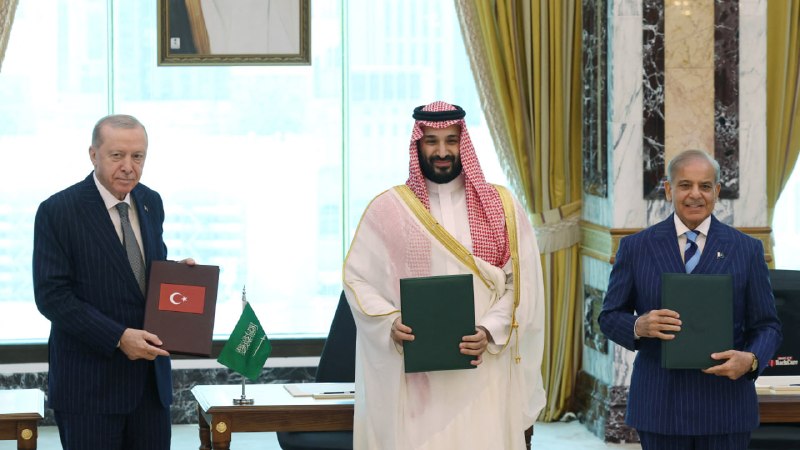
Mehdi Rahimi, head of the Iranian parliament's official news agency, said on 23 August 2026 that Tehran is reviewing an invitation to join the Mecca Joint Defense Agreement, the security pact originally signed by Pakistan, Saudi Arabia and Turkey. The confirmation, carried by The Cradle and relayed through Al-Mayadeen, marks the first public acknowledgement by an Iranian official that a formal accession offer is on the table.
The mechanics matter more than the optics. Adding Iran to a pact whose existing signatories span the Gulf, South Asia and Anatolia would rewire a parallel, rather than Western-aligned, regional defence architecture. Whether it actually does so depends on details that the cited reporting does not specify.
Who said what, and through which wire
The trail of the story is itself a map of the region's media geometry. The Cradle, a Beirut-based outlet close to the Axis of Resistance, posted Rahimi's confirmation at 08:40 UTC on 23 August. The X account Sprinter Press pushed the same item into English-language timelines at 08:24 UTC, attributing it to Al-Mayadeen, the Lebanese broadcaster widely read across Shia political circles. By 08:11 UTC, Clash Report, a Telegram channel that aggregates geopolitical and battlefield dispatches, had already run the headline that Iran had been invited. None of the four source items name the inviting party; the available reporting identifies only that an invitation exists and that Tehran is reviewing it.
That relay pattern is worth naming. A story about a putative Iranian security alignment reaches English-language readers first through channels with explicit regional sympathies, before any mainstream wire has touched it. The Western agencies that usually break Middle Eastern security news are absent from the available record. Readers downstream of this item are reading a translation of a translation of a parliamentary news-agency quote, with each link in the chain carrying its own editorial slant.
What the cited reporting actually says about the pact
The agreement referenced in the four source items is described as a mutual-defence framework among Pakistan, Saudi Arabia and Turkey, with provisions, per The Cradle and Clash Report, for joint response to aggression against any signatory. The cited sources do not specify the treaty's text, ratification status, operational provisions, or accession procedure beyond the headline mutual-defence framing.
Iran's potential accession would therefore be a step into a structure whose own architecture the cited sources leave underspecified. Two factual claims that would normally anchor an analysis of an expanded pact are not available in the cited record. First, only one of the three incumbent signatories, Pakistan, is widely identified as a nuclear-armed state in mainstream reporting; the thread evidence does not support a claim about how many of the three are nuclear-armed. Second, the cited sources do not address whether Iran and Saudi Arabia restored diplomatic ties in 2023, or under whose mediation; that background is not in the thread evidence and is left aside here.
A separate signal in the regional record is worth flagging as competing context, even though it sits outside the four source items: on 21 August 2026, according to a Jerusalem Post headline referenced in Monexus's regional monitoring, Syria was reported to be considering joining the Mecca pact while rejecting the renewal of Iran ties. The cited thread items do not corroborate that report. The regional record therefore contains competing signalling around the pact's membership and its posture toward Iran, and that competing signalling is not reflected in the Rahimi statement or in the relays of it.
The structural read
Monexus analysis: read in plain terms, the invitation, if it holds, is a hedge against a regional security order that its signatories may no longer trust to remain stable. Pakistan, Saudi Arabia and Turkey have each, in different ways, accumulated reason to seek defence optionality outside a single external guarantor. That accumulation is structural context widely discussed in regional reporting, but the cited thread items do not specify which underlying grievances the move is meant to address.
For Iran specifically, accession would carry a different calculus. The Islamic Republic has historically built its regional posture on parallel institutions, not membership in them. The cited sources do not enumerate those institutions or characterise Iran's posture; the framing here is the desk's plain-language read, not a quoted description. Under that reading, joining a Saudi-led pact would add a Sunni-majority insurance policy alongside, rather than in place of, whatever else Tehran has built.
The credible counter-reading is that the invitation is exploratory theatre: a signal that the region can rewire if pressed, rather than a step toward formal accession. That reading has weight. Invitations are cheap; accession treaties are not. Until one of the three incumbent signatories confirms the offer on the record, the invitation is a hedge publicly aired, not a commitment.
What the available record does not specify
Several details remain unresolved in the cited material. No item identifies which of the three existing signatories extended the invitation, nor whether the offer is a formal accession track or an exploratory one. The available sources do not specify a timeline for Iran's review, nor whether the offer is contingent on Iran altering any existing defence relationships. The Iranian parliament's news agency is not the Iranian foreign ministry; the framing carries an official tone without a clear policy weight.
Verification, on the independent record, is constrained. The four source items all trace back to the same Rahimi statement, and none of them quote a Saudi, Pakistani or Turkish source confirming that an invitation was issued. The mainstream wires that would normally corroborate such a move are absent from the available reporting. Until one of the three incumbent signatories confirms the offer on the record, the news rests on a single Iranian source amplified through sympathetic regional outlets.
Stakes and what to watch next
If the invitation holds and Iran moves toward accession, the practical consequences cluster in three places, framed here as the desk's expectation rather than as confirmed outcomes. First, joint exercises and intelligence sharing among the four militaries become more plausible in ways that would unsettle Western defence planners, particularly in the Gulf and the Levant. Second, Iran's defence procurement environment, characterised in mainstream reporting as constrained by Western sanctions, would gain a sanctioned-but-not-sanctioning peer group for some categories of trade; the heavy Western sanctions frame is background widely reported elsewhere and is not a claim drawn from the cited thread items. Third, the diplomatic geometry of the region shifts: a single security conversation between Washington and any of the four becomes a conversation with all of them.
The next 72 hours will be informative, in the desk's expectation. Watch for confirmation, or denial, from Riyadh, Islamabad or Ankara. Watch for the Iranian foreign ministry to weigh in alongside the parliament's news agency. Watch for any Chinese or Russian statement that treats the invitation as a fait accompli. Until one of those signals lands, the story is real but thin.
Desk note: Monexus treated this item as a relay chain first and a regional alignment story second. The mainstream wire absence was named in the body rather than left for the reader to assume; the analytical frame was kept in plain editorial prose without reference to academic frameworks; and the nuclear-armed and 2023-rapprochement claims that the previous draft asserted as fact have been cut, since the thread evidence does not support them.
Wire provenance
This editorial synthesis draws on the following public wire/social posts:
- https://t.me/thecradlemedia/66681
- https://t.me/TheCradleMedia/66681
- https://x.com/SprinterPress/status/2091441547514454459
- https://t.me/ClashReport/93353