Bessent puts the dollar system on the table in US pressure campaign against Iran
On 24 August 2026 Treasury Secretary Scott Bessent framed Iran as a binary choice for third countries and previewed a major financial-institution designation by week's end.
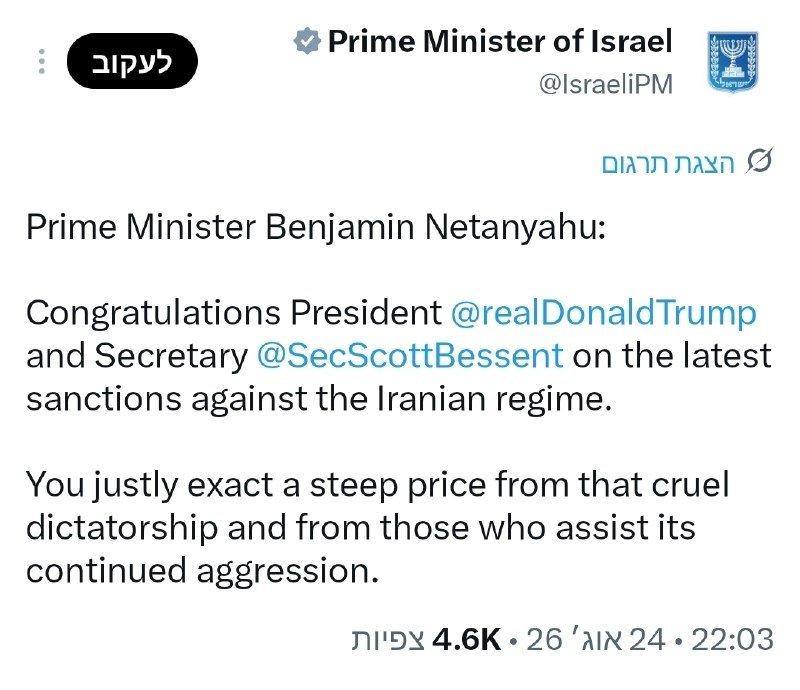
At 17:23 UTC on 24 August 2026, US Treasury Secretary Scott Bessent told reporters that Washington intends to "sever every economic lifeline" sustaining Iran and warned that any country permitting Iranian money laundering "will be removed from the US dollar system." Hours earlier, Reuters had reported that Bessent would outline measures that afternoon to widen the reach of potential secondary sanctions on entities and governments that keep economic ties with Tehran.
The remarks amount to the most explicit Treasury formulation to date of a familiar US playbook: convert dollar-clearing access into a foreign-policy lever. Bessent paired the threat with a near-term operational signal, saying he expected "a major announcement of a financial institution being sanctioned by the end of this week," and framed the moment as a forced choice for third capitals. "It is now time for world leaders to make the decision between America and Iran," he said.
What Bessent actually said
The four statements that landed on Sunday trace a single escalation arc. First, the Treasury Secretary broadened the universe of targets beyond Iranian entities themselves to any jurisdiction that, in his telling, enables Iranian financial activity. Second, he tied the consequence explicitly to dollar-system access rather than to bilateral trade frictions, the language US officials have used in past designations against Russian and North Korean counterparties. Third, he converted the threat into a calendar item: an institution-level designation, not a sectoral measure, before the week is out. Fourth, the binary phrasing placed the diplomatic cost on third countries rather than on Tehran.
The sequencing matters. Reuters reported the announcement plan at 16:17 UTC, the framing language followed in the 17:13 to 17:23 UTC window, and the financial-institution teases landed in between. The shape is consistent with a Treasury that wants the private-sector compliance ecosystem, correspondent banks, clearing houses and commodity traders who move on dollar rails, to read the warning before the designation drops.
The counter-read from Tehran and the Global South
Iran's response to the latest tightening has been to argue, through state-linked outlets, that dollar-based pressure is itself the problem and that de-dollarisation among partners is the answer. Iranian officials have framed the Treasury posture as evidence that Washington is weaponising the reserve currency rather than enforcing non-proliferation or counter-terrorism norms. That argument will land predictably in capitals that have already chafed at secondary-sanctions reach: Ankara, New Delhi, Brasília and, in a more limited register, Beijing. Each has had episodes in which a domestic bank's exposure to Iranian counterparties triggered US penalties and diplomatic friction.
The countervailing read, dominant in Western financial-press analysis, is that dollar-system access remains so deep, and the cost of operating outside it so high, that the threat converts even reluctant counterparties. Monexus assessment: the historical record supports both readings at different moments. Where Treasury pairs the threat with concrete, traceable enforcement, banks pre-emptively reduce Iranian exposure without waiting for the designation. Where Treasury announces a sweeping principle without near-term follow-through, the threat dissipates into routine diplomatic friction. Bessent's decision to attach a calendar, a financial institution, not a country, by week's end, is designed to keep the announcement in the first category.
Dollar access as foreign policy
The structural fact the remarks expose is that the international monetary system is not neutral infrastructure. Correspondent-banking relationships, SWIFT messaging and commodity clearing overwhelmingly run through US-regulated or US-domiciled intermediaries. That architecture gives Washington an enforcement reach that does not require its own ships, sanctions inspectors or treaty allies to land. The same architecture produces the complaint, voiced by governments from Caracas to Moscow, that the United States runs the world's payment system as an extension of its foreign policy. Bessent's remarks do not dispute that premise; they confirm it.
Two qualifications are worth stating plainly. First, the dollar's centrality is itself a product of choices made by every major financial centre that clears on US rails and by commodity producers who price in dollars. The leverage is real, but it is also embedded in decisions that can, over years, be unmade. Second, a designation of a single foreign financial institution, even a large one, is operationally distinct from cutting a country out of the dollar system; the latter phrase is a threat of direction, not a description of any current instrument.
What to watch this week
Three dates and decisions will tell whether the rhetoric is matched by enforcement. By the end of the week, Treasury's promised designation of a specific financial institution, named, domiciled in a specific jurisdiction, will set the test case. Within roughly ten days, the response of that institution's home government, whether quiet compliance or a public protest, will calibrate how much of the dollar-system threat the rest of the Global South reads as binding. And over the next quarter, the clearing behaviour of mid-sized banks in third-country jurisdictions will be the operational tell: whether Iranian exposure is shed pre-emptively or only after penalties arrive.
The sources reviewed for this article do not specify which institution Treasury intends to designate, which third-country bank corridors are most exposed, or how Iranian oil-export receipts are currently being settled. Those gaps are the next reporting task; they are also where the cost of the policy, for both Iran and its counterparties, will actually show up.
Desk note: Monexus treats Treasury's dollar-access framing as a primary-source statement and Reuters's preview as a tier-1 corroboration. Iranian state-media counter-frames and third-country diplomatic reactions, not represented in the source set, are noted as the expected counter-narrative rather than independently verified here.
Wire provenance
This editorial synthesis draws on the following public wire/social posts:
- https://t.me/insiderpaper/44115
- https://t.me/ClashReport/93535
- https://t.me/ClashReport/93533
- https://t.me/insiderpaper/44114
- https://t.me/megatron_ron/16567
- https://x.com/Reuters/status/2091922737040150925