Bessent launches 'Operation Economic Outcast' against Iran in dollar-system ultimatum
US Treasury Secretary Scott Bessent announced what he called an "economic D-Day" against Iran on 24 August 2026, naming five named sectors, including digital assets, in new sectoral sanctions and warning every jurisdiction still touching the Islamic Republic's money.
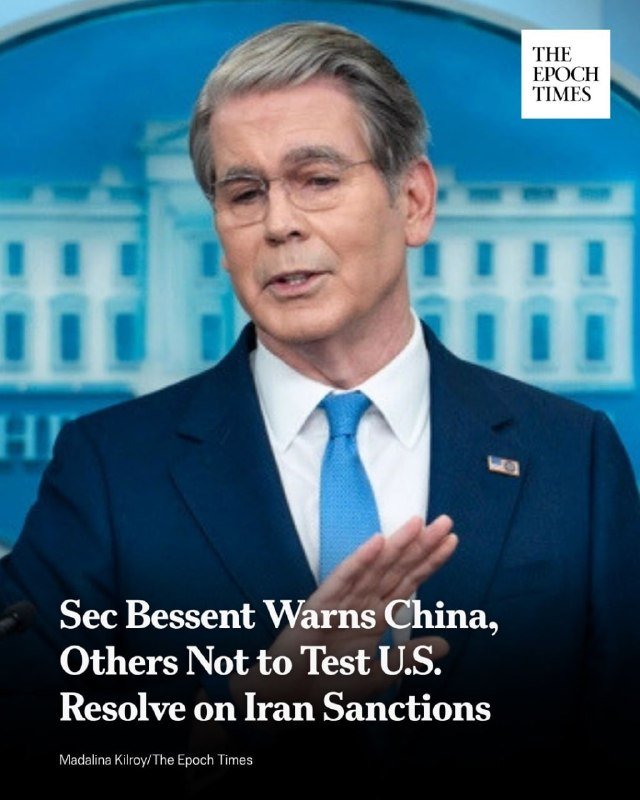
At 17:14 UTC on 24 August 2026, the Financial Times published a piece in which US Treasury Secretary Scott Bessent announced what he called an "economic D-Day" against Iran, characterising the package as the largest financial offensive ever assembled against a single adversary. Within an hour, on the Treasury podium and through written remarks circulated to outlets, Bessent put a name to the operation: "Operation Economic Outcast," launched at President Donald Trump's direction, according to relays carried by BellumActaNews, wfwitness and englishabuali between 17:15 and 17:56 UTC.
The announcement is the most explicit US articulation yet of a strategy Washington has been signalling for months: pressure Iran's access to dollar-denominated finance not only through Tehran's banks but through the third-country facilitators, digital-asset rails and shipping intermediaries that have allowed a sanctions-bound economy to keep importing dual-use goods, refined petroleum and military components. Bessent framed the new measures as a binary choice, complete global isolation and a subsistence economy for Tehran, or a path back to normalcy through compliance. He named five sectors newly in scope, digital assets, technology, gold, aviation and shipping, and warned that any entity laundering money for the Islamic Republic would be cut off from the US dollar system, with what he called "the clock" having "just started" ticking.
What Bessent actually announced
The sectoral sanctions determinations target five lifelines that Bessent said Iran exploits in other countries: digital assets, technology, gold, aviation and shipping. The "two paths" formulation echoes the language used by senior Trump-administration officials in earlier maximalist messaging on Iran. It is consistent with the secondary-sanctions architecture Treasury has built since the early 2010s, in which non-US firms that touch dollar-clearing through any US correspondent bank become exposed to designation if they transact with designated Iranian counterparties.
The Bessent statement went further than a routine sanctions designation. He addressed two non-Iranian audiences directly. To the governments of countries still trading with Tehran: "Those who enable Tehran do not discount the cost of testing Washington's resolve. No nation should expect to enjoy the rewards of the dollar system while underwriting the Iranian threat." And to Iranian soldiers, in a passage carried by wfwitness, he urged them to consider whether their commanders "are leading your country to triumph or to ruin," and recalled that "the Berlin Wall fell when ordinary soldiers decided not to shoot at their own people."
That second audience is the analytical tell. Monexus assessment: the operation is not only a financial-enforcement package. It is also a domestic political-economy operation inside Iran, designed to convert external sanctions pressure into internal unrest by threatening the regular payroll of the security services at the same time that the broader economy is being throttled.
The dollar as weapon, and what it costs third parties
The implicit premise of the operation is that the dollar remains indispensable enough to compel compliance even from adversaries. Bessent made that premise explicit in his closing warning: any entity that facilitates money laundering on behalf of Iran will be removed from the US dollar system. In a global economy where dollar pairs still dominate foreign-exchange turnover and where the SWIFT messaging layer remains anchored to dollar-clearing banks, exclusion from correspondent banking is not a slap on the wrist. It is the difference between a firm being able to settle a routine container shipment and not.
Treasury is not merely punishing Iran; it is restating the rules of dollar access for every jurisdiction that still does business with Tehran. The refining networks that process Iranian crude, the regional re-export hubs, the banking corridors that have historically absorbed Iranian transactions, and the small but growing constellation of over-the-counter desks that settle in stablecoins are now in the crosshairs the announcement implicitly draws. The FT framing, carried by wfwitness at 17:14 UTC, used the language of "largest financial offensive ever assembled against a single adversary."
Monexus analysis: the operative question is not whether Iran can be starved of dollars. Treasury has done significant damage to that end already. The operative question is whether third-country facilitators will absorb the cost of defying Washington, or whether enough of them will decide that the dollar system's gravitational pull makes defiance uneconomic. The history of secondary sanctions suggests that, given enough time, the second outcome tends to prevail. The speed with which it prevails is what the announcement is trying to compress.
What the operation is not
Three caveats belong in the room. First, the source items relay only Treasury's podium remarks and the FT column; they do not contain an Executive Order number, an OFAC designation list identifier, or a Treasury press release URL. The reporting on the operation is currently routed through Telegram channels relaying Treasury remarks and the Financial Times column, not through a primary US government document. Second, the Financial Times framing of the package as the "largest financial offensive ever assembled against a single adversary" is the FT's characterisation, not Bessent's quoted words. Third, this article has not independently established whether the central bank of Iran, the foreign ministry, or the IRGC have issued a statement in response.
A second-order counter-reading also belongs here. The same dollar-leverage operation that threatens Iran's facilitators also threatens to harden the political incentive inside China, Russia and parts of the Gulf to build alternative clearing infrastructure that does not touch a US correspondent bank. The CIPS and SPFS systems, the mBridge project, and the growing use of central-bank-held yuan and dirham balances for cross-border settlement are not theoretical. Operation Economic Outcast will accelerate them. Whether that acceleration is a net win or a net loss for US financial hegemony is the question Treasury will have to answer in retrospect; the announcement today treats it as a cost worth paying.
Stakes and what to watch
The short-term stakes are concrete and dated. The next 48 to 72 hours, in Monexus's expectation, will reveal which governments and which firms feel exposed enough to publicly announce a wind-down of Iran-linked business, and which decide to test the warning. Designation-list updates from OFAC are likely to follow within days; any digital-asset service provider that has settled even a few thousand dollars of Iranian-origin stablecoin volume is now operating under a named threat. Watch for the first publicly named non-Iranian entity cut off from a US correspondent bank in the wake of the announcement; that designation will set the precedent the operation lives or dies on.
The medium-term stakes are larger. If Operation Economic Outcast compels compliance quickly enough, it gives the Trump administration a non-kinetic win to take into the autumn, and it tightens the noose on Iran's drone and missile industrial base at a moment of regional strain. If it does not, the announcement will be remembered as the moment Treasury publicly bet that the dollar's structural primacy was intact, and lost.
This article drew on relays of the Treasury announcement carried by BellumActaNews, wfwitness and englishabuali, plus the Financial Times column at 17:14 UTC. The primary Treasury press release, the OFAC designation list, and a verified first-person Iranian response were not present in the source items at the time of publication.
Wire provenance
This editorial synthesis draws on the following public wire/social posts:
- https://t.me/BellumActaNews/176646
- https://t.me/BellumActaNews/176647
- https://t.me/BellumActaNews/176648
- https://t.me/BellumActaNews/176649
- https://t.me/BellumActaNews/176650
- https://t.me/BellumActaNews/176651
- https://t.me/BellumActaNews/176652
- https://t.me/wfwitness/108117
- https://t.me/wfwitness/108118
- https://t.me/wfwitness/108119
- https://t.me/wfwitness/108120
- https://t.me/englishabuali/78243
- https://t.me/englishabuali/78244
- https://t.me/BellumActaNews/176646
- https://t.me/BellumActaNews/176647
- https://t.me/BellumActaNews/176648
- https://t.me/BellumActaNews/176649
- https://t.me/BellumActaNews/176650
- https://t.me/BellumActaNews/176651
- https://t.me/BellumActaNews/176652
- https://t.me/wfwitness/108117
- https://t.me/wfwitness/108118
- https://t.me/wfwitness/108119
- https://t.me/wfwitness/108120
- https://t.me/englishabuali/78243
- https://t.me/englishabuali/78244