Doug Ford puts electricity and minerals on the table in US-Canada trade fight
Ontario Premier Doug Ford told the Associated Press on 24 August 2026 that Canada should be ready to cut electricity and critical minerals to the United States if the trade dispute worsens, adding that Ronald Reagan would be 'throwing up' over the current US approach.
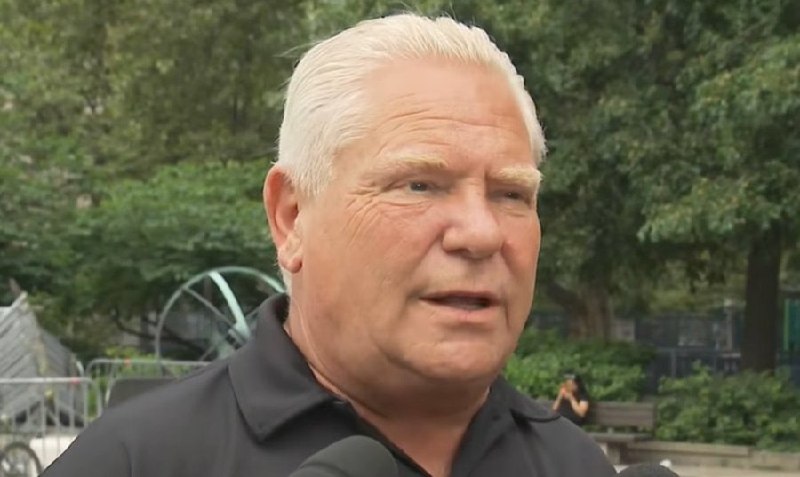
Ontario Premier Doug Ford said on 24 August 2026 that Canada should be ready to restrict electricity and critical-mineral shipments to the United States if the trade dispute worsens, and that former US president Ronald Reagan would be "throwing up" over the current US trade approach. The remarks, as carried by the Associated Press, were relayed the same day by Insider Paper, by Clash Report and by Unusual Whales on social channels.
What Ford has done is make the conditional explicit. He told AP that Canada should hold those supplies in reserve as leverage, and the available summaries describe his framing as a threat that the cutoff would come if the trade fight escalates. The supplied items do not record whether Ford named a date, a tariff line, a commodity list or a legal authority for any future restriction. They record the warning itself, the historical contrast, and the conditional wording.
What the wire summary says
The three relays that contain the central claim attribute it directly to the Associated Press. Insider Paper's post, time-stamped 15:28 UTC on 24 August 2026, says Ford "threatened to cut off electricity and critical minerals to the U.S. if the trade dispute escalates" and links to a longer read. Clash Report's post at 14:43 UTC the same day uses the more measured wording that Ford "tells AP Canada should be ready to cut electricity and critical minerals to the U.S. if the trade fight worsens." Unusual Whales on X, time-stamped 13:58 UTC on 24 August 2026, gives the same AP attribution in shorter form. The two characterisations differ in tense (threatened versus should be ready) but not in substance: both place the action in a conditional future, contingent on the trade dispute worsening.
A fourth item, also from Clash Report at 14:42 UTC on 24 August 2026, carries the Reagan quotation: Ford "tells AP that Ronald Reagan would be 'throwing up' over Trump's trade policies." That post stands alone in the supplied record; it is not paired in the same thread entry with the electricity-and-minerals remark, but it is attributed to the same AP interview.
The sourcing is narrow. Every consequential quotation in this article traces back to channels relaying an AP story. None of the supplied items is a first-party statement from Ford's office, the Ontario government or Ottawa. The available source items do not specify whether Ford made the remarks in a written statement, a sit-down interview, a press conference or a phone call with AP, and they do not contain the surrounding AP transcript.
What the supplied evidence does and does not contain
The headlines and excerpts establish three things and stop there. They establish that Ford made the conditional warning, that he framed it as a national posture rather than a purely provincial one, and that he invoked Reagan as a rhetorical contrast. They do not establish the underlying US measures that prompted the warning, the tariff rates under discussion, the affected mineral categories, electricity volumes across the border, or the legal authority a provincial premier or the federal government would invoke to restrict either flow.
It is important to note what the record does and does not say. The supplied items do not specify whether Ford was responding to a particular US action announced that day, the week before or earlier. They do not specify whether Ontario alone would act, whether Ford was speaking in concert with Ottawa, or whether other provincial premiers had taken a similar position. They do not specify whether the "critical minerals" in his framing refers to a single commodity such as nickel, lithium or uranium, or to the broader category of inputs used in batteries, semiconductors and defence production. Each of those gaps is a question the supplied evidence cannot answer; raising it as analysis is fair, asserting it as fact is not.
The Reagan quote raises a similar caveat. Clash Report attributes the "throwing up" remark to Ford via AP. The supplied item does not include AP's full question, the venue of the interview, or whether Ford offered the line as a spontaneous aside or a prepared line. The quotation is solid as a quotation. The context around it is not.
Reading the remarks as analysis
Monexus analysis: the most natural reading of the conditional wording is that Ford is broadening the bargaining space rather than announcing an operation. "Should be ready" is the language of preparation, not implementation. "If the trade fight worsens" is a contingency clause that preserves every available future path: escalation, de-escalation and a negotiated settlement. A premier who wanted to lock in a cutoff would, in our assessment, say so; a premier who wanted to keep the option open while making the cost visible tends to say what Ford said.
The second analytical move is to read the two remarks together. Electricity and critical minerals are the two trade flows that Ford's summaries single out. The Reagan line reframes the dispute as a break with the trade politics of the 1980s. Read together, the comments locate Canada's leverage in physical inputs and locate the US position outside a tradition Ford is prepared to invoke by name. That pairing is a construction Monexus finds in the supplied material; it is not stated as such by the wire relays themselves.
The plausible alternative read is that Ford's intervention is chiefly theatre for a domestic audience. On that view, the premier is signalling toughness before negotiations resume, and the specific inputs he names are illustrative rather than operational. The supplied items cannot adjudicate between those readings. They show a conditional warning with named commodities; they do not show a plan attached to it.
Where this leaves the dispute
Ford's office controls Ontario's electricity and mining files at the provincial level. The supplied reporting does not specify the scope of that authority over cross-border flows, over commodities in transit, or over federal jurisdiction in trade matters. Whether the federal government in Ottawa would have to act in parallel, under Canadian trade or national-security statutes, is a question the supplied items do not address.
The structural frame, in plain editorial language, is a bilateral relationship in which leverage is being advertised rather than concealed. For decades, supply chains between the two countries have been treated as facts of geography rather than instruments of policy. By placing electricity and minerals inside a political warning, even conditionally, Ford is treating those flows as something a premier can speak about publicly in the context of a trade dispute. That change in register is the practical news of the day, regardless of whether a cutoff follows.
Monexus assessment: the strongest supported claim is also the narrowest one. Ford made a conditional warning on 24 August 2026, attributed to him by AP and relayed through three channels; he framed it as national leverage and paired it with a Reagan reference. Anything beyond that sentence, the commodities affected, the volume at stake, the legal authority required, the US measures being answered, lies outside the supplied record and should await first-party documentation before being treated as established.
Desk note: Monexus treated the supplied posts as relays of Associated Press reporting rather than as primary documents, separated Ford's conditional threat from any implemented cutoff, and excluded unsupported figures, legal claims, and operational details not present in the thread.
Wire provenance
This editorial synthesis draws on the following public wire/social posts:
- https://t.me/insiderpaper/44108
- https://t.me/ClashReport/93500
- https://t.me/ClashReport/93499
- https://x.com/unusual_whales/status/2091887752409432293