Ontario's Ford escalates Canada-US trade fight, threatens energy and critical-minerals leverage
Doug Ford publicly floats sanctions on electricity, fuel and uranium exports to the United States, warning that Trump tariffs aim to dismantle Canada's auto sector.
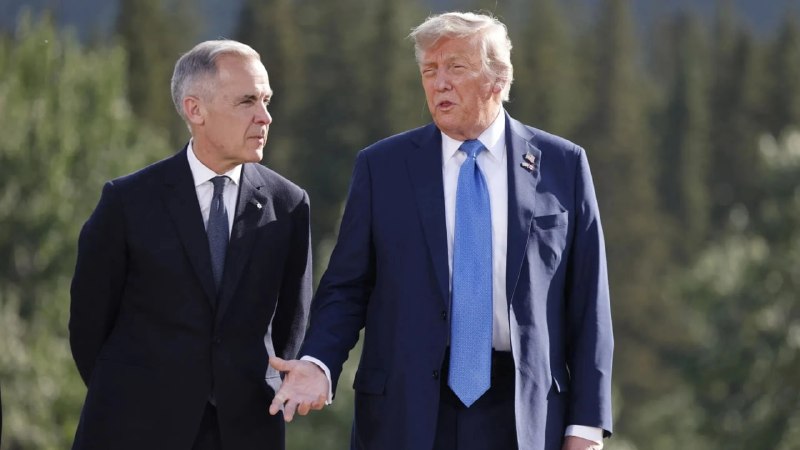
At 18:48 UTC on 24 August 2026, the Telegram channel Megatron carried what it framed as Ontario Premier Doug Ford's retaliation menu against the United States, including "sanctions on electricity, fuel, uranium." Roughly twenty-two minutes later, the Osinttechnical account on X posted a clip of Ford aimed at President Donald Trump. By 20:28 UTC, The Cradle's Telegram feed was summarising the dispute as an open trade war, with Ontario "ready to cut energy, critical minerals" to the United States. By 21:50 UTC, Reuters had posted video of Ford arguing that Canada must "stand up" to US trade pressure.
The simplest reading is that a provincial premier is publicly floating a retaliation package that would hit the United States at several infrastructure chokepoints Ontario happens to control. The harder reading, and the one Monexus finds more useful, is that this is a stress test of an integrated North American supply chain, with rhetoric calibrated for a domestic audience but pointed at Washington.
What Ford actually said
Two distinct lines surfaced in the available source items, and they need to be separated. The first is a personal insult aimed at the US president. According to the Osinttechnical post on X, relayed by the Osintlive Telegram channel at 19:10 UTC, Ford said he had "a lot of real estate on my ass, so he has a lot of room to kiss my ass." The Megatron Telegram channel carried the same phrasing at 21:07 UTC, again without specifying venue or fuller context.
The second line is the policy threat. Megatron's earlier 18:48 UTC post summarised Ford as saying Canada would "throw everything" at the United States, including sanctions on electricity, fuel and uranium, and that Canada would "put massive pain" on Trump. Reuters video at 21:50 UTC quoted Ford separately arguing that the tariffs hurt Americans as well as Canadians, and that Canada must "stand up" to the US pressure. The Cradle's 20:28 UTC framing added that Ford accused Trump of trying to "destroy" Canada's auto industry and "move it south" across the border.
A third flourish surfaced at 21:41 UTC from the Polymarket account on X: that Ronald Reagan, the historical standard-bearer of US free-trade Republicanism, would be "throwing up" over Trump's tariff policy. That post carries no direct verbatim confirmation of a Ford quote beyond the original characterisation.
The source ledger does not specify the press venue, the audience or the full transcript of any Ford appearance on 24 August 2026. What it does establish is that, across at least four independent channels operating between roughly 18:48 and 21:50 UTC, Ford deployed both personal invective against Trump and a substantively specific set of threatened countermeasures spanning electricity, fuel, uranium and the auto sector.
Why the auto sector is the centre of gravity
Ford's claim that Trump is trying to "destroy" Canada's auto industry and relocate it south of the border, as summarised by The Cradle, locates the dispute in a specific industrial sector rather than in generalised trade friction. The available source items do not specify the exact tariff schedule, the product codes or the Section 232 authority under which any duties might have been imposed. They do specify that the contested object is Canadian-assembled automotive trade.
That framing maps onto a familiar North American pattern. The integration of Canadian and US auto manufacturing under NAFTA and its successor USMCA was built around cross-border supply chains for steel, aluminium, batteries and finished vehicles. A tariff regime that lands on Canadian-assembled vehicles without exempting the inputs that flow back and forth inside the integrated chain treats a single sector as if it were a discrete national industry. Ford's argument, as relayed, is that this is structurally self-defeating for the United States, not a manoeuvre against a foreign competitor.
The leverage menu, in Monexus reading
Three categories of retaliation are now publicly on the table. The source items themselves name them: electricity, fuel (read narrowly as petroleum products refined in or exported from Canada) and uranium. "Critical minerals" appears in The Cradle's framing without further specification in the available items.
Beyond that inventory, the analysis that follows is this publication's reading, not a deduction from the wire evidence. Ontario is one of Canada's largest provinces by both population and industrial output, and it sits on the industrial corridor that includes much of the country's auto assembly, refining capacity and mining. The leverage claims of recent trade-war rhetoric from the province depend on assets that the sources name but do not quantify: grid interconnections, uranium reserves, refined-product flows, and battery-mineral supply. The available items do not specify the share of US electricity, fuel or uranium supply that originates in Ontario, nor the operating status of named refineries, mines or processing facilities.
Monexus assessment: the credibility of Ford's menu depends on assets the source evidence does not size. The threat is genuinely specific in category (electricity, fuel, uranium, critical minerals) and weak in the data the public is being asked to take on faith. That gap between named assets and quantified leverage is itself the story.
The counter-read: deterrence as theatre
The most plausible alternative reading is that the public menu is calibrated for a domestic audience and not a prelude to actual disruption. Three reasons support that view, none of them spelled out in the source items but consistent with what those items describe.
First, the on-camera insult and the sanction list serve different audiences. Cable-news insult travels inside Canada; a credible threat of energy disruption travels inside Washington. The mix is consistent with a premier performing strength for one electorate while signalling seriousness to another, without committing to either.
Second, the broader Ontario-Canada framing matters. The available items report Ford speaking alone; they do not establish whether the federal government in Ottawa has endorsed, rejected or merely received his threat. Provincial premiers in Canada do not unilaterally control cross-border energy contracts, and the federal cabinet has historically been the formal trade-war actor. Ford's rhetoric, on the available evidence, is provincial.
Third, the political arithmetic points toward performance. A provincial Progressive Conservative leader visibly standing up to Washington costs little at home and burnishes his brand before the next election. The source evidence does not specify polling, but the cross-partisan Canadian consensus against tariffs is well established and the political upside of the rhetoric is correspondingly broad.
Both readings can be partly right. The threats may not be carried out; they may nonetheless raise Washington's cost-of-next-escalation. That is how trade-war signalling typically works, and the available evidence is consistent with that pattern even if it does not prove it.
What to watch next
Three markers will distinguish rhetoric from administrative preparation. First, any retaliatory tariff list from the federal Canadian government, which would convert a provincial threat into a national instrument. Second, the public posture of the US automakers who operate in Ontario; their quiet lobbying in Washington has historically been the most effective brake on earlier escalations. Third, any draft Ontario legislation authorising restrictions on cross-border electricity sales, which would convert a press appearance into an administrative track.
The larger arc is one that has run through earlier US tariff fights: duties announced as leverage on a specific irritant end up reshaping integrated supply chains that took decades to build. The source evidence cannot tell us whether that is now happening to the North American auto sector, only that a provincial leader has decided to make it the visible fight of the week.
The desk note: where wire coverage frames the Ford-Trump exchange as personality theatre, Monexus reads it as a stress test of an integrated North American supply chain. The category list, electricity, fuel, uranium, critical minerals, is more consequential than the quoted insult, even though the source items quantify none of it.
Wire provenance
This editorial synthesis draws on the following public wire/social posts:
- https://x.com/Reuters/status/2092006535136158081
- https://t.me/thecradlemedia/66742
- https://t.me/megatron_ron/16570
- https://t.me/megatron_ron/16571
- https://t.me/osintlive/566435
- https://x.com/Polymarket/status/2092004270266859551