Beijing defends Iran trade as Clinton warns of US munitions strain
China's Foreign Ministry spokesperson defended Beijing's Iran cooperation as a matter of international law, on the same morning Hillary Clinton publicly questioned whether Washington has the stockpiles to sustain its pressure campaign.
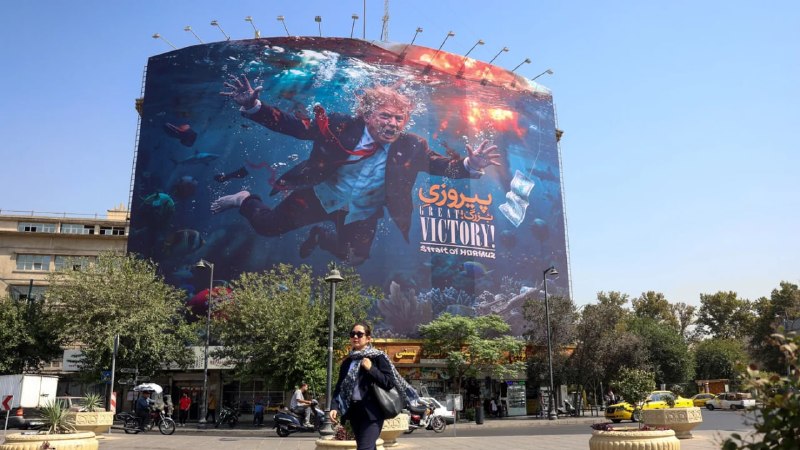
At 08:44 UTC on 25 August 2026, the Open Source Intel channel on Telegram reposted a statement from a Chinese Foreign Ministry spokesperson defending Beijing's cooperation with Tehran. The spokesperson said the relationship "falls within the framework of international law" and should not be interfered with, and the channel framed the line as a response to a US "economic war declaration" on Iran. About thirty-five minutes earlier, the Clash Report channel had posted remarks attributed to Hillary Clinton arguing that the United States had "wasted" munitions in Iran and that the Islamic Revolutionary Guard Corps, not the clerical establishment, effectively runs the country. Both sets of remarks circulated again at 08:44 UTC via Open Source Intel.
The two messages, distributed within a tight window on the same morning, capture the split-screen nature of the moment. Beijing is publicly attaching itself to Iran's economy on a day when Washington's pressure campaign is being openly second-guessed in US political commentary. The thread evidence does not specify the venue or forum for either intervention; the available sources show only the circulated text.
Beijing's framing
The Chinese MFA line, as posted, carries the diplomatic vocabulary of long-standing Chinese practice: international law, non-interference, opposition to unilateral sanctions. The phrasing is familiar. What is harder to read from the cited posts alone is the venue. The Open Source Intel excerpt does not specify whether the spokesperson spoke at a regular MFA press conference, issued a written release, or answered a specific media question, and does not name the spokesperson.
The structural reading, per Monexus analysis: by treating Chinese-Iranian cooperation as a sovereign prerogative grounded in international law, the MFA line provides rhetorical cover for commercial actors who keep transacting under existing frameworks. The post frames the MFA statement as a response to a US "economic war declaration" rather than as a stand-alone policy announcement; the cited excerpt does not specify whether the "economic war" label originated with Chinese state media or with the US side, and this article has not independently established the origin. The MFA statement reads as commercial cover for sanction-era trade in either case.
Clinton's two warnings
Clinton's remarks, posted at 08:09 UTC on 25 August via Clash Report and again at 08:44 UTC via Open Source Intel, combine a public-policy critique with a statement about stockpiles. The cited posts do not specify the venue, whether the remarks came from a single appearance, or whether the two passages were delivered together.
On munitions, she argues the United States has "wasted" stockpiles against Iran and "sent a lot" to Gulf allies, who in turn "have used it to defend themselves," leaving Washington "in a difficult position." On Iranian agency, she argues that anyone who knows "anything about Iranian history" or how the IRGC operates will recognise that "they run the country. The clerics" do not.
Read together, the two passages argue that US policy has been out-paced by both the IRGC's command structure and the material demands of Gulf defence. The cited posts do not specify whether the munitions warning reflects an official US stockpile assessment or a single political voice; the framing rests on Clinton's words as quoted by the two Telegram channels.
Why the timing matters
The two interventions land on the same morning by way of channel aggregation, not necessarily by design. Beijing's MFA line and Clinton's remarks may have been produced hours or days apart and assembled into a single news moment by the channels that reposted them. The cited posts do not specify the original timing of either intervention.
What the thread does support is a structural observation, per Monexus assessment: a hegemonic order calibrating the gap between announced policy and durable capacity. Beijing's MFA line states the principle of non-interference in plain terms. Clinton's remarks state the inventory problem in plain terms. The two together describe, from opposite vantage points, the same underlying question about whether Washington's announced posture can be sustained.
Stakes and what to watch
The next 48 to 72 hours will be informative. Monexus expects the MFA line to harden if Washington imposes secondary measures on Chinese entities; equally, any Iranian announcement of new IRGC-supervised procurement channels would test whether the IRGC's role, as Clinton described it, is being institutionalised rather than rolled back.
What remains contested in the available sources: whether Clinton's munitions warning reflects official US stockpile anxiety or a single political voice, and whether the Beijing statement marks a hardening of policy or routine affirmation. The cited posts do not specify the MFA venue or spokesperson identity, and they do not specify the original forum or date of Clinton's remarks. Reuters, AP and AFP will be the cleanest triangulation points for both.
The take-away is less about who is winning the Iran file than about who is reading it correctly. Beijing is reading it as a sovereignty dispute. Clinton is reading it as a production and stockpiling problem. US policymakers will have to decide which of those two frames better describes the position Washington actually holds, and act before the gap between frame and fact widens further.
Desk note: where wire coverage of the same events tends to treat Beijing's statement as defensive and Clinton's remarks as commentary, Monexus reads both as operational signals within the limits of the cited thread. The MFA phrasing functions as commercial cover for sanction-era trade; Clinton's inventory warning reads as a constraint map on what US escalation can credibly deliver. The cited posts do not specify venues, spokesperson identity, or original timing for either intervention, and this piece reflects that uncertainty rather than smoothing over it.
Wire provenance
This editorial synthesis draws on the following public wire/social posts:
- https://t.me/osintlive/566534
- https://t.me/osintlive/566532
- https://t.me/osintlive/566531
- https://t.me/ClashReport/93592
- https://t.me/ClashReport/93588