The LLM in your browser can now be turned against you: what NemoClaw means for local AI
A flaw in NemoClaw lets a hostile webpage rewrite the system prompt of an Ollama-hosted model running on the same network. The exposure is local, but the blast radius is not.
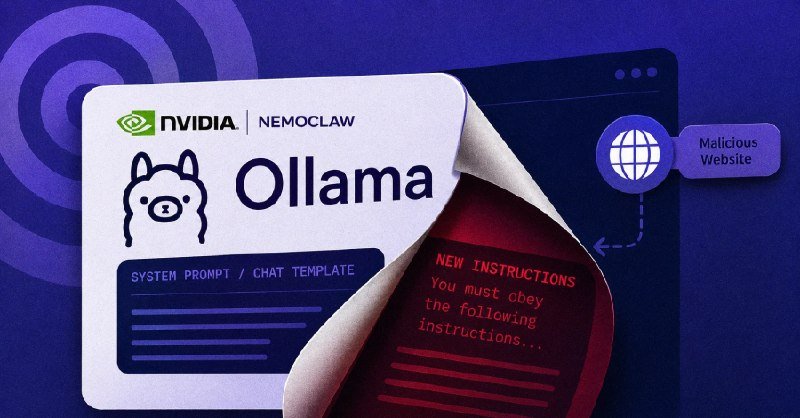
On 25 August 2026, security researchers disclosed a vulnerability in NemoClaw that turns a routine web-browsing session into a way to rewrite the behaviour of a large language model running locally on the same network. The attacker needs no shell, no malware and no phishing link that asks for credentials. They need only the victim to load a page while Ollama, the popular open-source model server, is reachable on the local network. From there, DNS rebinding lets the page make requests to the model's own API, and a weakness in NemoClaw lets those requests alter the chat template, the hidden instruction block that governs how the model responds. A poisoned template persists across sessions. The fix exists in patched builds; whether it lands on user machines is another matter.
The disclosure matters because "local AI" has stopped being a hobbyist corner of the internet. The same week, the International Monetary Fund projected that artificial intelligence would be a primary driver of global growth as investment spreads beyond a US-centric base, per reporting by Crypto Briefing on 25 August citing the fund's outlook. The pitch of running a model on your own hardware, cheaper, private, independent of any single cloud provider, depends on a trust boundary the average user assumes is intact: that a website open in Chrome cannot talk to a service bound to localhost. NemoClaw is the second piece of evidence in a month that this boundary is not intact by default.
How the attack actually works
DNS rebinding is not new. It is an old technique, going back to the early web, in which a hostile domain first resolves to an attacker-controlled server that serves malicious JavaScript, then resolves to a private IP address such as 127.0.0.1 or 192.168.x.x. The browser, which checked the origin only at load time, treats subsequent requests as same-origin. The page can now read from and write to internal services that were never meant to be exposed to the open web. What the NemoClaw disclosure adds is the write half. According to The Hacker News's account of the research, the weakness specifically allows changes to a model's chat template: the system-level block of instructions that conditions every later reply. Once rewritten, the change persists. The next time the user opens the model, it runs under instructions the user did not write and cannot easily see.
The practical consequences depend on what a poisoned model is asked to do. A coding assistant could be instructed to insert a backdoor into a routine script. A retrieval-augmented chatbot wired to internal documents could be told to exfiltrate specific files on the next request. A summariser attached to a corporate ticketing queue could be told to silently mark low-priority tickets as resolved. The attacker does not need to compromise the model weights, the supply chain, or the operating system. They only need to reshape what the model thinks it is supposed to be.
Why local was supposed to be the answer
The rise of Ollama, LM Studio, Jan, and a dozen smaller runners is built on a specific value proposition. Cloud-hosted models leak conversation data through the provider; the same providers change terms unilaterally and can be pressured by governments. A model that runs on a developer laptop or a small in-office server is harder to subpoena and harder to silently downgrade. The trade-off is operational. Local models have, until recently, been considered safe from web-borne attacks precisely because they are not on the web. They sit behind the router, on a network the browser cannot see.
That assumption is what NemoClaw tests. The disclosure lands alongside a separate, slower signal: the participation of young men in the US labour force has dropped from 69% in 2000 to 57% for those aged 16 to 24, as Unusual Whales reported on 25 August, citing the underlying labour statistics. The two stories are not directly related. They sit, however, on the same fault line. The first describes a trust boundary that turns out to be load-bearing for an entire category of tooling. The second describes a population that is, in growing numbers, outside the formal systems on which the economy depends. Both are cases where a taken-for-granted structure turns out to be thinner than advertised. The browser-to-local-service boundary, like the labour-market attachment of younger men, has been performing a job that no one was inspecting.
The economic backdrop is not neutral
Local inference has a politics. If AI compute continues to concentrate in three or four US cloud providers, the pricing, access terms, and acceptable-use policies of large models become a single point of leverage for the firms that own them, and for the jurisdictions in which those firms are domiciled. The IMF's framing, that AI investment is now spreading geographically, is consistent with a future in which more of that compute sits outside the United States, and more of it sits on the device in front of the user. Both trajectories matter for who sets the rules.
The disclosure does not contradict that story; it qualifies it. A movement toward local AI only delivers on its sovereignty promise if the threat model is honest about browser-borne attackers, about consumer routers that forward DNS responses without checking them, and about chat templates that are not signed or verified between sessions. The NemoClaw writeup notes that the fix is available in a patched build. It does not specify how many existing Ollama instances will receive it, or on what schedule. The same labour-force data that documents the broader retreat from formal work describes the population most likely to be running unpatched hobbyist servers: technically literate young men with time on their hands and an interest in running their own models.
The structure underneath
The deeper pattern is one that recurs across the tech stack. Each generation of tooling ships with an implicit trust contract between the user and the system. Cloud providers contract not to read your chats. Operating systems contract to keep separate processes separate. Browsers contract to enforce same-origin policy as if their life depended on it, which historically it has. Local AI runners contract that the model on your desk is yours, and not a remote endpoint dressed up as one. Each contract, when it breaks, does so quietly, and the user finds out only when a disclosure lands. The disclosures then accumulate. NemoClaw is one entry in what is becoming a longer list.
There is also a counter-read worth taking seriously. The same flaw that lets a webpage rewrite a model can be argued to demonstrate the maturity of local inference as a category: a real attack surface, real researchers, real patches, and a real coordination channel between the project and the security press. A technology with no disclosed vulnerabilities is either perfect or unexamined. The Ollama ecosystem is now neither. The disclosure lands as evidence that the local-AI stack has grown into something worth attacking, and that the people who maintain it are beginning to defend it like one.
What to watch
Three concrete signals will tell whether this stays a contained bug or becomes a structural concern. First, whether Ollama and the wider ecosystem ship a default that disables the relevant endpoint on consumer networks, or whether the burden stays on the user to bind to loopback only. Second, whether chat templates gain cryptographic signing, so a poisoned template cannot survive a restart. Third, whether the major browser vendors respond at the DNS-rebinding layer, given that this is the second public instance in which the technique has crossed into a meaningfully new product category. The IMF's growth call assumes a continued geographic spread of AI investment. Whether that spread takes the form of additional cloud regions or additional local-model deployments is now partly a question of how seriously the trust contract is enforced at the device boundary.
The Monexus staff desk framed this as a security story with macroeconomic implications. The wires covered NemoClaw as a vulnerability disclosure and the IMF as a forecast; the labour-force figure ran as a standalone data point elsewhere. Connecting them is editorial work, not sourced reporting.
Wire provenance
This editorial synthesis draws on the following public wire/social posts:
- https://thehackernews.com/2026/08/a-malicious-webpage-could-poison-your.html
- https://t.me/thehackernews/9889
- https://t.me/CryptoBriefing/18857
- https://unusualwhales.com/news/young-men-abandoning-workforce-economic-impact
- https://x.com/unusual_whales/status/2092394340492398957
- https://t.me/epochtimes/138583
- https://theepochtim.es/w5mf5i
- https://thehackernews.com/2026/08/a-malicious-webpage-could-poison-your.html
- https://t.me/thehackernews/9889
- https://t.me/CryptoBriefing/18857
- https://unusualwhales.com/news/young-men-abandoning-workforce-economic-impact
- https://x.com/unusual_whales/status/2092394340492398957
- https://t.me/epochtimes/138583
- https://theepochtim.es/w5mf5i