Iran's security chief pairs oil-sales claim with Netanyahu threat in single evening
In a roughly ninety-minute span on 27 August, Major General Mohsen Rezaei rejected an alleged Iranian plot against Trump's son, claimed oil sales had returned to pre-sanctions levels, and said Iran would 'send Netanyahu to hell.'
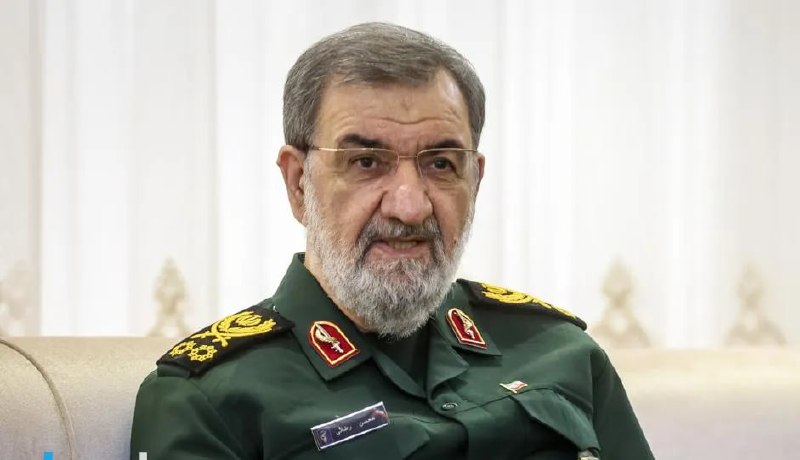
At 19:23 UTC on 27 August 2026, the English-language account of Tasnim News, the outlet tied to the Islamic Revolutionary Guard Corps, posted a video of Major General Mohsen Rezaei, the secretary of Iran's Supreme National Security Council, rejecting claims of an Iranian plot to assassinate the son of the United States president. Within the next hour and a half, four Iranian state-aligned channels posted overlapping English-language versions of his remarks, which fused three discrete messages: a denial of the alleged plot, a warning that Iran would target American economic interests "with intensity and force" if a US blockade continues, and the declaration that Iran would "send" Israeli Prime Minister Benjamin Netanyahu "to hell" (https://t.me/tasnimnews_en/32895, https://t.me/presstv/204432, https://t.me/wfwitness/108522, https://t.me/presstv/204434, https://t.me/osintlive/567486, https://t.me/presstv/204438).
Read in tandem, the messages are not the improvisation of a single news cycle. They are a packaged statement aimed at three audiences at once: a denial for Washington paired with an economic threat, an insult for Tel Aviv, and, for a domestic Iranian audience still absorbing sanctions, a softer commercial claim that crude exports have "returned to pre-sanctions levels" and that floating reserves are being unloaded (https://t.me/osintlive/567487). The combination is the work of a security apparatus that has learned to choreograph escalation in single-paragraph soundbites.
What the channels actually carried
The English-language posts cluster between 19:23 and 21:01 UTC. The earliest item on the list is a video on Tasnim News English of Rezaei reacting to what the channel framed as claims of an Iranian plot to assassinate Trump's son, captioned by the outlet as a response to allegations Rezaei rejected in full (https://t.me/tasnimnews_en/32895). A second Tasnim English video on the same subject follows at 19:33 UTC (https://t.me/tasnimnews_en/32896). PressTV's English-language account posts its own item at 19:30 UTC carrying the economic threat and the Netanyahu line alongside the oil-sales claim (https://t.me/presstv/204432), and repeats the economic threat at 20:10 UTC (https://t.me/presstv/204434). War and Witness, an Iran-aligned channel, posts a text summary at 20:04 UTC characterising Rezaei as denying the alleged assassination plot (https://t.me/wfwitness/108522). Open Source Intel carries two posts at 20:58 UTC, one quoting the Netanyahu threat and a separate post carrying the oil-sales claim (https://t.me/osintlive/567486, https://t.me/osintlive/567487). PressTV posts the Netanyahu line at 21:01 UTC (https://t.me/presstv/204438).
The visible English-language markup across these posts is consistent. The threats are framed in the wording of the originating outlets, the clip captions are short, and the original Farsi delivery appears to have been transcribed and posted within minutes. For all the noise, the subtext is measured: no specific target, no timetable, and no operational detail accompanies any of the threats on the cited channels. The language is calibrated for headlines rather than for planners.
The oil claim inside the threats
The line most easily missed in the cascade is also the one with the most operational weight. Rezaei said Iran's "level of oil sales has returned to pre-sanctions levels; in addition to unloading floating reserves," and the available source material frames floating-reserve drawdowns and the pre-sanctions comparison as related but distinct points rather than as a single quantitative assertion (https://t.me/osintlive/567487). The English paraphrase implies ongoing loading of crude onto the market through channels that have absorbed US secondary sanctions in past enforcement cycles. The published English-language posts do not specify which methodology or baseline Rezaei is citing, nor whether "pre-sanctions" refers to the period immediately before the Trump administration's 2018 withdrawal from the JCPOA or to a different reference period.
Independent tanker-tracking firms and the US Treasury's Office of Foreign Assets Control are the public arbiters of Iranian export volumes, and neither is referenced in the cited posts. Monexus assessment: the most natural reading is that the oil claim is intended to do diplomatic work in the same room as the threats, signalling that the sanctions architecture has thinned enough to be worth boasting about in English on state media. Whether the figure will survive independent verification is a separate question the cited posts do not settle.
A pattern, not an outburst
The shape of the day's messaging fits a longer arc in which Iranian officials have paired bellicose statements with quiet commercial ones. The threat to Netanyahu is the headline. The boast that oil is moving, even if provisional, is the working argument. Each item is built for a different reader, and together they suggest a sequence: provoke first, then prove that the pressure is no longer binding.
Whether that read is correct depends on three things the cited posts do not establish. First, whether independent tracking confirms the export rebound Rezaei describes. Second, whether the US naval posture and secondary-sanctions enforcement described by Western wire reporting remains as tight as the blockade framing implies, or whether it has, as the Iranian claim suggests, become porous enough to move pre-sanctions volumes. Third, whether Israeli officials treat the rhetoric as escalation or as the background noise that has long accompanied the shadow war between the two countries. The available source items do not specify any of these.
What to watch in the next seventy-two hours
Three calendar items will determine whether 27 August becomes a flare or a turn. First, whether Iran's oil customers in Asia receive any official guidance from Tehran on September volumes, the cleanest test of whether the export claim has operational substance. Second, whether the US Treasury issues any new designations on Iranian shadow-fleet operators, which would indicate that Washington believes the blockade is still binding. Third, whether Israeli officials respond in kind or absorb the rhetoric as the cost of doing business with a sanctions-battered adversary. The cited posts do not specify any of these moves.
The most useful read is also the most cautious. The threats are calibrated for headlines. The oil claim is calibrated for negotiators. The room Tehran believes it still has to manoeuvre is the gap between the two.
How Monexus framed this: the wire will lead with the Netanyahu threat and stop there. We held the threat to the same prominence, gave equal weight to the oil-sales claim that accompanied it, and read the package as a deliberately sequenced signal rather than as a spontaneous outburst.
Wire provenance
This editorial synthesis draws on the following public wire/social posts:
- https://t.me/presstv/204438
- https://t.me/osintlive/567487
- https://t.me/osintlive/567486
- https://t.me/presstv/204434
- https://t.me/wfwitness/108522
- https://t.me/tasnimnews_en/32896
- https://t.me/presstv/204432
- https://t.me/tasnimnews_en/32895