Doha and Tehran sit down in Tehran, with a Hormuz corridor on the table
Qatar's Prime Minister Sheikh Mohammed bin Abdulrahman Al Thani met Foreign Minister Abbas Araghchi in Tehran on 27 August 2026. Iranian readouts name a proposed joint temporary maritime corridor through the Strait of Hormuz and continued Qatari mediation as the two items on the table.
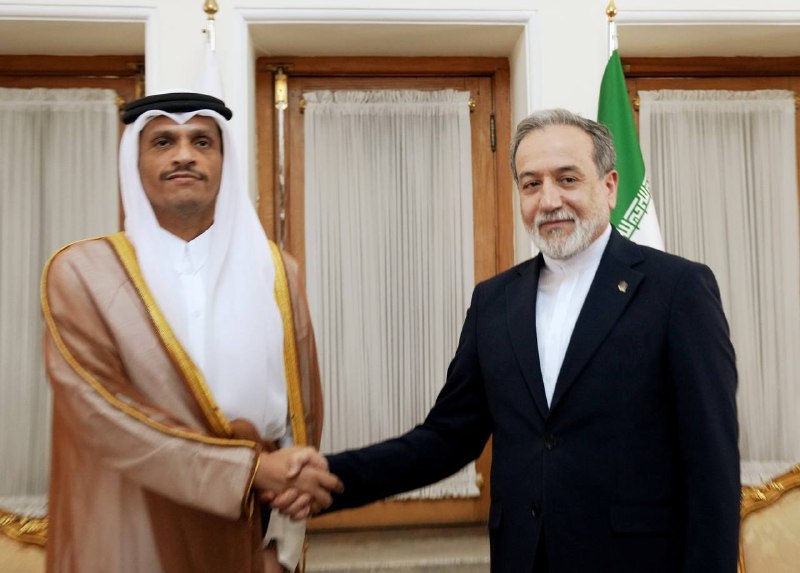
Qatar's prime minister and foreign minister, Sheikh Mohammed bin Abdulrahman Al Thani, met his Iranian counterpart Abbas Araghchi in Tehran on the morning of 27 August 2026, according to readouts circulated by Iran's state-aligned outlets. Press TV posted the encounter at 10:47 UTC, Tasnim put out an English-language account at 10:31 UTC and again later in the morning, and IRNA filed its Tehran-datelined English item by 11:40 UTC. The clustering of posts, three Iranian-aligned channels publishing in parallel within roughly an hour, is itself part of the story.
The Iranian readouts put two items on the table. Tasnim's English dispatch describes discussions covering a proposed phased framework for a joint temporary maritime corridor through the Strait of Hormuz, and records Qatar's foreign ministry emphasising sovereignty and freedom of navigation in the same passage. IRNA's Tehran-datelined English item frames the meeting around the continuation of Qatari mediation and regional de-escalation, and singles out what it characterises as Qatar's commendable efforts in recent months to help prevent an escalation of regional tensions after what the same IRNA framing calls military aggression by the US and the Israeli regime against Iran.
What the Iranian readouts actually say
Tasnim's English dispatch sets out the substantive content most explicitly. It describes discussions covering a proposed phased framework for establishing a joint temporary maritime corridor through the Strait of Hormuz, and records Qatar's foreign ministry emphasising sovereignty and freedom of navigation in the same passage. IRNA's Tehran-datelined English item, timestamped to the 11:40 UTC window, frames the meeting around the continuation of Qatari mediation and regional de-escalation, and singles out what it characterises as Qatar's commendable efforts in recent months to help prevent an escalation of regional tensions after the US and Israeli action against Iran earlier in the year. Press TV's post, timestamped 10:47 UTC, names the meeting and provides Press TV's own video without adding new substantive claims beyond what Tasnim and IRNA report. The 10:31 UTC post in the available cluster is a Tasnim English item, not a Press TV item.
Taken together, the available items describe a meeting at which two named topics were on the table, not a closed bilateral with no disclosed content. That distinction matters: Gulf-Iran readouts of this kind usually issue a single sentence of boilerplate and a date. Two named subjects in parallel, on the same morning, is closer to message discipline aimed at an outside reader than to routine courtesy.
Doha's widening portfolio
Al Thani now holds both the prime ministership and the foreign affairs portfolio, a consolidation reflected in how the Iranian readouts title him. The merged role makes Doha's Iran channel faster to convene: a single figure can speak for the Emir on a mediation file and for the foreign ministry on the maritime file without coordinating two separate offices. Tasnim and IRNA both refer to him as prime minister and minister of foreign affairs in the same breath.
The Strait of Hormuz corridor proposal is the more striking item, because it is the kind of arrangement that requires buy-in from outside the room. A joint temporary corridor, phased in, implies a working-level mechanism with both Iranian and Qatari involvement in traffic management, escort coordination, or some combination of the two. Doha has the diplomatic standing to convene such a process and the financial weight to underwrite parts of it. Tehran has the geography.
Reading the message, with caveats
Monexus assessment: the most natural reading of the Iranian decision to publish a named agenda in English, within an hour of the meeting, is that Tehran wanted an outside audience to see both the maritime file and the mediation track as live, simultaneous items, rather than as a single negotiation packaged under one label. Putting the corridor proposal in writing also forces any future party to the conversation to respond to a defined text rather than to a vague aspiration. That is a communications choice, not a policy commitment; the available items do not specify that any other government has formally agreed to the framework.
A plausible alternative read is narrower: Iran is signalling to Washington, through a Qatari carrier, that it is willing to talk about shipping security in the Gulf without preconditions, while reserving the right to keep characterising earlier US-Israeli strikes as aggression. IRNA's framing of the meeting as a continuation of mediation after that action supports that interpretation. What the available items do not establish is whether Doha is acting on its own initiative, on behalf of a Gulf bloc, or as a back channel for a Western capital. The Qatari foreign ministry's public emphasis on sovereignty and freedom of navigation is consistent with each of those readings and does not by itself discriminate between them. Reporting outside the Telegram cluster this article is built on, including items headlined as a Qatar-Iran discussion of a temporary shipping corridor through the Strait of Hormuz dated 26 August 2026, suggests that the corridor proposal has been the subject of regional reporting before today's meeting, which weakens the case for treating 27 August as the proposal's first public airing; the available Telegram items do not specify that temporal sequence and Monexus has not independently verified the dating of those external reports.
What is missing from the public record
Two gaps are worth flagging. First, the Telegram cluster this article cites does not contain a Qatari-government readout or a Western-wire confirmation of the corridor framework in the same specific terms; the substantive content above comes from Iranian state-aligned outlets (Tasnim, IRNA, Press TV) and one OSINT channel (Clash Report), each relaying material that originated with the Iranian foreign ministry. Second, the available items do not specify whether the meeting produced a communiqué, a follow-up date, or named working-level contacts. The Iranian readouts describe the substance but not the procedural shape of what comes next.
The next pressure points sit outside this meeting. Any readouts from Doha, Riyadh, or Washington within 48 to 72 hours that confirm, modify, or reject the corridor framework will retroactively define what 27 August was for. The sources cited here do not specify that such movement is imminent, and this article has not independently established whether one trajectory is more likely than another. What is on the public record is narrower than it has been for previous Gulf-Iran sit-downs: two named subjects, two officials, and a corridor that, if it works, would put Qatar and Iran in the same room on shipping for the first time in a defined format.
How Monexus framed this: the available source items are Iranian-aligned Telegram channels (IRNA, Tasnim, Press TV) plus one OSINT channel (Clash Report). The article quotes the named agenda items from those sources and labels them as Iranian readouts rather than as confirmed bilateral outcomes. The Western wire line, a Qatari first-party readout, and the broader regional reporting on the corridor proposal, if they land in the next 24 hours, will turn the day's reporting into a story with a verifiable second voice and a clearer timeline.
Wire provenance
This editorial synthesis draws on the following public wire/social posts:
- https://t.me/Irna_en/38624
- https://t.me/tasnimnews_en/32805
- https://t.me/tasnimnews_en/32799
- https://t.me/presstv/204380
- https://t.me/presstv/204371
- https://t.me/ClashReport/93857