South Lebanon strikes logged, but the major wires went quiet
On 27 August 2026 the south-Lebanon open-source channels logged Israeli strikes on Nabatieh, Qantara, Al-Mansouri and the Al-Dubsha heights within ninety minutes. The provided source set for the day contains no corresponding major-wire bulletin in the same window.
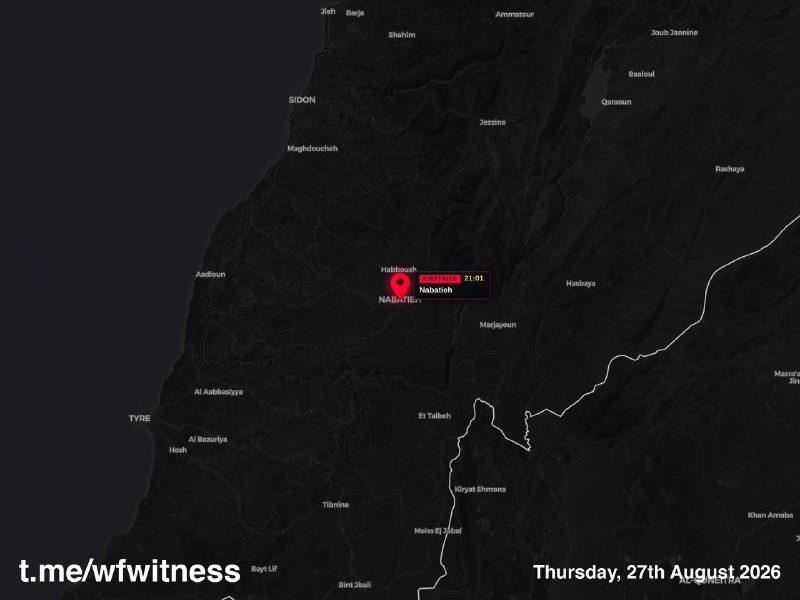
At 18:02 UTC on 27 August 2026, the open-source channel wfwitness logged an Israeli airstrike on Nabatieh in southern Lebanon. By 18:15 UTC two more strike notices had cleared: multiple airstrikes on the outskirts of Qantara, and a separate strike on Nabatieh al-Fawqa. By 18:35 UTC a large explosion was observed in Al-Mansouri, attributed by the channel to Israeli demolition activity. At 19:16 UTC a further strike was recorded on the Al-Dubsha heights. Four towns, seventy-four minutes, one Telegram channel logging all of them.
The asymmetry worth examining is editorial. The provided source set for 27 August contains six open-source items, five of them strike logs from wfwitness and one a Polymarket post about Google Maps renaming Lake Ontario that wfwitness-adjacent channel WarMonitors amplified at 18:59 UTC. The same input file contains no corresponding Reuters, AP, BBC or AFP item naming those four towns in that window. Whether that absence reflects wire behaviour on the day, an incomplete research set, or both is something Monexus cannot establish from these materials. What the materials do show is who is doing the public timestamp-and-geolocate work on the southern front right now.
The tempo, in plain sequence
Read in order, the wfwitness dispatches from 27 August describe a mechanical cadence. Airstrike on Nabatieh at 18:02 UTC. Multiple strikes on Qantara outskirts at 18:15 UTC. Strike on Nabatieh al-Fawqa, also at 18:15 UTC. Demolition blast in Al-Mansouri at 18:35 UTC. Strike on the Al-Dubsha heights at 19:16 UTC. Each item is timestamped to the minute and geolocated to a named town. None of the items specifies which unit struck, what was targeted, or whether the IDF Spokesperson issued a parallel statement within the same window. The available source items do not specify that.
The channel war-monitoring ecosystem has been the de facto public ticker for the Israel-Lebanon border since the cross-border phase of the war reopened in late 2023. That context is structural, not editorial. The single-day question is narrower: on 27 August, within the seventy-four-minute stretch from 18:02 to 19:16 UTC, the only public geolocated strike logs in the source set are Telegram-channel logs. The major-wire entries that would normally accompany such a sequence are absent from the same input file.
Reading from a thin file
The narrow claim the evidence supports is descriptive: the strike-by-strike narrative for the southern front on 27 August is being written, in the public record, by open-source channels. This publication's assessment: that is the pattern, and it carries consequences that compound over weeks. Coverage that builds from the wire layer treats a strike on a town already inside the active combat zone as a data point inside a larger aggregate, not as a discrete event. Coverage that builds from the channel layer treats each strike as a discrete event with no aggregate behind it. The two streams do not aggregate each other in real time, and the audience ends up reading two different wars.
The Polymarket contract on Google Maps renaming Lake Ontario, flagged on WarMonitors at 18:59 UTC, is a useful control case. It is the kind of small, vivid, platform-native artefact that travels far in English-language feeds. The five south-Lebanon strike logs are equally vivid but harder to fold into a pre-existing narrative. Whether one or the other received more algorithmic reach in the same news cycle is something the materials in this set do not measure. The honest finding is that a Polymarket market price and a series of confirmed strike logs were sitting in the same input file within seventeen minutes of each other, and only one of them comes pre-formatted for the way English-language homepages run.
What the channels cannot do, and why that matters
Open-source channels have a sharp edge and a known discipline gap. They timestamp and geolocate; they sometimes get the actor wrong; they almost never supply context on the political or military logic of the strike. The wfwitness items for 27 August do not specify the unit, the target class, or whether the IDF Spokesperson issued a parallel statement. The available source items do not specify that. They also do not specify whether Hezbollah fired inbound projectiles that triggered any of the strikes, an absence that matters because the military rationale for any individual air action depends on the inbound picture.
This is the trade-off the wire layer is paying for. Speed versus verification, and verification against a duty desk that is itself operating in a contested information environment. Channels that publish in minutes cannot wait for that desk. Wires that wait for the desk cannot match the minute-by-minute tempo. The southern front has been running long enough that the gap between the two streams is structural, not episodic. A reader who learned about 27 August from the channel layer knows the time, the place, and almost nothing about the why. A reader who waited for the wire layer, in this source set, learned almost nothing at all.
What stays unverified, and what changes that
Three things would re-anchor the day's tempo in the mainstream record. A single wire bulletin out of Beirut or Jerusalem naming one of the four towns. An IDF Spokesperson statement parallel to any of the channel timestamps. A Hezbollah claim of responsibility for inbound fire that triggered the strikes. None of these appear in the source set for 27 August. Monexus's independent verification of the strike-log sequence itself runs only as far as the channel's own timestamps and geolocations; whether each item corresponds to a confirmed air action on the ground is something the materials in this set do not establish. The available source items do not specify.
The honest read is that 27 August is a case study in where the public record of the southern front is currently being written. It is being written in feeds that punch above their verification weight, in a media environment that often rewards the punch line more than the verified sentence. The four towns logged between 18:02 and 19:16 UTC are either the day's news for the southern front, or a partial sketch of it. Either way, the record in front of the reader is the channel record until something heavier lands.
Wire provenance
This editorial synthesis draws on the following public wire/social posts:
- https://t.me/wfwitness/108506
- https://t.me/wfwitness/108508
- https://t.me/wfwitness/108509
- https://t.me/wfwitness/108515
- https://t.me/wfwitness/108519
- https://t.me/WarMonitors/45376