$220 million in long positions liquidated in one hour as Bitcoin's Coinbase premium flips positive
Traders lost roughly $220 million in the hour ending 16:41 UTC on 28 August 2026, almost entirely from long positions. Hours earlier, on 27 August, a CryptoQuant-cited indicator on Bitcoin had turned positive for the first time in 40 days.
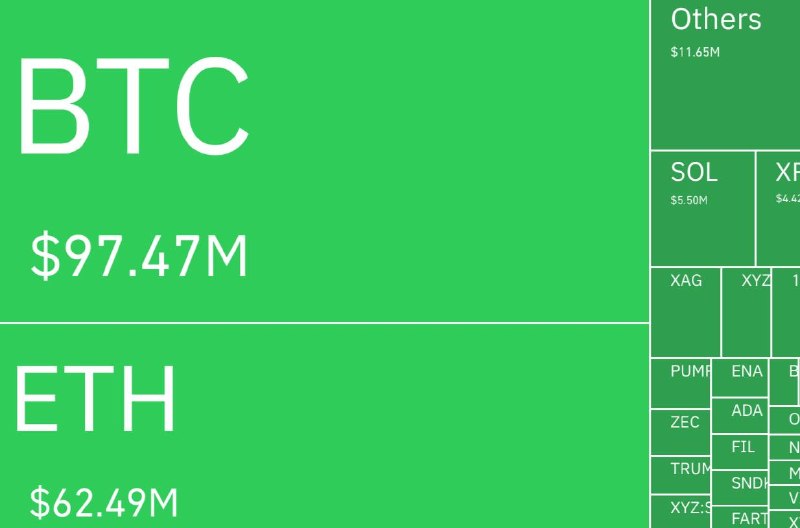
Crypto traders lost roughly $220 million in the hour ending 16:41 UTC on 28 August 2026, with the bulk of the damage falling on long positions, according to a Cointelegraph alert posted to its Telegram channel that afternoon. Hours earlier, on 27 August at 17:46 UTC, the same channel reported that Bitcoin's so-called Coinbase premium, the gap between Bitcoin's price on Coinbase and on offshore venues, had turned positive for the first time in roughly 40 days, citing a CryptoQuant analyst.
The pairing is the story. A $220 million one-hour wipeout on the long side is, on its face, a bearish print. A flip to a positive Coinbase premium is, on the same face, a bullish one. They arrived within a day of each other, and the contradiction is the editorial point. Markets this leveraged do not always move on macro logic; they move on positioning, and positioning can be cleared out before the macro view catches up.
The one-hour reckoning
Cointelegraph's alert, posted at 16:41 UTC on 28 August, characterised the $220 million in losses as flowing "mostly from long positions." That framing is consistent with how forced-selling cascades typically read: when leveraged longs are margined out, the resulting market sells deepen the move, which margin-calls the next tier of longs, and so on until the order book finds buyers willing to absorb the flow. The cited post does not specify the venue mix (which exchanges were hit hardest) or the trigger (a specific price level, a cascade from a large wallet, or a broader risk-off move), and this article has not independently established those details.
What can be said is the magnitude. A $220 million one-hour loss event is well above the median hourly clearing number for the asset class. Monexus assessment: the most parsimonious reading is that leverage had built up on the long side into the latest leg of price action and was cleared by a routine pullback, not a structural break. The cited post does not specify whether the $220 million figure is gross trader losses, net realised losses, or notional value of positions closed.
The Coinbase premium flips
Roughly 23 hours before the liquidation alert, at 17:46 UTC on 27 August, Cointelegraph reported that Bitcoin's Coinbase premium had turned positive for the first time in 40 days, citing a CryptoQuant analyst. The premium is a rough proxy for the gap between US retail-and-institutional flow and offshore flow: when it is positive, US buyers are paying up relative to the rest of the world; when it is negative, the inverse holds. A 40-day stretch in negative territory implies sustained selling pressure or distribution from US-based accounts, or alternatively, weaker US demand relative to offshore spot.
A flip to positive therefore reads as renewed US bid. The signal is well-watched but not definitive; the metric is sensitive to which venues are sampled and to Coinbase-specific factors (fees, payment rails, custody flows into and out of the exchange). The plain reading is that the marginal US buyer returned sometime in the prior session. The contrarian reading is that the premium can flip briefly on relatively thin order flow, particularly around US market open, before reverting.
The juxtaposition with the next day's liquidation print is the editorial hook. The window surrounding a $220 million flush of leveraged longs also saw the US-flow indicator turn. That can be reconciled: forced selling of one cohort of leveraged longs, and a return of spot demand from a different cohort of buyers, are not mutually exclusive events. Monexus assessment: the most parsimonious reading is that leverage was cleared, not that the directional view flipped.
Regulatory and macro underlay
Two other threads from the same week help frame the regime. On 26 August at 14:22 UTC, Cointelegraph reported that the US Securities and Exchange Commission is preparing an overhaul of crypto custody rules for investment advisers, clarifying how firms can hold digital assets for clients. On the same day at 12:41 UTC, the channel carried the second estimate of US Q2 GDP: an annualised 1.5%, unchanged from the initial reading.
The custody-rule story is structural. An adviser regime that has, for several years, been uncertain about whether advisers can hold client crypto at all, is moving toward a defined framework. That is the kind of slow institutional plumbing that does not move an hourly tape but does, over quarters, change who can allocate to the asset class. The unchanged GDP print is the kind of macro data point that, on its own, does not move crypto much; the second estimate matching the first reduces one source of uncertainty around the Fed path without changing it.
On 27 August at 07:39 UTC, Cointelegraph carried a quote from CZ, the principal associated with Binance, stating that "Bitcoin will be more important than gold." The statement is a directional opinion from an industry principal, not a market-moving data point, but it captures a view widely held among long-duration crypto holders and worth flagging in a week when the gold-versus-Bitcoin framing is being re-litigated by large allocators.
Outside the price tape
Two non-market items from the same window are worth recording. On 28 August at 13:00 UTC, Cointelegraph reported that HM Revenue & Customs counted 240 UK crypto millionaires in the 2024–2025 tax year, with the group reporting a combined $975 million in capital gains, per the cited post. The figure is reported here as the Telegram excerpt presents it: the available source item states the number as "$975M in capital gain" without further unit or currency specification in the truncated text, and this article has not independently reconciled the number to first-party HMRC releases or to alternative press coverage that may cite a different currency or scope. Readers should treat the headline figure as the channel's stated number, not a verified pound-sterling or US-dollar aggregate.
On 27 August at 18:11 UTC, Cointelegraph reported, citing Axios, that the United States is "reportedly close to a deal for an ownership stake in Venezuelan oil fields holding 90 billion barrels of proven reserves." That item is geopolitical rather than market-related, but a US stake in 90 billion barrels of proven reserves is the kind of headline that can move the energy complex and, indirectly, the inflation expectations that feed back into risk-asset pricing.
What remains uncertain
The cited posts do not specify the venue mix behind the $220 million one-hour liquidation, the magnitude of the Coinbase-premium flip in basis points, the unit or currency convention behind the HMRC figure, or whether that figure reflects realised gains on disposals or unrealised mark-to-market. The source items also do not state whether the reported $220 million is gross trader losses, net realised losses, or notional value of positions closed, and this article has not independently established which of those definitions applies. The StarkWare quantum-safe Bitcoin transaction reported on 27 August at 03:24 UTC is a separate technical item that does not bear on the liquidation tape but is worth noting as a datapoint on the security-roadmap debate.
The single most useful thing a reader can take from this week is that the leveraged-long cohort is being pruned while the spot-bid cohort is, on at least one measure, returning. That combination is more often the precursor to a continuation move than to a reversal, but the cited posts do not specify the next 48 to 72 hours, and Monexus makes no forecast beyond flagging the next US macro prints and any further Coinbase-premium updates from CryptoQuant as the obvious things to watch.
This piece sits inside the crypto desk's standing brief: report what the wire said, label what is analysis, and let the contradiction between a $220 million long flush and a positive Coinbase-premium flip stand on its own. The desk deliberately avoided any framing that treats the liquidation as either a top signal or a non-event without source material to support the call, and flagged the HMRC figure as the channel's stated number rather than a verified currency aggregate.
Wire provenance
This editorial synthesis draws on the following public wire/social posts:
- https://t.me/Cointelegraph/71830
- https://t.me/Cointelegraph/71818
- https://t.me/Cointelegraph/71825
- https://t.me/Cointelegraph/71819
- https://t.me/Cointelegraph/71789
- https://t.me/Cointelegraph/71787
- https://t.me/Cointelegraph/71804
- https://t.me/Cointelegraph/71800