Fedorov to advise Italy's Crosetto on defence innovation, Il Foglio reports
Il Foglio says former Ukrainian defence minister Mykhailo Fedorov has accepted an advisory post with Italian defence minister Guido Crosetto on adopting wartime-era defence technologies.
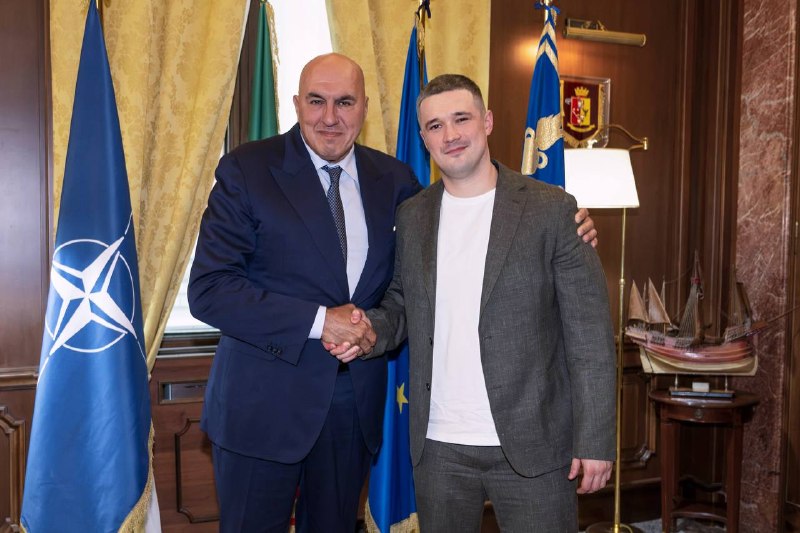
The Italian daily Il Foglio reported on 28 August 2026 that Mykhailo Fedorov has accepted a proposal from Italian Defence Minister Guido Crosetto to serve as an adviser on defence innovation, according to the Telegram channels that relayed the story in the hours that followed. Within the European afternoon, the open-source monitor Status-6, the Italy-watch channel noel_reports, the war-tracker Clash Report and Kyiv Post's official channel had all carried versions of the same announcement.
The move is small in personnel terms and large in what it signals. The Telegram channels uniformly identify Fedorov as "former Ukrainian Defense Minister," a phrasing that does not by itself resolve whether he remains in his current post or has left it. The available source items do not specify Fedorov's present status inside the Ukrainian government. What they do say is that he has agreed to advise Crosetto on how Italy adopts "modern warfare technologies," a phrase that recurs across the relays without further elaboration. The advisory slot, on the evidence available, places him inside one of NATO's southern-tier governments at a moment when Rome has preferred to play industrial-convener rather than matériel-donor.
What the available reports actually say
The thread items converge on three points. Il Foglio, cited by Status-6's open-source feed, frames the appointment as Fedorov agreeing "to be an advisor to the Italian Minister of Defense on defense innovation." noel_reports, citing Il Foglio, adds the detail that Crosetto made the proposal and that Fedorov has accepted it, describing the role as "Italy's innovation adviser." Clash Report's relay adds Fedorov's own characterisation: that he will "help Italy adopt modern warfare technologies." Kyiv Post's channel Kyivpost_official frames the brief more assertively, saying Fedorov "will help Italy develop new defense technologies while continuing to work" in his Kyiv portfolio.
The four relays differ in tone more than in substance. Il Foglio's original framing, as relayed, is the most neutral; Clash Report and Kyiv Post lean harder into the operational language. What the thread items do not specify is the contractual length of the engagement, whether the role is paid or honorary, where Fedorov will be based, whether he will retain his Ukrainian cabinet post in parallel, or whether the Italian defence ministry has issued a formal press release. The available source items contain none of those details, and this article has not independently established them. Readers should expect them to surface, if at all, in a follow-up statement from the Italian defence ministry.
The man and what the labels do and do not tell us
The Telegram posts describe Fedorov consistently as "former Ukrainian Defense Minister." That label is the only public role the thread evidence attaches to him. It does not say when he held the defence portfolio, when he left it, or whether he holds any other portfolio now. Kyiv Post's framing implies a continuing Kyiv mandate; the other three relays do not contradict that, but neither do they confirm it. The available source items do not specify whether Fedorov is currently a sitting minister, a former minister advising from outside government, or something in between. Until the Italian defence ministry publishes terms of reference, or Fedorov issues a personal statement, that ambiguity will remain.
What the thread evidence does not establish is any of the biographical detail that other public coverage of Fedorov has carried in recent years. The reader should treat the role-description in the Telegram relays as the only role-claim this article can stand behind, and the "former" prefix as the only status-claim. Monexus has not independently verified Fedorov's wider career chronology from the items in hand.
Why Rome, and why this matters
Italian defence policy under Crosetto has been publicly cautious on unmanned systems and on the procurement reform that the war in Ukraine has made harder to defer. Bringing in a Ukrainian figure who, on the evidence of the relays, frames himself as a translator of "modern warfare technologies" is a politically legible way for the minister to attach his modernisation file to an operator with wartime credentials, without yet taking on the Italian defence-industrial lobby directly.
The reading does have a counter-narrative worth naming. Italian procurement reform has stumbled for the better part of two decades over the gap between ministerial rhetoric and what the country's fragmented industrial base can actually absorb. An advisory mandate, on the evidence available, does not change which Italian firms win which contracts, or how the EU's Permanent Structured Cooperation framework channels funding. The dominant framing, Fedorov as a vector for wartime software into Italian doctrine, holds only if his mandate is allowed to touch procurement. On the thread evidence, it is not yet clear that it will be.
A second counter-narrative runs through the same news cycle but does not appear in the thread items in hand. Other coverage earlier in the summer, dated 25 July 2026 and identified by the independent audit as AnewZ, UA.NEWS and The Star, described Crosetto's approach as an offer to an "ousted" Ukrainian counterpart, and used "offered" rather than "appointed" language. The Telegram posts in this thread, by contrast, describe the role as accepted and, in Kyiv Post's case, as an "appointment." Monexus cannot reconcile those two readings from the thread evidence alone. The simplest working assumption is that the offer reported on 25 July 2026 is the same offer Fedorov has now accepted, but the political context around his departure from the Ukrainian defence ministry is not addressed in the thread items and is not asserted in this article.
Assessment: a corridor, not yet a programme
Monexus assessment: what this announcement opens, more than what it resolves, is a corridor. Italy gains a relationship with a figure the Telegram posts describe as a former Ukrainian defence minister. Crosetto gains a visible reform partner whose own framing of the role, per the relays, is to help Italy adopt modern warfare technologies. Fedorov gains a NATO-government platform. The Ukrainian government, on Kyiv Post's reading, gains a southern-European institutional foothold in a country that has been more politically supportive than operationally engaged.
What remains uncertain is whether the advisory role carries the institutional weight to bend Italian procurement outcomes, or whether it will read better in communiqués than in contracts. The available source items do not specify how much of Fedorov's time the role will consume, whether he will relocate to Rome, or how his present portfolio, whatever its precise title, will be reshaped around the additional load. Those details will determine whether this becomes the software-defined version of Italy's post-2022 contribution to the European defence conversation, or another short-cycle headline that ages quickly. Watch for the Italian defence ministry's first follow-up announcement; that is where the substance will either arrive or fail to.
Desk note: Monexus treated this as a sourcing-led confirmation of a single Italian daily's report, propagated through Telegram channels that explicitly attribute the underlying reporting to Il Foglio. The Il Foglio article itself appears as a URL in the thread but its full text is not reproduced in the items in hand; the article's quotations of Il Foglio's framing are therefore drawn from the Telegram relays' paraphrases, not from Il Foglio's own words. Biographical claims about Fedorov's earlier roles and the precise political context of his departure from the Ukrainian defence ministry are not entailed by the thread evidence and have been left out or, where they could not be left out, flagged as unspecified.
Wire provenance
This editorial synthesis draws on the following public wire/social posts:
- https://www.ilfoglio.it/esteri/2026/08/28/news/fedorov-sara-consulente-per-linnovazione-dellitalia--405939
- https://t.me/osintlive/567749
- https://t.me/noel_reports/51840
- https://t.me/noel_reports/51839
- https://t.me/ClashReport/94044
- https://t.me/Kyivpost_official/39175