Lake Ontario, Now Lake America: A Renaming in Search of a Reason
The U.S. Geological Survey has rebranded a Great Lake on a presidential signature. The order lands in the same week that trade talks with Ottawa collapsed, and the symbolism is doing most of the work.
On 27 August 2026, the U.S. Geological Survey updated its electronic records to refer to Lake Ontario as "Lake America," with printed documents to follow over the coming days. The change was ordered by President Donald Trump in the same week that U.S.–Canada trade talks collapsed, according to initial reporting, and was trailed the same day by a separate remark in which Trump publicly raised the prospect of renaming the Atlantic or Pacific Oceans next.
The order itself is short. The symbolism is long. A body of water shared by two countries has been unilaterally rebranded on one side of the border, by executive fiat, with no consultation from Ottawa reported in the available sources. The move lands less as geography than as a tariff in another form: a reminder that the bilateral relationship is being rewritten in the vocabulary of grievance, not commerce.
What the order actually does
The USGS renaming applies to its own naming database and to the documents, maps, and publications that flow from it. Canadian maps, charts, and federal references will continue to call the lake Ontario. The lake itself, of course, has not moved. The administrative change is more a posture than a fact.
In practical terms, the change touches U.S. federal documents first. State agencies, academic publications, and commercial mapmakers will adjust over time, but none are bound to do so. What the order does not specify, on the available evidence, is how the renaming will be reflected in U.S. agencies that share data with Canadian counterparts, or whether any provision exists for restoring the prior name.
The Canadian counter-reading
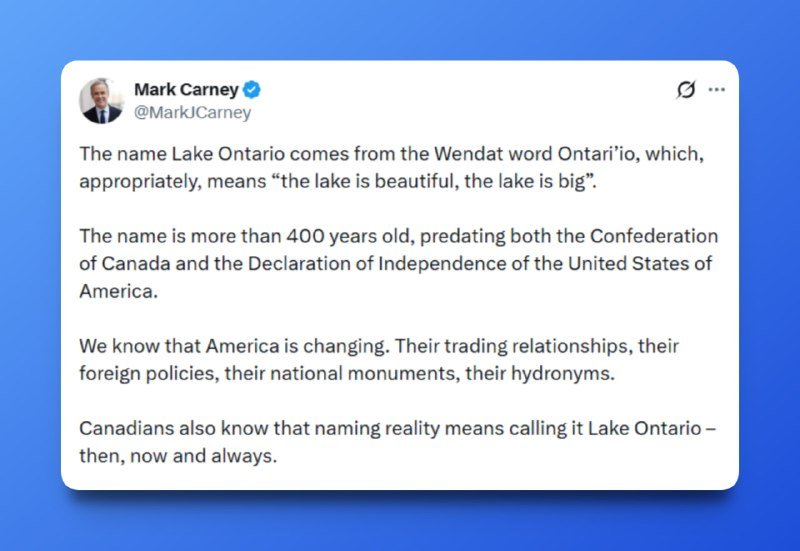
The Canadian response is not silence. According to separate reporting from CTV News on 28 August 2026, Prime Minister Mark Carney publicly challenged the Trump order, stating that the lake would be Lake Ontario "then, now and always," and the Toronto Star reports Canadian political leaders and First Nations have fired back against the renaming. For Canadian federal agencies and provincial ministries, the lake remains Ontario. The U.S. now calls its shoreline Lake America; Canada will continue to call its shoreline Lake Ontario. The water does not care. The politics do.
Monexus assessment: read against the backdrop of the collapsed trade talks, the order functions less as cartography than as escalation. A body of water named for a Canadian province becomes a body of water named for the United States. The geography is local; the message is bilateral, and the Canadian reply has already arrived in kind.
Why a lake, why now
Trump's suggestion that the Atlantic or Pacific Oceans could be renamed next is the line that carries the most signal. The oceans cannot be renamed by executive order in any meaningful sense; they are governed by international bodies. But the rhetoric matters. The framing is not about accuracy but ownership: an assertion that what touches American shores can be called what Americans choose to call it. Monexus reads the gesture as continuity with a broader posture that has treated water, minerals, and energy infrastructure across the hemisphere as a kind of national estate to be asserted rather than negotiated.
Caveat worth flagging: the BBC report confirms only that the trade talks collapsed "late last week," and the available sources do not establish a direct causal chain between that collapse and the lake renaming. The temporal proximity is documented; the linkage is inference. The order and the ocean remark also arrived through separate channels on the same day (the Sprinter Press X post carrying the ocean remark timestamped at 21:02 UTC, the Unusual Whales post reporting the broader threat timestamped earlier at 19:52 UTC), and the available evidence does not establish that the ocean suggestion was a sequenced follow-up to the signing.
What stays unresolved
A few things remain genuinely unclear. The available source items do not specify whether the order includes any provision for restoring the prior name should the bilateral relationship change. The trade talks are described as collapsed in initial reporting, but the underlying source items do not specify whether any channel for resumption remains open. And the long tail of the renaming, whether it migrates into school textbooks, tourism branding, or state-level nomenclature, will depend on decisions that have not yet been made.
What is not in doubt is that the lake will carry two names. One on each side of the border. The U.S. now calls its shoreline Lake America; Canada, through its Prime Minister and provincial leadership, has already said it will not follow. The water does not care. The politics, very visibly, do.
Desk note: Wire coverage led with the procedural fact of the USGS update. Monexus framed the renaming against the failed trade talks rather than as a standalone naming dispute, on the view that the gesture only makes sense once the bilateral context is set. This revision incorporates the Canadian first-party rejection reported by CTV News and the Toronto Star, which the prior version understated.
Wire provenance
This editorial synthesis draws on the following public wire/social posts:
- https://www.bbc.co.uk/news/articles/ckgwdn1g58yo?at_medium=RSS&at_campaign=rss
- https://t.me/ClashReport/93951
- https://x.com/SprinterPress/status/2093081802714050994
- https://x.com/Polymarket/status/2093092916889518289
- https://x.com/unusual_whales/status/2093064151509745988