A lake by any other name: Trump's executive order, and why a renaming fight is bigger than the water
The USGS has renamed Lake Ontario "Lake America" in its electronic documents after a Trump executive order, per wire relays on 27 August 2026. New York's governor says her state will not follow. A fight about geography has become a fight about who speaks for the country.
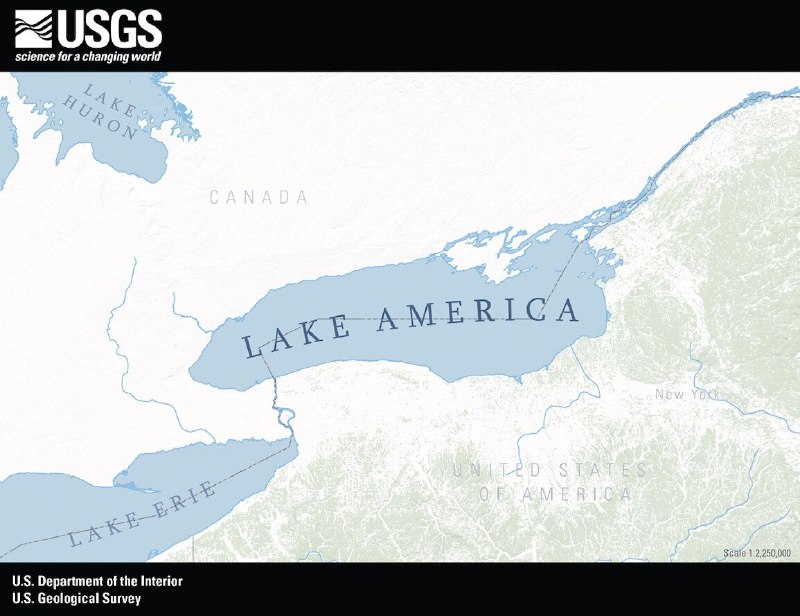
A single line in an internal USGS database, changed late on 27 August 2026, has produced the first federalism brawl of the autumn. According to wire relays on Telegram and X, the U.S. Geological Survey renamed Lake Ontario "Lake America" across all official electronic documents, with printed documents set to be updated over the next several days. The Telegram posts relay and attribute the change to a Trump executive order signed the same day. Within hours, New York Governor Kathy Hochul announced her state would not adopt the new name. The map, in other words, has become a paperwork case study.
The story is small enough to miss and large enough to read the room by. A lake does not change identity because Washington types a new word into a database. The people who fish it, ship over it, draw drinking water from it, and write its name on deeds and charts will continue to call it Lake Ontario. What changes is who owns the official record, and what happens when two layers of American government refuse to speak the same language about the same piece of geography. That is the question this rename has actually put on the table.
The order and the database
The action is administrative in form and symbolic in intent. A Polymarket breaking-news bulletin posted at 21:46 UTC on 27 August 2026 stated that USGS had renamed Lake Ontario "Lake America" across all official electronic documents, with printed documents to follow over several days. A Clash Report post at 21:51 UTC the same day used near-identical language, adding that the rename was applied across "all USGS electronic documents." A Disclose.tv summary relayed through an OSINT Live post at 21:59 UTC attributed the change to a Trump executive order signed the same day. None of the four items in the thread carries a direct White House or USGS statement; all four are relays of the same underlying report. The federal action is presented as a patriotic relabeling; it does not move a coastline, redraw a maritime boundary, or change a nautical chart used by commercial shipping. It changes the text in federal forms, geological surveys, and the agency's public-facing name database.
Reading those relays together, our assessment is that the rename was driven by executive direction rather than the customary deliberative process, because the wire language describes the change as already executed in federal systems rather than as a proposal under review. The thread items do not specify whether the order cites a particular statutory authority, whether the Board on Geographic Names has issued a concurring determination, or whether the rename was issued as a determination by the Board's secretary under existing authority. Those documents are the ones that will determine whether the rename is an administrative act or a directive that sidestepped the standard procedure.
The state that will not type the word
Hochul's pushback is the part with teeth. Insider Paper reported at 22:02 UTC on 27 August 2026 that the New York governor declared her state would not call the lake "Lake America," framing the dispute as one of New York's authority over its own records, signage, and communications. The state's counter is procedural as much as political: New York licenses ferries, regulates shoreline infrastructure, names state-owned facilities, and prints tourist maps. None of those documents will be reissued in federal shorthand on Albany's instruction. The practical effect is that two parallel nomenclatures now exist for one body of water, and which one a reader sees depends on which agency they happen to be standing in front of. This is not a court fight yet. It is a paperwork fight, the kind that usually precedes one.
Why a name is a federalism question
Geographic naming in the United States has long been a soft-power compromise between Washington, the states, and centuries of prior usage. The federal Board on Geographic Names exists precisely because the country decided long ago that a single national register prevents confusion in shipping, mapping, and emergency response. The most natural reading of the wire framing is that the rename is presented to the public as already accomplished rather than as a recommendation under consultation, which would mark a procedural break with how the Board has historically handled politically sensitive renames. New York's response is the predictable mirror image: if the federal register can be altered by decree, state agencies can decline to mirror the change, and the result is a bifurcated record that has to be litigated, legislated, or quietly walked back. There is no third option that ends well for the administrative state.
The deeper read is that this is not really about a lake. It is about whether an administration that has spent the year rebranding institutions, restoring place names, and re-labeling federal property can extend that project to the physical geography of the continent without resistance. New York has chosen to be the first state to refuse in public. Others will watch to see whether the cost of refusal is purely political or whether it carries operational consequences: federal grants held up, signage disputes on federal land, mapping inconsistencies in disaster planning. Those costs, if they arrive, will determine whether the next governor in a different state decides the same fight is worth picking.
Stakes and what to watch next
The immediate stakes are narrow. Boats still navigate by coordinates. Fisheries are still managed under the old name. Cross-border shipping with Canada, which also uses Lake Ontario on every chart, is unaffected by a unilateral U.S. register change. The dispute becomes consequential only if it metastasises: if federal funding or signage on federally managed shoreline begins to require the new name; if the Board on Geographic Names is restructured to remove the deliberative step; if other states copy New York and the country ends up with a checkerboard map. Monexus analysis: the political incentive in Washington is to push the rename as far as the system will bend; the political incentive in Albany is to make the cost of doing so visible. The lake is the same lake. The argument is about who gets to write it down.
The honest uncertainty is on the legal terrain. The thread sources do not specify whether the executive order cites a specific statutory authority for the rename, whether the Board on Geographic Names has issued a concurring determination, or whether a federal court has been asked to clarify the boundary between the federal register and state usage. They also do not specify whether USGS has posted a first-party statement on its own site confirming the change. Those are the documents that will decide whether this is a culture-war headline that fades by October or the opening move in a multi-state naming fight. Right now, the water is unchanged, and the names are multiplying.
Desk note: Monexus treats this as a federalism story first, a Trump-era symbolism story second. The four items in the thread are relays of the same underlying report rather than first-party statements from USGS or the White House; the framing here treats the rename as reported by those relays while flagging the missing primary documents as the next thing to verify.
Wire provenance
This editorial synthesis draws on the following public wire/social posts:
- https://t.me/insiderpaper/44230
- https://t.me/osintlive/567504
- https://t.me/ClashReport/93951
- https://x.com/Polymarket/status/2093092916889518289