Russian drone salvo hits two Kyiv Oblast ammunition sites; ballistic warning open at 20:44 UTC
Two Russian Geran-4 strikes on ammunition depots in Bucha District and the village of Myla, Kyiv Oblast, were logged between 18:44 and 20:02 UTC on 28 August 2026, after which @AMK_Mapping opened an open-ended ballistic-missile threat advisory for the city and oblast.
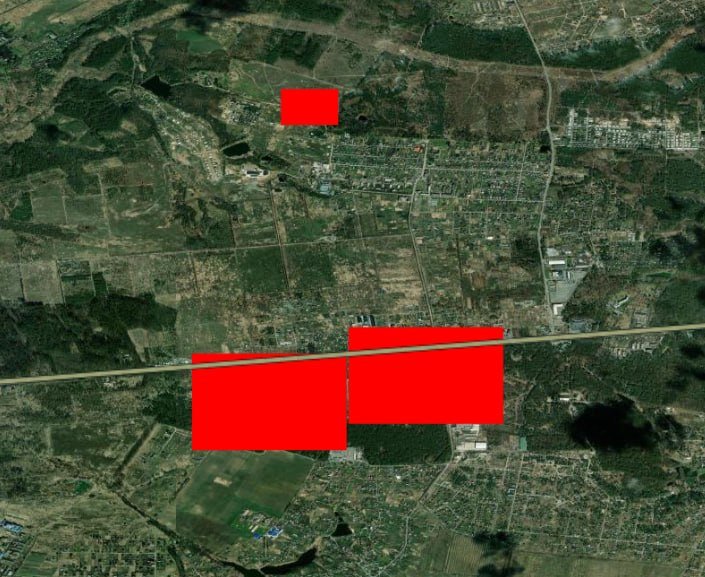
At 18:44 UTC on 28 August 2026, the open-source channel @intelslava reported that a Russian Geran-4 loitering munition struck an ammunition depot near the M06 Zhytomyr Highway in Bucha District, Kyiv Oblast, producing a fireball and shockwave followed by multiple secondary detonations. Roughly thirty-six minutes later, at 19:20 UTC, @GeoPWatch logged a "large explosion" in Bucha following what it described as a Russian Geran-4 drone attack on what appeared to be a munitions depot, citing the presence of a "massive fireball and secondary" detonations visible on geolocated footage. At 20:02 UTC, the mapping account @AMK_Mapping reported a third Geran-4 strike on an ammunition depot in the village of Myla, Kyiv Oblast, again with a "large secondary detonation and subsequent fire." By 20:44 UTC, @AMK_Mapping had opened an increased ballistic-missile threat advisory for Kyiv City and Kyiv Oblast, warning that if a ballistic attack proceeded, launches could occur anywhere from one hour to five hours from the post. The day's pattern was already in motion by the time @GeoPWatch logged additional Russian drone groups heading toward the oblast at 21:27 and 21:32 UTC.
Three Telegram channels, operating independently and arriving at compatible descriptions inside the same hour, place Russian-origin loitering munitions on ammunition storage at two named locations in Kyiv Oblast: near the M06 Zhytomyr Highway in Bucha District, and in the village of Myla. A ballistic-missile advisory followed for the city and the oblast. The pattern that emerges from those posts is consistent enough to treat the strikes as a real event at the coordinates claimed; it is not sufficient to treat the tactical details, warhead counts, intercept results, or Ukrainian losses, as established. This article works inside that line.
The shape of the salvo
What the three posts share is the ordnance signature. Each hit is described as a Geran-4 strike producing a "secondary detonation and subsequent fire," the visible fingerprint of stored ammunition cooking off after a primary blast. @intelslava's Bucha post specifies the location as an ammunition depot near the M06 Zhytomyr Highway; @AMK_Mapping's Myla post describes the same munition type hitting an ammunition depot in a separate village. The cluster of strikes, on the available evidence, was aimed at materiel, not at population centres described in the posts.
The @AMK_Mapping ballistic advisory is the second structural beat. Posted at 20:44 UTC, the post framed an increased ballistic threat to Kyiv City and Kyiv Oblast and gave a launch window of "anywhere from 1 hour to 5 hours from now" if an attack proceeded. Ballistic missiles do not loiter; their flight time from launch aircraft inside Russian airspace to targets in the Kyiv area is short, and Ukrainian air-defence operators are forced to commit interceptors on warning rather than on confirmed radar contact. The cautionary framing in the post is consistent with a standard wait-and-see posture: hold the heavier tier until a raid package is built up, then release.
The inbound drone traffic @GeoPWatch logged at 21:27 and 21:32 UTC is harder to read. The posts describe "drone groups" en route to or detected heading toward Kyiv Oblast, but the available source items do not specify how many airframes were in each group, whether they completed the run, or whether they were intercepted en route. The posts are early-warning traffic, not impact confirmation.
What the channels can and cannot tell us
All six items feeding this piece are open-source intelligence channels on Telegram. They publish geolocated video, often within minutes, but they are relays of eyewitness footage plus analyst interpretation rather than primary reporting. The directional picture, Russian-origin drones striking ammunition storage at two named locations in Kyiv Oblast, followed by a ballistic warning for the oblast and the city, is consistent across @intelslava, @GeoPWatch and @AMK_Mapping, which raises confidence that something real happened at the coordinates claimed. The tactical picture is not in these posts, and this article has not independently established it.
A further caveat: the "M06 Zhytomyr Highway" anchor in the @intelslava post is precise enough to be falsifiable, and the Bucha fireball footage was circulating widely enough to be picked up by independent trackers within the same hour, which is the standard reliability test for OSINT geolocation. The Myla strike is corroborated only by @AMK_Mapping in the present source set; readers should treat that hit as one-channel preliminary reporting until a second geolocated source appears. The 21:27 and 21:32 UTC drone-group alerts do not specify outcome.
Monexus analysis: reading the salvo
Two points are worth making in plain editorial voice, with the caveat that this is interpretation of open-source traffic, not established fact.
First, on the available evidence, the salvo's targeting logic appears oriented around ammunition storage rather than urban centres. All three confirmed impact posts describe Geran-4 strikes on ammunition storage, and the shared "secondary detonation" language across the three channels is the kind of cross-channel consistency that tends to survive independent verification. Whether the underlying motive is to degrade a specific logistics corridor, to force interceptor consumption ahead of a heavier strike, or simply to attrit stored materiel, the source items do not specify.
Second, the two-front architecture, slow drones ahead, a ballistic tier held in reserve as a warning, is the part of the picture the @AMK_Mapping advisory makes visible. The post's stated launch window runs from one hour to five hours after the 20:44 UTC post, putting the earliest possible launch window opening around 21:44 UTC on 28 August 2026 and the latest possible launch window closing around 01:44 UTC on 29 August 2026, as stated by the channel itself. Whether that architecture converts into launches during that window is not established in the available items, and the available source items do not specify whether a ballistic attack occurred within it.
What to watch
The open question for the next several hours is whether the drone groups logged at 21:27 and 21:32 UTC complete their run to the oblast, and whether the ballistic tier that @AMK_Mapping flagged converts into launches inside the channel's own stated window. Ukrainian air-force and General Staff briefings carry primary-source authority for strike readouts on this war; the available source items do not include such briefings. Readers should expect clearer attribution and intercept figures once official Ukrainian channels post.
The structural story, beyond this stretch of the evening, is that three ammunition-storage strikes inside roughly ninety minutes, two of them referenced under one Kyiv Oblast thread, are enough to register as a pattern even before a ballistic follow-on is confirmed. Whether the pattern holds into the morning summary, or dissipates into the routine attrition that both sides absorb nightly, is the test the next twenty-four hours will set.
Desk note: Monexus framed this as an open-source intelligence relay story rather than a confirmed-tactical account, in line with our standing practice on Telegram-only source sets. Three independent channels arriving at compatible descriptions inside an hour raised our confidence in the strike coordinates; one-channel-only corroboration for the Myla hit is flagged accordingly. We did not assert targeting motive, logistics-corridor logic, or weapon-family provenance beyond what the posts themselves state, and we did not infer the geographic relationship between the M06 Zhytomyr Highway reference and the village of Myla beyond what the source items specify.
Wire provenance
This editorial synthesis draws on the following public wire/social posts:
- https://t.me/intelslava/93410
- https://t.me/GeoPWatch/39022
- https://t.me/AMK_Mapping/36615
- https://t.me/AMK_Mapping/36628
- https://t.me/GeoPWatch/39035
- https://t.me/GeoPWatch/39037