Kyiv depot strike tells a familiar story, just louder
A Russian strike on an ammunition depot near Ukraine's capital killed at least 37 people on 29 August 2026, one of the year's deadliest attacks, against a backdrop of 72 hours of near-constant drone strikes.
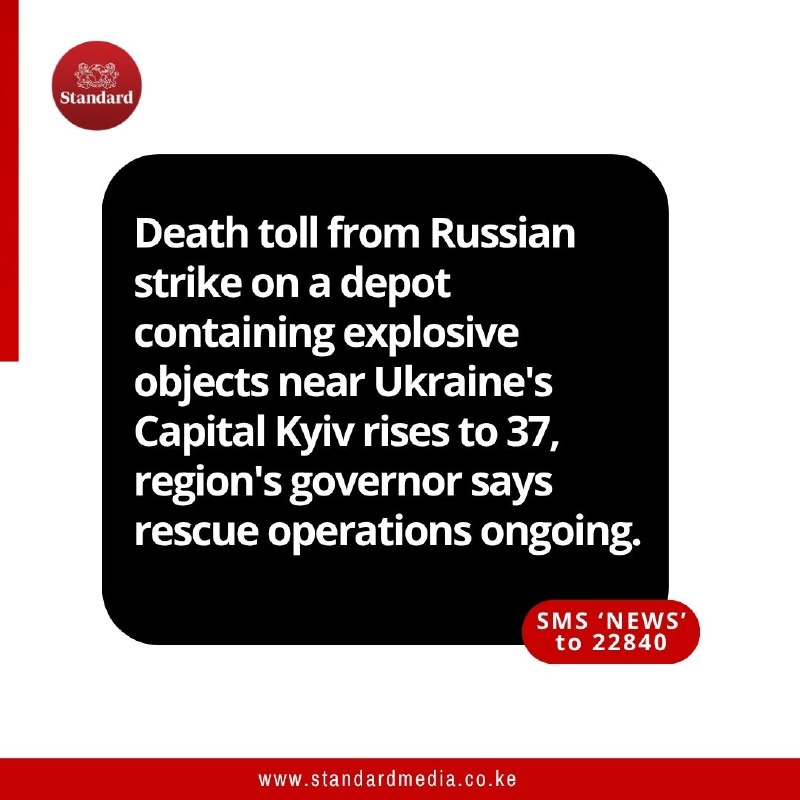
A Russian strike on a depot in the Kyiv region killed at least 37 people on 29 August 2026 and forced hundreds more to flee as a fuel and ammunition fire tore through the site. The regional governor said rescue operations were still under way by mid-afternoon UTC, with the death toll expected to rise.
The attack is not an aberration. It is the loudest datapoint yet in a 72-hour stretch of near-constant Russian drone strikes across Ukraine that has shredded any pretence of a quiet summer front. Read closely, it is also a story about what the war is doing to the infrastructure that keeps Ukrainian cities running, and about how the Western briefing cycle still struggles to put a number on that.
The day, in numbers
Al Jazeera English reported the 37-fatality figure at 16:12 UTC on 29 August, citing the regional governor and ongoing rescue work. NPR, filing from Kyiv, framed the strike as one of the deadliest of the year and placed it inside a 72-hour tempo of drone attacks that has severely disrupted daily life across Ukrainian cities. Deutsche Welle added the structural detail: the target was an ammunition depot, the strike was the second to hit an arms storage site near Kyiv in less than two months, and the detonations triggered a fire large enough to empty surrounding settlements.
The available reporting does not specify the exact locality within the Kyiv region, the type of munition used, the model of drone or missile, or whether the depot was a known logistics hub for frontline resupply. Those gaps matter: the weapon choice and the siting, more than the casualty figure, tell you what Moscow is trying to do.
The counter-narrative, and why it does not hold
The reflex on Russian-aligned channels is to describe strikes on depots as legitimate attrition of Ukraine's war-making capacity, and to keep casualty figures vague. That framing deserves to be stated plainly so it can be answered plainly. A depot is a lawful military objective under the laws of armed conflict; the doctrine governing it is the doctrine governing every other dual-use target in this war.
What the framing cannot absorb is the geography. The four cited reports place the strike in the Kyiv region, a metropolitan area of roughly four million people. The 72-hour drone tempo NPR describes does not look like a focused campaign against a handful of hardened sites; it looks like pressure on a civilian population that happens to live next to the sites Russia needs to hit. Under the established laws of war, the civilian cost of an attack is not a side note to be tucked into the lede.
What the pattern actually looks like
Monexus analysis: read across the four available reports, the picture is consistent and ugly. Russia is hitting ammunition and logistics infrastructure in the Kyiv region, on a tempo that is steadily shortening. DW's note that this is the second depot strike near Kyiv in under two months is the kind of sentence that does not get the weight it deserves in English-language coverage: a doubling of frequency on high-value targets is exactly the curve an attritional air campaign produces when one side believes it cannot win a ground breakthrough.
There is a quieter story underneath. Depots burn hot and long. Each fire of this kind consumes materiel that Ukraine will need through the autumn and into the seventh winter of the full-scale war. The strategic cost is paid by soldiers at the front, months later, in shells and missiles that are no longer in a warehouse outside the capital. The 37 people who died on 29 August are the visible cost. The invisible cost is the supply curve bending at exactly the moment of year when logistics gets harder.
What is being under-reported
Western wires are doing what Western wires do: leading with the casualty figure, the regional governor, and a one-of-the-year's-deadliest framing. What gets less column-inches is the mechanical link between a 72-hour drone tempo, an ammunition fire, and the civilians who live inside the radius. The same outlets that report the deaths with care routinely accept Moscow's framing that depots are simply military targets, and treat the human geography around them as scenery.
There is also a contest inside the European press ecosystem about how to count. Numbers from Ukrainian officials are quoted live; figures from Russian sources are framed as counter-claim material with explicit caveats. That is correct practice. But the audience for that distinction is editors; the audience for the strike itself is the people in the affected settlements, and they do not have a press conference.
The stakes, plain
If the 72-hour tempo holds through September, expect the Western debate to shift from political will to inventory. The structural bet Moscow is making is that Ukraine's ammunition supply is the constraint, not its allies' patience, and that a winter of attrition can be won by burning warehouses one at a time. The counter-bet, in Kyiv and in European capitals, is that depot losses can be absorbed if resupply lines out of production are wide enough.
Both bets land on the same question: who can keep producing faster than the other side can burn. The strike on 29 August does not answer it. It moves the clock.
What remains uncertain
The cited reporting does not specify the exact locality within the Kyiv region, the munition type, the origin airbase, or whether the depot was a known resupply node for a specific frontline axis. The available source items do not contain a Russian Ministry of Defence statement on the strike, and this article has not independently established whether one was issued. The death toll, attributed to the regional governor, is described as rising; the final figure may move before the day ends. NPR characterises the attack as one of the deadliest of the year, not as the deadliest single attack of the year.
Desk note: Monexus framed this strike around casualty verification, target characterisation, and the 72-hour tempo rather than the kinetic-event framing dominant in evening wires. The intent is to keep the human geography of depots visible without inflating the count.
Wire provenance
This editorial synthesis draws on the following public wire/social posts:
- https://t.me/aljazeeraglobal/140219
- https://www.npr.org/2026/08/29/nx-s1-5948714/russian-strike-kyiv
- https://www.dw.com/en/russian-strike-on-ammunition-depot-near-kyiv-kills-dozens/a-78556008?maca=en-rss-en-all-1573-rdf
- https://t.me/StandardKenya/45358