Gunfire and explosions rock Niger's capital as junta cuts power in Niamey
Residents in Niamey reported sustained gunfire and explosions near a military base at the international airport on 29 August 2026. Hours later, a Telegram channel monitoring the country said the junta had cut electricity to districts of the capital.
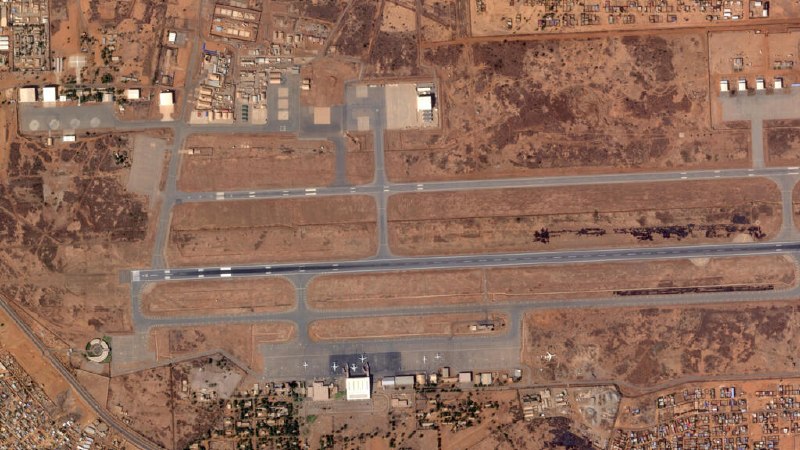
Sustained bursts of automatic fire and several explosions were audible across central Niamey from the morning of 29 August 2026, with residents describing the bursts as concentrated near a military base adjoining the city's international airport, according to France 24's English service and Reuters correspondents. Reuters, citing two sources it did not name, separately reported "explosions, gunfire at Niger's Niamey airport and presidency perimeter," placing the events on the same morning. By 09:42 UTC, the Telegram channel RN Intel, which tracks Russian-aligned and African security feeds, posted that Niger's military authorities had begun cutting electricity to a district of the capital. The geography matters: an airport with an embedded military garrison and the presidential perimeter are two of the three nodes any seizure of power in Niamey would have to hold or storm.
The junta that took power in July 2023, after soldiers ousted elected president Mohamed Bazoum, is now into its fourth year in charge and presiding over a country formally suspended from ECOWAS, progressively evicted from French military basing, and absorbed into a new Moscow-aligned Sahelian security architecture built around the Alliance of Sahel States. A serious incident at the heart of the capital on a Saturday morning, with the lights going out in at least one district, raises the question of whether control of the state itself is now contested from inside the ruling camp.
What the wires and channels describe
France 24's English service, relaying local residents in Niamey, reported gunfire and explosions "near a military base at an international airport" in the capital from the morning of 29 August 2026. The France 24 item notes that the airport was attacked twice earlier in the year by jihadists, a detail that anchors the reporting in a prior pattern rather than treating the incident as unprecedented. Reuters, citing two unnamed sources, separately confirmed "explosions, gunfire at Niger's Niamey airport and presidency perimeter" on the same morning. RN Intel posted at 09:42 UTC that the junta had cut power to "certain district of the country's capital, Niamey." The RN Intel item does not name a specific neighbourhood, and the available source items do not specify whether the cuts covered one district or several.
Two things align across these independent feeds: a sustained burst of small-arms fire rather than a single detonation, and a geography centred on the airport and its adjacent military base, with Reuters separately placing the presidency inside the affected perimeter. The available source items do not specify whether official Nigerien government spokespeople have named a perpetrator or issued a public communique on the events.
Why the timing matters
Niger's military authorities have spent three years projecting a single, disciplined image of the state. General Abdourahamane Tchiani, who heads the National Council for the Safeguard of the Homeland (CNSP), has centralised command around a tight circle of officers and restructured Niger's external alliances to align with Burkina Faso and Mali, both also under military rule. The two neighbouring juntas have backed Niamey through ECOWAS sanctions and the loss of Western troop presence.
An incident inside this perimeter is therefore politically volatile on two levels. It would expose either a real breach of the security apparatus, which the junta has built its legitimacy on guaranteeing, or an internal split inside the officer corps that has until now held a common front. Monexus assessment: the most plausible readings, given what is in the sources, are either a factional challenge from within the military, a kinetic response by an armed opposition that the junta has repeatedly insisted does not exist on Nigerien soil, or a continuation of the jihadist pattern France 24's own reporting references. Until the regime speaks publicly, all three remain live, and treating any one of them as settled would outrun the evidence.
The regional backdrop
The event lands inside a Sahel that has reorganised itself at speed since 2023. France completed the withdrawal of its remaining forces from Niger in late 2024, ceding bases that had anchored its regional posture for a decade. The United States followed with a drawdown of its own counter-terrorism footprint. In their place, Russian military instructors, private security contractors linked to the Kremlin, and expanded ties with Ankara have filled the vacuum. Mali and Burkina Faso have taken similar paths.
This realignment has not produced stability. Jihadist groups affiliated with Islamic State and al-Qaeda continue to operate across the Liptako-Gourma tri-border region, and humanitarian access in eastern Niger has narrowed. For Western capitals, Niamey's pivot has read primarily through the lens of lost basing and Russian penetration. For the juntas, it has been framed as recovery of sovereignty after decades of perceived French domination, a position that retains genuine purchase across the wider West African public, including in countries that have not experienced coups. Both readings are partial, and neither fully captures the security vacuum inside the Sahel itself.
What remains unknown
The sources do not specify who carried out the incident, whether the firing originated from inside or outside the military base, the casualty count, or whether General Tchiani and the senior CNSP leadership are confirmed safe. Reuters and France 24 describe the events through resident witnesses and unnamed sources, which is consistent with how breaking security news travels out of Niamey but also means that every claim about who fired on whom remains preliminary until verified. The wider regional bodies, ECOWAS and the African Union, are not named in the available source items as having reacted, and any forecast of further escalation is, at this stage, analysis rather than reporting. The available source items do not specify whether state broadcast signals were affected alongside the power cuts.
For now, the most that can be said with confidence is what residents across central Niamey heard on the morning of 29 August 2026: a sustained burst of automatic fire, several explosions near a military base at the international airport, Reuters' separate report of gunfire at the presidency perimeter, and, within roughly two hours, the electricity going out in a district of the capital. The political meaning of that sequence will become clearer once the junta speaks, or once it cannot.
Desk note: Monexus treats the available source items as a breaking-news cluster and has avoided attributing agency beyond what residents and wire correspondents have so far confirmed. The airport, the presidency perimeter, and the power cut are kept as three separate observations drawn from three separate feeds, rather than merged into a single geography the sources do not jointly establish. The Sahelian realignment is framed from public record rather than the current thread, and the article has kept historical claims conservative.
Wire provenance
This editorial synthesis draws on the following public wire/social posts:
- https://reut.rs/4qRHECw
- https://x.com/Reuters/status/2093617196723245496
- https://f24.my/C7zi.g
- https://t.me/france24_en/18404
- https://t.me/rnintel/65838