Bitcoin prints its best August since 2017 as Saylor returns to X with a four-word post
Cointelegraph flagged on 29 August that 2026 is Bitcoin's strongest August since 2017; a day later, Michael Saylor resurfaced with a four-word note: "We're back." What the cited wire says, what it does not, and why a posture read and a posture-reset read are both defensible.
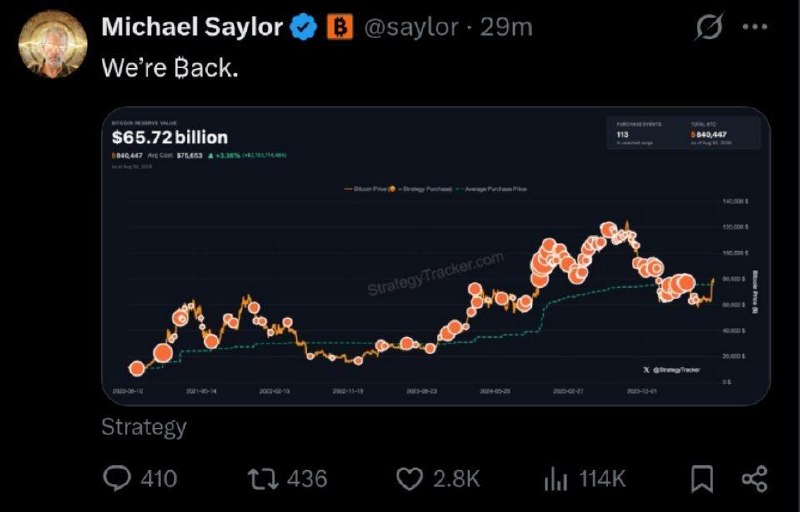
Bitcoin closed August 2026 as its best August since 2017, per a 29 August Cointelegraph dispatch (14:57 UTC). Less than 24 hours later, Michael Saylor reappeared on social media with a four-word line that the wire summarised as: "We're back." Bitcoin is above their average buying price for the first time in a while, Cointelegraph added in its 30 August item (14:29 UTC).
That is what the cited wire says. What it does not say is more important than what it does. The available items name Saylor and characterise the post, but they do not name his current corporate role, do not identify the entity whose average buying price the wire is referencing, and do not disclose a new acquisition, an at-the-market tranche, or any preferred-stock issuance. A four-word post plus a price note is, on the cited evidence, a signal, and a signal is not a transaction.
What the wire actually says
Read closely, the 30 August Cointelegraph item is short on specifics and long on framing. The phrase "their average buying price" is possessive plural. The wire does not specify whether the referent is Saylor's personal acquisition cost, the cost basis of a corporate vehicle he is associated with, or a generic figure drawn from market commentary. The wire does not name an entity. It does not name a position size. It does not record a same-day price spike or a change in on-chain treasury holdings attributable to the post.
Read at face value, the only hard claim in the post is comparative: spot is above some prior average. The only hard claim in the 29 August item is historical: the August print is the best since 2017. Both are wire statements of fact, and both are thin.
August in the rear-view
The August 2017 comparison matters because the August 2017 candle sat inside the run-up to the late-2017 blow-off top. Cointelegraph is making a calendar-comparison claim, not a pattern-equivalence claim. The wire does not say this is the start of a 2017-style melt-up, and the desk does not either. What the comparison does is reset the rhetorical baseline: when the August print is the strongest in nine years, the conversation about year-end drift is louder than it was in July.
The cited items do not specify the drivers behind the August 2026 candle. They do not break out spot ETF flows, miner dynamics, macro liquidity, or any single attribution. The structural plumbing behind the move is not addressed in the available sources.
The other items on the same wire
Two adjacent Cointelegraph items bracket the Saylor post and are worth flagging because they set the operating environment for any large-treasury allocation decision.
On 30 August at 09:01 UTC, Cointelegraph reported that Polygon had quietly patched serious denial-of-service flaws in its most recent hard forks before they were publicly disclosed, with no exploits reported. The note is a reminder that even major chains live on a rolling cycle of vulnerability discovery and mitigation, and that "no incident" can coexist with material risk reduction in the background.
On 28 August at 01:11 UTC, the wire carried X's safety team statement that it had uncovered a roughly 200,000-account network attributed by X to Chinese origins, with around 200 accounts posting AI-generated content designed to manipulate the debate around American AI and energy policy. The disclosure is a reminder that the information environment around US technology and energy policy is itself a contested surface, and that any treasury operator reading the policy tape is reading a tape that someone is actively trying to bend.
Neither item is causally tied to the bitcoin print in the cited evidence. They sit alongside it on the same wire, which is a placement fact, not a linkage fact.
The honest read
Monexus analysis: the most charitable read of "We're back" is that the spot price has crossed back over a personally relevant cost basis and Saylor is acknowledging it publicly, in the same declarative register he has used in prior cycles. That is a posture statement, not yet an executed trade, and the available Cointelegraph items do not specify a buy size, instrument, or timing.
The counter-read is that Saylor is signalling confidence in front of a forthcoming communication rather than telegraphing a near-term purchase, and that the next binding event will be a subsequent disclosure that names a specific instrument and size, not another four-word post. That read is consistent with the cited wire, which records no transaction.
A third read, which the desk flags without endorsing, is that a "we're back" post in a market sitting on nine-year-best August performance is more about reinforcing narrative positioning for a retail audience than about discrete capital deployment. The cited evidence does not adjudicate between these reads. The forward calendar, on this desk's reading, is light on confirmed dates within the available items, and the next binding event will be any subsequent disclosure that names a specific instrument and size, not any further social-media post.
One thing the cited wire does not establish, and which this article has not independently verified: whether Saylor's relevant cost basis is personal or attached to a corporate vehicle, whether any such vehicle has been a net buyer or net seller in the weeks preceding 30 August, or whether the post was timed to coincide with a planned capital-markets action. Those questions sit outside the four URLs in the source ledger and would need first-party disclosure or on-chain confirmation to answer.
This piece was reported from Cointelegraph's Telegram wire and published on the crypto desk.
Wire provenance
This editorial synthesis draws on the following public wire/social posts:
- https://t.me/Cointelegraph/71843
- https://t.me/Cointelegraph/71835
- https://t.me/Cointelegraph/71842
- https://t.me/Cointelegraph/71822