Kyiv's nightly drone arithmetic: what five Geran alerts in four hours actually tell us
Five Telegram alerts from a single open-source mapper between 21:30 and 00:23 UTC show a pattern the wire services rarely quantify: the Geran tempo against Kyiv is relentless, and most of the aircraft never reach the city.
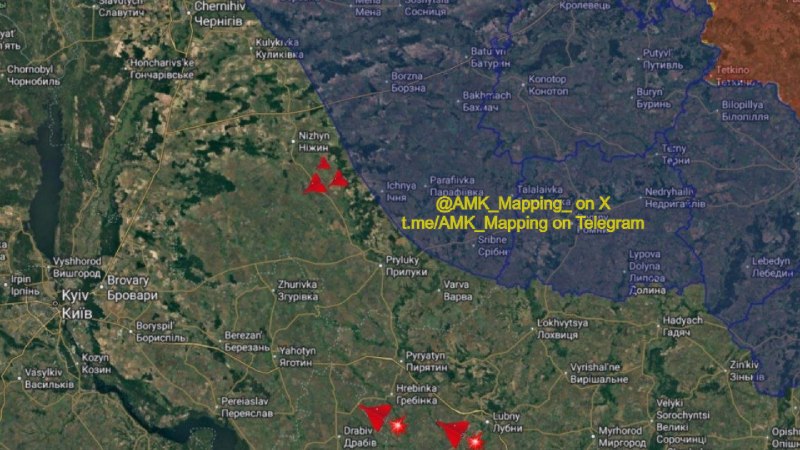
At 21:30 UTC on 29 August 2026, the open-source mapper AMK_Mapping logged three more Russian Geran-4 jet-drones closing on Kyiv Oblast. Four minutes later the channel confirmed the count. By 21:42 UTC, four Geran-4s were down, all intercepted by Ukrainian air defence before reaching the capital. At 00:21 and 00:23 UTC on 30 August, two further batches appeared on radar, two Geran-4s and three Geran-2s, the lead aircraft roughly 100 km out, again approaching from two axes. By the time the second alert posted, the two Geran-4s had already been intercepted.
The arithmetic is the story. Five alerts in roughly three hours, eight individual drones named across them, none confirmed by AMK as striking Kyiv. That gap, between the tempo of the launches and the tempo of confirmed hits, is what the nightly Telegram traffic is actually measuring. It is also what the wire coverage of the war, with its appetite for single dramatic impacts, tends to miss.
The shape of a Geran night
Read the timestamps in sequence and a pattern emerges. AMK's first warning of the cluster, at 21:30 UTC on 29 August, identified three Geran-4 jet-drones inbound on Kyiv Oblast. By 21:42 UTC the channel reported all three, plus a fourth, had been shot down before reaching the capital, and stated in the original post that none of the four appeared to have been targeting Kyiv itself. The operational takeaway: a salvo of four long-range one-way attack drones named in the alerts was neutralised over the oblast, not the city.
A little under three hours later, at 00:21 UTC on 30 August, a new batch appeared: at least two Geran-4s and three Geran-2s, the lead aircraft about 100 km from the capital and tracking from two directions. By the time the follow-up post landed at 00:23 UTC, the two Geran-4s had been intercepted. The Geran-2 loitering munitions, slower and cheaper than the Geran-4s, were still in the air at the moment of posting.
Five alerts, eight named drones across the alerts, a 100 km detection horizon in the second salvo, and an interception cadence measured in minutes rather than hours. That is the unit of warfare Kyiv's defenders now operate in, at least as AMK documents it.
What the open-source mappers can and cannot tell us
AMK_Mapping is one of a handful of Ukrainian and diaspora channels that publish near-real-time drone tracks, drawing on acoustic sensors, observer networks and unclassified reporting. The channel does not publish bomb-damage assessments and does not claim to speak for the General Staff. When it says a drone was intercepted, it is relaying what its sources tell it was intercepted; when it says one is 100 km away, it is passing on a tracking estimate with an implicit error margin it does not quantify.
That epistemic humility is part of why the channel is useful. Over a single night, five alerts from one mapper cannot establish a campaign-level trend. They can establish that, on this night, the tempo of Geran launches against Kyiv was continuous rather than episodic, that air-defence engagement happened at oblast rather than city scale, and that the loitering-munition mix (Geran-2 alongside the faster Geran-4) was preserved across salvos. The remaining unknowns are first-order: the launch sites, the number of drones that were not tracked, the proportion of the salvo that reached Ukrainian airspace at all, and whether the four-down claim at 21:42 UTC will be corroborated by the General Staff in its morning briefing.
Monexus analysis: the war that arrives in batches
What the cluster of posts makes visible, when laid end to end, is a campaign geometry the wire services rarely name. The pattern AMK documents is consistent with a sustained, low-yield pressure around the capital rather than a single decisive strike: batches spaced hours apart, mixed munition types, engagement at the oblast perimeter. The interception record AMK reports, four for four in one salvo, two for two in the next, is the metric Ukraine's defenders would prefer to publicise, and it is also a metric that flatters the defender. Every Geran costs Russia a fraction of what a Patriot or IRIS-T round costs Ukraine to fire against it.
The structural read, stripped of jargon: when a cheaper system is launched faster than the defender can afford to spend, the defender's interception rate becomes a long-run liability rather than an asset. The five alerts in three hours are a snapshot of exactly that arithmetic in motion, as AMK recorded it.
Stakes and what to watch next
The tactical stakes for Kyiv residents are immediate and concrete: another night of air-raid alerts, another morning in which the Geran-2s that survived interception may have landed somewhere in the city. The strategic stakes are quieter and more durable. If the launch tempo against the capital continues at the cadence AMK documented on 29-30 August, the question for Ukraine's Western partners shifts from whether to supply interceptors to how rapidly they can be produced and delivered. That question is already being asked in Berlin, Warsaw and Washington; the Telegram traffic out of Kyiv is, in effect, the public ledger that keeps it on the agenda.
The next data points to watch are unglamorous: the count of posts AMK publishes between sunset and sunrise over the coming week, and whether the interception ratio holds. The arithmetic, not the headline, is where this war is being decided.
Desk note: Monexus framed this piece around the open-source tracking record rather than official Kyiv or Moscow communiqués, because the available source items are Telegram alerts from a single mapper and the most defensible reporting stays inside that evidentiary lane. The interception claims are AMK's, not the Ukrainian General Staff's, and have not been independently corroborated in the available source material.
Wire provenance
This editorial synthesis draws on the following public wire/social posts:
- https://t.me/AMK_Mapping/36755
- https://t.me/AMK_Mapping/36756
- https://t.me/AMK_Mapping/36757
- https://t.me/AMK_Mapping/36776
- https://t.me/AMK_Mapping/36777