Three signals on one corridor: a tanker stop, an F-35 engagement, and a ship-count boast on the Strait of Hormuz
Three Telegram-sourced reports inside roughly two and a half hours, anchored to the same waterway: a halted Saudi tanker, an Iranian fire on a US F-35 relayed via Axios, and a presidential count of ships.
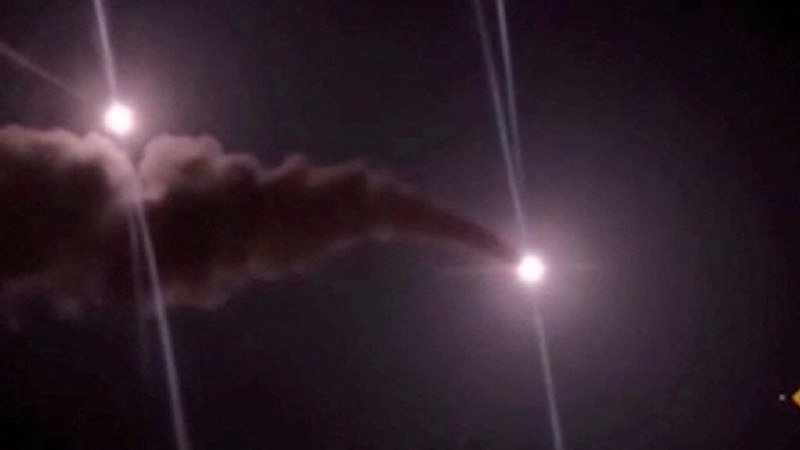
At 21:36 UTC on 31 August 2026, the Telegram channel rnintel posted initial reports of Iranian projectiles launched towards the Strait of Hormuz. Earlier in the same news cycle, Clash Report and osintlive carried Iranian media claims that a Saudi oil tanker named Cedar, capable of carrying two million barrels, had been stopped while transiting the southern corridor of the strait; the osintlive version was logged at 21:10 UTC and the Clash Report version at 21:18 UTC. The same day, at 20:08 UTC, an open-source channel carried a Donald Trump statement about the waterway: "We have the Strait of Hormuz in extremely good shape. We've been averaging 30 ships a night. That's a lot." At 19:08 UTC, the same open-source channel relayed an Axios report, citing a US official, that Iranian air defences had fired upon a US F-35 fighter jet that was providing cover to ships in the strait in recent days. Four messages, one corridor, two and a half hours.
What the cited material describes, taken at the relay values, is a day on which a Saudi tanker was reported halted, a fifth-generation American fighter was reported engaged by Iranian air defences, and the US president publicly asserted operational control. None of those three claims has independent first-party confirmation in the available sources. All three route through Telegram channels that aggregate wire copy, Iranian state-aligned reporting, and presidential messaging. The reading below labels each accordingly.
What the day actually contained
Two episodes, both reported via open-source intelligence channels and anchored to the same geography. The first, logged by Clash Report at 21:18 UTC and corroborated by osintlive at 21:10 UTC, was the reported interception of the Cedar, described as a Saudi oil tanker with a two million barrel capacity, in the southern Strait of Hormuz. Iranian media was the cited source for the stop in both relays. The available sources do not specify the tanker's current disposition, its owner, or its cargo manifest beyond the headline capacity figure. The available sources also do not state the vessel's flag; "Saudi oil tanker" is the language used in the cited reporting. Framing the stop as flag-state specific therefore exceeds the thread evidence.
The osintlive relay of the same story adds a detail not present in the Clash Report version: that UKMTO, the United Kingdom Maritime Trade Operations centre, reported receiving word of a security incident involving an oil tanker in the area about an hour earlier, without the excerpt specifying what that "earlier" reference point is. UKMTO receives industry reports and acts as a first-pass record for merchant incidents in regional waters. The available excerpt does not state whether the UKMTO report named the Cedar, named the location with precision, or has been publicly confirmed by UKMTO itself. The detail matters because it indicates that the merchant-shipping reporting chain was active around the time the Iranian media version was being amplified, but the precise temporal relationship between the UKMTO report and the Iranian media claim is not specified in the cited material.
The second episode sits behind the first in the day's news flow. At 19:08 UTC, osintlive relayed an Axios tweet reporting that Iranian air defences had fired upon a US F-35 providing cover to ships in the Strait of Hormuz in recent days. The chain runs: Axios, citing a US official, relayed via osintlive. Two intermediaries stand between the cited US official and the cited Telegram post. The available excerpt does not specify whether the F-35 was over open water or over Iranian-claimed waters, whether the jet returned to base undamaged, or which specific US official spoke to Axios. The plain reading is that an Iranian surface-to-air engagement against a US fifth-generation fighter on a tanker-escort mission has been disclosed through a back channel. The lower reading is that the disclosure is correct in outline but unspecified in detail, which is the level of certainty the relay supports.
The third signal sits between them. The 20:08 UTC Trump statement is a presidential claim of effective US control of the waterway, made on the same day that Iranian-aligned channels were broadcasting an interception and an engagement. The available sources do not reconcile the ship-count claim with the reported interception or engagement. The contradiction is itself a usable fact.
The sourcing chain, and what each link can bear
Three of the five cited items route through open-source intelligence Telegram channels. Clash Report and osintlive operate as aggregation feeds with editorial selection; rnintel is an Iran-watcher channel that curates claims from Iranian state-aligned outlets. The original sourcing on the Cedar interception is Iranian media, the interested party. The original sourcing on the F-35 engagement is an Axios tweet citing a US official. The original sourcing on the ship-count claim is the US president. None of these is a neutral observer.
Monexus assessment: where the relays converge on the same event, the underlying incident is more likely than not to have occurred. Where they diverge, the divergence is itself the reportable fact. The F-35 incident is the most consequential of the three, and the most thinly sourced, because two relays stand between the cited US official and the reader.
The available sources do not contain independent first-party confirmation of any of the three claims. There is no UKMTO public statement in the thread items, no Pentagon read-out, no Saudi energy ministry comment, no Iranian foreign ministry briefing, no Omani or Emirati statement on tanker traffic through the southern corridor. The Cedar's disposition as of publication is not specified in the cited material; this article has not independently established whether the vessel has been released, redirected, or remains held. That uncertainty is treated here as a feature of the reporting window, not as a conclusion about what occurred.
Why this corridor, and why the messaging
The Strait of Hormuz is the narrow chokepoint between Iran and the Arabian Peninsula, with shipping lanes confined to a small fraction of its width. Monexus assessment: the pattern across the cited reporting is consistent with a graduated pressure campaign against commercial traffic, conducted with forces that allow for deniability, designed to demonstrate reach without producing a casus belli. The Iranian playbook has historically relied on interception of named vessels, on the record, in waters Tehran considers its sphere of enforcement, with the read-out delivered through Iranian state media.
The openness of the messaging is the variable that distinguishes the cited reporting from past cycles. The Cedar stop was described by Iranian media and amplified by international aggregators within minutes. The F-35 disclosure, if independently corroborated, would represent an escalation, but the available excerpt does not specify whether it is novel to 31 August 2026 or part of a longer arc; the source language, "in recent days," leaves that open. The thread context does not contain prior reporting on either incident from established wires, and this article does not have material to date either event more precisely than the relays allow.
What is present in the thread is an assertion of operational control by the US president on the same day, in the same channel, as reports of action on the water. The contradiction between the two narratives is what makes the day legible at all.
Stakes, and what to watch before sunrise
The near-term stakes run through three vectors. First, oil markets: a confirmed and prolonged interception of a two million barrel Saudi tanker would, on historical price sensitivity, be expected to lift benchmarks. The available sources do not specify the Cedar's status. Second, military signalling: the F-35 incident, if confirmed by the Pentagon or by an independent wire, becomes the second vector of escalation. Third, diplomatic cover: the Trump statement of thirty ships a night is a political claim of dominance. The question is whether it is matched by the operational reality on the water.
Watch, in the next 12 to 36 hours, for: a Pentagon read-out of the F-35 incident; a UKMTO public advisory on the southern corridor; an Omani or Emirati statement on tanker traffic through their adjacent waters; any Saudi energy ministry comment on the Cedar; and Iranian state media confirmation that the vessel was, in fact, intercepted and on what grounds. The available thread items do not include any of those first-party confirmations.
Desk note: Monexus has treated the three core claims as relay-sourced and labelled each with its sourcing chain rather than as established fact. The "Saudi-flagged" detail from an earlier draft has been removed because the cited material does not specify the vessel's flag. The UKMTO detail flagged in the osintlive relay has been incorporated and source-scoped to the excerpt without asserting a precise temporal sequence the excerpt does not specify. The F-35 incident is presented as a back-channel disclosure relayed through two intermediaries, not as a confirmed engagement. The Wikipedia Commons satellite view is used in place of any Telegram image to avoid crediting an unverified outlet.
Wire provenance
This editorial synthesis draws on the following public wire/social posts:
- https://t.me/rnintel/65920
- https://t.me/ClashReport/94422
- https://t.me/osintlive/568576
- https://t.me/osintlive/568544
- https://t.me/osintlive/568538