Modi and Pezeshkian meet in Bishkek, framing the SCO summit as a stage for India-Iran recalibration
On the margins of the Shanghai Cooperation Organisation summit in Bishkek on 31 August 2026, Narendra Modi and Masoud Pezeshkian held a bilateral that the Indian foreign ministry described as "fruitful," with the Iranian readout quoting an Indian MEA spokesperson on West Asia, dialogue and the freedom of navigation.
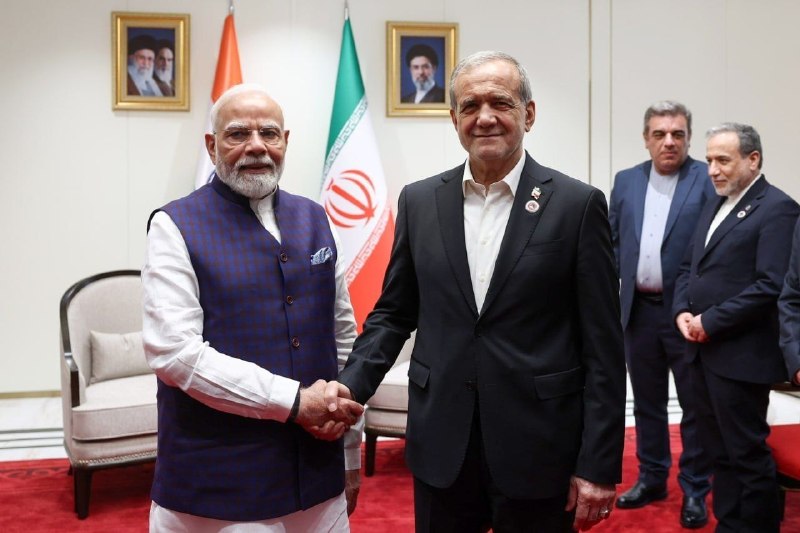
At 10:55 UTC on 31 August 2026, Iran's official IRNA English channel posted that Indian Prime Minister Narendra Modi and Iranian President Masoud Pezeshkian had held a meeting on the sidelines of the Shanghai Cooperation Organisation (SCO) summit in Bishkek, Kyrgyzstan, and relayed Indian foreign ministry language describing the talks as "fruitful."
The substance that the same IRNA post pulled from Indian external-affairs spokesperson Randhir Jaiswal's X account goes further than the single adjective. According to that post, as carried by IRNA, Jaiswal said the two leaders reviewed "recent developments in the West Asia region," discussed the bilateral relationship, and reiterated India's commitment to "dialogue and diplomacy" and to the freedom of navigation. The Indian readout, in other words, was not only a courtesy line.
Two readouts, overlapping substance
The Iranian and Indian sides converged on a similar set of signals, with the substantive overlap now visible in the IRNA post. Tasnim, the news agency affiliated with the Islamic Revolutionary Guard Corps, quoted Modi as telling Pezeshkian that India sought to expand ties and reiterating a commitment to "strengthening" cooperation. IRNA's English channel published both the "fruitful" characterisation attributed to the Indian foreign ministry and the longer set of remarks attributed to Jaiswal. Pezeshkian's own post on Telegram recorded the meeting as having taken place during his Bishkek trip for the SCO summit and the Shanghai Plus meeting.
PressTV's English channel independently confirmed the bilateral at 10:19 UTC, posting that Pezeshkian had left Tehran for Bishkek to attend and address the SCO summit and the Shanghai Plus meeting, and that he had met Modi on the margins. The four Telegram posts from three Iranian state outlets agree on date, venue, and counterparties. The gap between them is now smaller than it first appeared: the Iranian readouts foreground the SCO and Shanghai Plus formats, while the Indian-side readout, as carried by IRNA, adds substance on West Asia, dialogue and navigation. Both note that further engagement is intended.
Why Bishkek, and why now
The SCO summit in Bishkek and the Shanghai Plus format function, in practice, as one of the few diplomatic rooms where an Indian prime minister and an Iranian president can meet, talk substantively, and have that meeting carried by state-aligned outlets on both sides without triggering the political sensitivities that attach to a high-profile bilateral visit in either capital. New Delhi's public posture on Iran has long been complicated by the sanctions regime, by energy-sourcing decisions, and by the operation of the Iranian port of Chabahar, which India has continued to develop with Tehran as part of its connectivity strategy toward Afghanistan, Central Asia and the Caucasus. Tehran, for its part, has an interest in keeping India engaged in those projects precisely because they route around the dollar-cleared financial system.
The Indian readout's references to West Asia and the freedom of navigation suggest the conversation was not confined to bilateral logistics. They are the kind of phrases a foreign ministry uses when it wants to register a position on regional security without binding itself to a specific operational outcome, and they belong to the same diplomatic vocabulary that has accompanied Indian commentary on the Indian Ocean and the Gulf.
A meeting on SCO margins, framed as an SCO and Shanghai Plus engagement rather than a freestanding bilateral, lowers the diplomatic temperature of any announcement that comes out of it. That is part of the design. The Indian foreign ministry can describe the meeting as "fruitful" and acknowledge the West Asia review without committing to a specific deliverable. Pezeshkian's team can publish the same line and signal continuity on the Iranian side.
What the readouts do not specify
The available source items do not specify whether any concrete project, contract, or agreement was discussed. They do not name energy volumes, Chabahar milestones, or sanctions-related technical arrangements. Modi's reported line about "expanding relations in the coming period" remains a directional statement, not a commitment to a specific deliverable on a specific date. The four Telegram posts are Iranian state-aligned and were carried in close sequence on the same morning; the IRNA post reproduces Jaiswal's remarks but is itself a relay of an Indian spokesperson's social-media account rather than an Indian external-affairs press release.
This is the most important caveat for any reader tracking the relationship. The signals are consistent across the readouts, and the Indian-side substance is broader than the headline adjective suggested, but the signals are still not contracts. The Indian ministry of external affairs' own press release on the meeting has not been independently confirmed in the available material; the available material contains only the Iranian state outlets' relay of the Indian framing.
Where the relationship sits structurally
Iran and India do not need each other the way they once did, but they still need the corridor. India's strategic interest in Chabahar, and in connectivity projects that run through Iran into Afghanistan and Central Asia, runs through the same Eurasian landmass that the SCO and the Shanghai Plus format are designed to convene around. For Tehran, India is one of the few large economies that has kept a sustained diplomatic and commercial channel open across years of sanctions pressure, and the readout language is consistent with preserving that channel at a moment when the regional security environment is unsettled.
The structural read, Monexus finds, is that the Bishkek meeting is best understood as corridor maintenance rather than a strategic pivot. The Indian foreign ministry's "fruitful" framing, and the wider Jaiswal remarks on West Asia, dialogue and navigation, are the diplomatic equivalent of keeping the line open and registering a position at the same time. The Iranian readouts are doing the same thing in a different register. Neither side is announcing a new architecture; both are signalling that the existing one is still in use, and that the regional conversation is still on the table.
The next test is whether the SCO summit and Shanghai Plus meeting produce a joint statement, a working-group announcement, or any side-event that references Iran-India deliverables by name. The four morning readouts give no indication that one is imminent.
This article will be updated if the Indian Ministry of External Affairs publishes its own readout, or if the Iranian side releases additional details from the meeting.
Wire provenance
This editorial synthesis draws on the following public wire/social posts:
- https://t.me/Irna_en/38755
- https://t.me/tasnimnews_en/33419
- https://t.me/tasnimnews_en/33417
- https://t.me/presstv/204855
- https://t.me/tasnimnews_en/33416