Berlin just named Moscow. Now comes the harder part.
Germany publicly blamed Russia for the Leipzig airport attack and moved to close consulates. The diplomatic theatre is settled. The strategic question is what comes next.
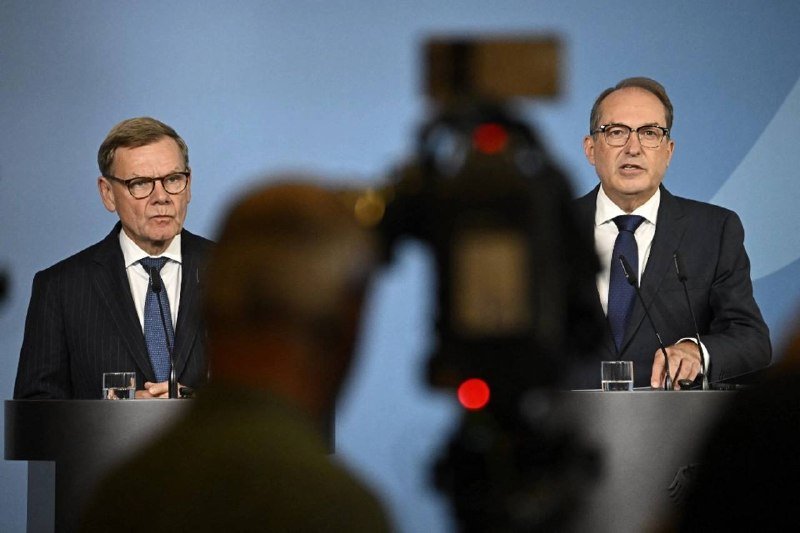
On 1 September 2026, in a joint appearance in Berlin, German Interior Minister Alexander Dobrindt and Foreign Minister Johann Wadephul said what the federal government had spent weeks avoiding. Russia, Dobrindt declared, is responsible for the attempted drone attack on Leipzig/Halle airport on 14 August. The incident, according to open-source channels, involved drones with explosives found at the airport and, per separate reporting, a Ukrainian cargo plane at Leipzig/Halle Airport. Liveuamap frames the airport as a key Ukraine supply hub. The German framing on 1 September was unambiguous. "Ladies and gentlemen, we are not at war," Dobrindt said. "But we are the target of hybrid warfare every day."
That sentence is the news. Not because attribution is new. US intelligence had already assessed that the drones carried devices used by Russia's GRU, and Politico reported that Chancellor Friedrich Merz was preparing to blame Russia for the attempted drone attack and announce extensive sanctions. But Berlin had previously chosen ambiguity. On 1 September it chose clarity, and clarity carries a price. The Russian ambassador has been summoned. The consulate general in Bonn is to close. The lease on the Russia House cultural centre in Berlin is to be ended. Entry controls for Russian citizens will tighten. NATO Secretary-General Mark Rutte offered "full solidarity" and called the incident a "Russian hybrid attack."
What Berlin is actually buying with this naming
Calling out a hostile act by name in front of domestic audiences is the cheapest move a government can make. It costs almost nothing, signals resolve, and shifts the political cost of any future retaliation onto Moscow. The harder moves are the ones announced alongside the language: consulate closure, tightened visa rules, a sanctions package expected to be unveiled in the coming days. Each of these is recoverable in a way that military escalation is not. Closing a consulate is a downgrade of diplomatic relations by one notch; it is not a break.
Monexus assessment: this is calibrated signalling, not a strategic pivot. The German establishment has spent two and a half years avoiding any single act that could be framed by Moscow as crossing a red line. Leipzig gave Merz a domestically legible pretext to ratchet up without owning the escalation narrative. The political work was already done in private; the public statement is the receipt.
The hybrid warfare frame, plainly
"Hybrid warfare" has drifted into a cliché. It deserves to be dragged back to the concrete. Drones with explosives were found at a civilian-military airfield on German soil in mid-August, and US intelligence, per reporting relayed across open-source channels on 1 September, assessed the devices as consistent with equipment used by Russia's GRU. Liveuamap describes the airport as a key Ukraine supply hub. The pattern fits a long catalogue of low-signature probes Western governments have documented for years: sabotage of arms depots, arson at logistics firms, GPS jamming over the Baltic, immigration pressure at border crossings, cyber intrusions into utilities.
The structural point the German statement makes, without saying so explicitly, is that the threshold of attribution has fallen. For most of the post-2014 period, governments preferred plausible deniability on both sides. The attacker could act without owning the act; the target could respond without naming the actor. That compact is breaking. When Berlin names Moscow, it is also signalling to other European capitals that the evidentiary bar for public attribution is now lower than it was a month ago. Expect more naming, faster, from more capitals.
Counterpoint: why the dominant frame might still be incomplete
Two things are worth saying against the consensus reading. First, public attribution is not the same as legal proof. German officials cited intelligence assessments; the underlying evidence has not been laid out in a public docket. The drones carried devices used by Russia's GRU, which is suggestive but not the same as forensic certainty about who launched them. Second, the timing is politically convenient in ways that should give pause. With federal coalition politics unsettled and a public that has grown weary of the Ukraine file, a dramatic Russia-linked attack on German soil is the kind of crisis that recasts domestic debate around security rather than cost. None of this means the attribution is wrong. The available evidence runs toward it. But a reader who treats today's announcement as the end of an investigation rather than the start of one is reading past the question.
What to watch next
Three filings matter in the next 72 hours. First, the German government's sanctions package, which Politico reported is being prepared alongside the attribution statement. Second, Moscow's response. Closing a consulate is the kind of act that invites reciprocal escalation in diplomatic representation; the question is whether the Kremlin treats this as a one-step downgrade or a pretext for a broader rupture. Third, the legal track. If Berlin intends to treat the Leipzig attack as a criminal matter under German law, indictments and Mutual Legal Assistance requests to third countries will follow, and those filings will reveal more about the evidentiary record than any press conference.
The honest reading is that Berlin has spent eighteen months trying to support Ukraine without becoming a co-belligerent in domestic argument. Leipzig gave Merz the political permission to step closer to that line. Whether the step holds depends on what the courts, the coalition, and Moscow do next, not on the language ministers used today.
Desk note: Monexus frames this as a calibrated attribution shift within an ongoing hybrid campaign, not as the start of a new conflict. Wire coverage led with the political announcement; this piece foregrounds the diplomatic, evidentiary, and domestic-political mechanics that the headline buried.
Wire provenance
This editorial synthesis draws on the following public wire/social posts:
- https://liveuamap.com/en/2026/1-september-16-russia-is-responsible-for-the-attack-on-leipzig
- https://t.me/osintlive/568776
- https://t.me/osintlive/568769
- https://t.me/osintlive/568766
- https://t.me/osintlive/568763
- https://t.me/wfwitness/109173
- https://t.me/wfwitness/109172
- https://t.me/rnintel/65951