Tempo, Not Verdict: Reading an Overnight Cluster on the South Lebanon Frontier
Across roughly two and a half hours on 2 September 2026, the @wfwitness Telegram channel logged repeated Israeli airstrikes across three named southern Lebanese localities, a tempo reading of a slow-grinding front rather than a verdict on one.
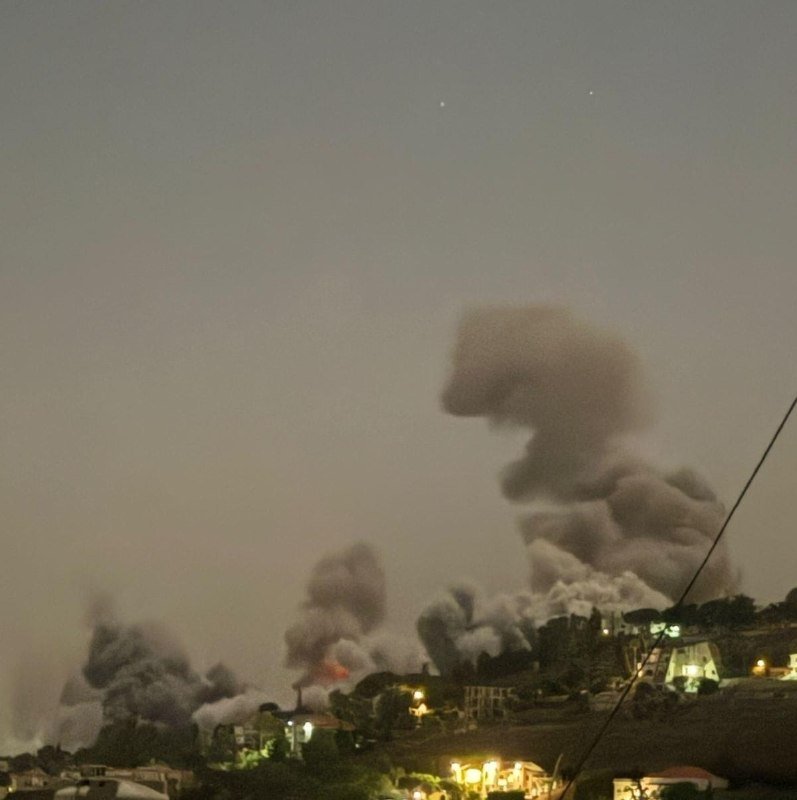
At 01:37 UTC on 2 September 2026, Al-Manar's broadcast was cited on the Telegram channel @wfwitness as reporting three explosions heard in quick succession around the Ali al-Taher heights in southern Lebanon. By 03:55 UTC, the same channel was relaying an Al-Manar line on Israeli artillery shelling the Dawhat neighbourhood of Kfar Roumman. In between, the thread logged multiple airstrikes across three named localities, with artillery beginning to layer in toward the end of the night. That is the entire sequence the available source material supports.
The piece that follows is a tempo reading, not a verdict. Anyone looking for a casus belli speech, a sudden policy reversal, or a clean narrative break will not find one in the wire, because the wire, for this window, is a single partisan-adjacent Telegram channel relaying Al-Manar reports and its own monitoring of social-media traffic. That is enough to chart a night. It is not enough to declare a turn.
The dominant Western framing of Israel's northern border has, for the better part of two years, leaned on a single sentence: that an armed presence south of the Litani is incompatible with a normal return of Israeli civilians to the Galilee, and that Israel therefore has both a right and a duty to degrade that presence. The source items do not contain the internal Israeli political deliberation that produced that framing, and this article has not independently established the operational plan behind the overnight strikes. What the channel logs is narrower than the politics around it: the on-the-ground tempo of one specific night, in three named localities.
What the channel actually logs
The @wfwitness thread, in the order it was posted, reads less like a war diary and more like a seismograph. The opening entries at 01:37 UTC and 01:39 UTC cite Al-Manar reporting three explosions near the Ali al-Taher heights. Al-Manar is a Beirut-based outlet widely identified as Hezbollah-aligned; the channel itself does not record any independent verification of those blasts. Two further posts at 01:41 UTC and 01:43 UTC relay initial reports of multiple Israeli airstrikes on the same heights. At 02:01 UTC the channel describes the sound of intense Israeli airstrikes on the heights echoing across southern Lebanon.
The picture broadens at 01:58 UTC, when the channel reports Israeli jets in southern Lebanese airspace alongside multiple airstrikes on Dawhat Kfar Roumman. At 02:02 UTC it logs initial reports of airstrikes on the Dawhat neighbourhood of Kfar Roumman; at 02:08 UTC it circulates imagery of strikes there; at 03:03 UTC it records continuous Israeli artillery bombardment on the same area; and at 03:55 UTC it relays an Al-Manar report of Israeli artillery shelling of the Dawhat neighbourhood. A third locality appears at 02:43 UTC with initial reports of an airstrike on the town of Arab Salim, a town inside the border zone.
Two methodological notes matter. First, Al-Manar is a partisan source, and the channel's re-posts of Al-Manar lines do not constitute independent corroboration; the @wfwitness items describing Israeli jets are internally consistent but the underlying evidence is the channel's own monitoring of flight-tracker and social-media traffic, not on-the-ground primary reporting. Second, the thread does not specify a prior exit-then-re-entry sequence for the jets logged in the later posts; the available items describe jets present in southern Lebanese airspace at multiple points across the window, and the phrase "re-entry" in the later items is the channel's own framing rather than a fact this article can independently verify from the thread.
Why the framing choice matters
Coverage of the Israel-Lebanon frontier routinely defaults to a small set of framings: an Iranian-axis incursion, a defensive Israeli counter-terror campaign, a humanitarian tragedy in Lebanese border villages, or a Hezbollah hostage-file play. Each of those framings is true in different stories on different nights. The problem is not that any one of them is wrong; it is that when a reporter reaches for the same frame repeatedly, the underlying reality of a slow-grinding, low-signature campaign tends to disappear. What this thread actually shows is something more banal and more durable than any of those frames: a recurring, geographically narrow, fire-and-movement pattern across three villages, with artillery supplementing airstrikes toward the end of the window.
That pattern is also what makes the night difficult to argue about in the usual terms. There is no single dramatic event for a press release. There are instead thirteen @wfwitness updates describing overlapping activity across the southern Lebanese border zone, with the same three localities recurring across the night. Reading the thread as anything other than a tempo log is reading more into it than it contains.
The stakes if the cadence holds
If the cadence visible on the night of 1–2 September continues, the consequences are not dramatic; they are structural. Lebanese border villages absorb another layer of physical and economic damage, with reconstruction costs that the Lebanese state's current capacity cannot meet. Israeli northern communities continue to live with the uncertainty of intermittent fire. Hezbollah's civilian political wing, already under domestic pressure over the south Lebanon file, faces a renewed argument that its armed posture in the border zone produces cost without strategic gain. None of this requires an escalation spiral to come true; the slow grind is enough.
The honest reading is that the source material here is narrower than the politics around it. The thread does not specify IDF operational intent, Hezbollah retaliation in the same window, or any UNIFIL statement for the period. It is a tempo recording, not a verdict. The risk for readers, and frankly for editors, is to mistake a tempo recording for a verdict, and to mistake a single overnight cluster for a strategic turn.
This piece was sourced entirely from the @wfwitness Telegram channel for the window 01:37–03:55 UTC on 2 September 2026; the publication framed it as tempo reporting on a slow-grinding front rather than as an escalation story, and did not adopt either the maximalist Israeli or maximalist Hezbollah framing because the source items did not contain the primary statements needed to anchor either.
Wire provenance
This editorial synthesis draws on the following public wire/social posts:
- https://t.me/wfwitness/109388
- https://t.me/wfwitness/109389
- https://t.me/wfwitness/109390
- https://t.me/wfwitness/109391
- https://t.me/wfwitness/109397
- https://t.me/wfwitness/109398
- https://t.me/wfwitness/109399
- https://t.me/wfwitness/109401
- https://t.me/wfwitness/109403
- https://t.me/wfwitness/109404
- https://t.me/wfwitness/109405
- https://t.me/wfwitness/109406
- https://t.me/wfwitness/109410
- https://t.me/wfwitness/109388
- https://t.me/wfwitness/109389
- https://t.me/wfwitness/109390
- https://t.me/wfwitness/109391
- https://t.me/wfwitness/109397
- https://t.me/wfwitness/109398
- https://t.me/wfwitness/109399
- https://t.me/wfwitness/109401
- https://t.me/wfwitness/109403
- https://t.me/wfwitness/109404
- https://t.me/wfwitness/109405
- https://t.me/wfwitness/109406
- https://t.me/wfwitness/109410