Xi in Cairo: a four-point security pitch and a pointed critique of the existing Middle East order
On a rare Cairo visit, Xi Jinping told Middle East states to be 'masters of their own affairs' and floated a four-point security plan built on what Beijing calls common, comprehensive, cooperative and sustainable security.
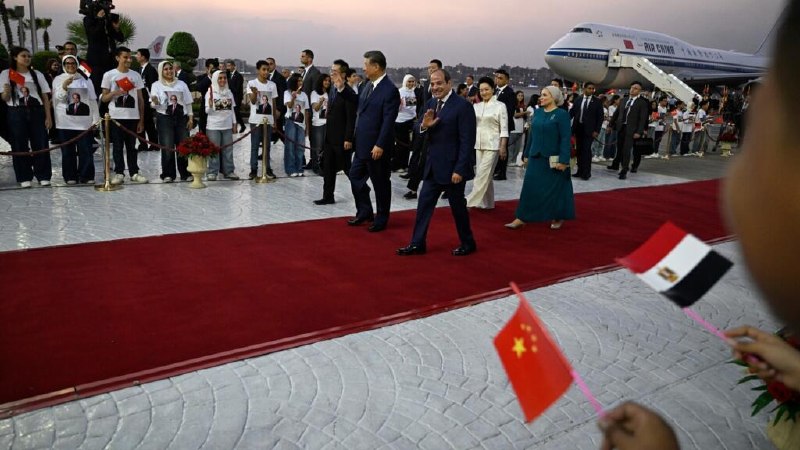
Chinese President Xi Jinping used a visit to Egypt on 2 September 2026 to call on "the people of the Middle East" to be "masters of their own affairs" and to reject "external interference," according to France 24's English-language report on the trip. CGTN, China's state broadcaster, said Xi raised a four-point proposal on building a new security architecture in the Middle East rooted in what Chinese officials describe as common, comprehensive, cooperative and sustainable security. BRICS News framed the intervention, in its own headline, as a Chinese rejection of external interference in Middle Eastern affairs.
The composite picture from the available source items is a position statement, not a deal. Xi offered a regional doctrine rather than a named negotiation track. The four adjectives are doing most of the political work: they describe a vision of security designed by regional states rather than the external powers that have policed the region for decades. The read-out is consistent across CGTN, the CGTN X account, BRICS News and France 24, and there is no third-party endorsement or rejection in the cited material.
The pitch, in the words the sources give us
CGTN reported that Xi's four-point proposal turned on a vision of "common, comprehensive, cooperative and sustainable" security. Translated into the language Middle Eastern governments already use, the four words imply that regional security should be designed in common by regional states, that it should cover political and economic as well as military dimensions, that cooperation should displace confrontation as the default, and that it should outlast any single political cycle. The accompanying line, carried by both France 24 and BRICS News, is the call for Middle Eastern states to reject external interference and to manage their own affairs. Together, the four adjectives and the anti-interference frame form the political content of the speech.
The implicit target of the anti-interference line is the security architecture that Arab and Israeli governments have lived inside since the 1990s, in which extra-regional powers station forces, supply advanced arms and run sanctions regimes. Beijing has a documented objection, of long standing, to US sanctions and to extraterritorial enforcement. Elevating that objection from a commercial complaint to a regional security doctrine, in Cairo, is the move that turns the speech from commentary into proposition.
What the available sources do, and do not, establish
On the speech itself, the four cited items converge: Xi was in Egypt around 2 September 2026 (the France 24 English report and the CGTN item carry that date, France 24's excerpt references "on Wednesday"); he framed his host region as capable of running its own affairs; he tabled a four-point proposal for a regional security architecture; and he named external interference as something to reject. The available source items do not specify whether any Arab or other Middle Eastern government has publicly endorsed, rejected or amended the proposal, nor do they document a written text, a follow-up summit, or a parallel negotiation track. The visit is therefore best read as a launched framework with diplomatic weight, rather than as a completed transaction.
Monexus analysis: the convergence between CGTN, the CGTN X account, France 24's English-language service and the BRICS News Telegram channel on the four adjectives and on the anti-interference frame is itself a data point. The framing is being coordinated, which suggests the speech is meant to travel. The absence of any third-party endorsement in the cited material does not, on its own, tell us anything about reception; it tells us only that the cited items do not yet record one.
The structural read, in plain prose
Monexus assessment: the Cairo pitch is best read as the public face of a longer effort by Beijing to position itself as an alternative venue for Middle Eastern security conversations, at a moment when several Arab governments are visibly hedging their external alignments. The four-point proposal is a framework, not a mechanism: it does not, on the cited evidence, offer to escort tankers, station forces or underwrite a ceasefire. It offers an agenda, a vocabulary, and the implicit promise of a regional table at which China is a peer rather than an outside patron, and at which the existing extra-regional powers would, by Beijing's design, have to operate on terms set in the region.
The constraint on that frame is the gap between diplomatic vocabulary and the operational hardware of regional security. Beijing can chair, finance and ideologically arm a forum; it cannot, on the cited evidence, replace the air defence, the naval escort capacity, or the sanctions enforcement that governments in the Gulf and the Levant have come to rely on. Whether the four-point proposal moves from vocabulary into contracting, basing and arms-procurement decisions is the question the next 30 to 90 days will settle, in the language of communiqués and in the politics of who shows up where.
Stakes and what to watch next
If the framework gains traction, the most concrete early consequences would be visible in three places: the venue of regional security summits, the language of joint communiqués, and the contracting patterns around energy, infrastructure and arms. A shift in any one of those would matter; a shift in all three would mark the kind of structural realignment that has been talked about for years but rarely measured. The next data points worth watching are official Egyptian read-outs, any reaction from the Saudi, Emirati, Qatari or Jordanian foreign ministries, Iranian state-media framing of Xi's words, Israeli responses from the Prime Minister's Office or the Foreign Ministry, and a US State Department brief.
What remains genuinely uncertain is whether this is the opening bid of a sustained Chinese security doctrine in the Middle East or a one-off statement calibrated to a specific Arab audience at a specific moment. The available source items do not specify whether China has tabled a written text of the four-point proposal, whether follow-up meetings have been scheduled, or whether any third-party government has formally endorsed the framework. Those are the questions the next reporting cycle will settle, and they will be settled in the language of communiqués, in the politics of who hosts the next meeting, and in the fine print of the contracts that get signed in the margins.
This piece framed Xi's Cairo speech as a structural intervention in Middle East security debates rather than a discrete mediation. Where the cited wire items framed the visit, Monexus reads the four-point proposal as a forum-building move; where BRICS News framed it as anti-interference, Monexus reads the adjectives as a coordinated diplomatic vocabulary designed to travel beyond Cairo.
Wire provenance
This editorial synthesis draws on the following public wire/social posts:
- https://www.france24.com/en/middle-east/20260902-xi-calls-on-mideast-nations-to-be-masters-of-their-own-affairs-in-rare-egypt-visit
- https://news.cgtn.com/news/2026-09-02/Xi-raises-proposal-on-new-security-architecture-for-Middle-East-1Q7b7AaQ4XC/p.html
- https://x.com/CGTNOfficial/status/2095169329377759574
- https://t.me/bricsnews/18059
- https://t.me/france24_en/18454
- https://www.france24.com/en/middle-east/20260902-xi-calls-on-mideast-nations-to-be-masters-of-their-own-affairs-in-rare-egypt-visit
- https://news.cgtn.com/news/2026-09-02/Xi-raises-proposal-on-new-security-architecture-for-Middle-East-1Q7b7AaQ4XC/p.html
- https://x.com/CGTNOfficial/status/2095169329377759574
- https://t.me/bricsnews/18059
- https://t.me/france24_en/18454