Madrid clears Rabat of orchestration in July Ceuta border rush, keeps internal police report under wraps
Pedro Sanchez says investigators found no proof Morocco directed the deadly July crossing into Ceuta. A Spanish police report pointed to multiple Moroccan failings. Both can be true, and Madrid is choosing which one to make public.
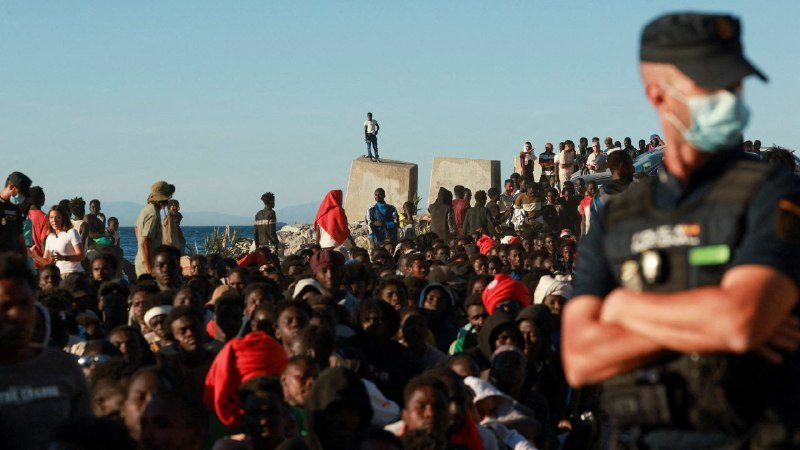
Spanish Prime Minister Pedro Sanchez told parliament on 3 September 2026 that investigators had found no "solid proof" Morocco orchestrated the 17 July migrant crossing into the North African enclave of Ceuta, in which at least two people died and dozens were injured. The statement, reported by Reuters at 08:35 UTC and by France 24 at roughly the same moment, narrows the public record while leaving a parallel Spanish police assessment, one that flagged multiple failings by Moroccan security forces, largely outside the official narrative.
The two accounts are not formally contradictory. Sanchez is drawing a legal line: there is no evidentiary basis to publicly accuse Rabat of directing the operation as a deliberate act of pressure against Madrid. The leaked police assessment, parts of which Spanish outlets have cited, points the other way: it describes coordination failures, slow reaction, and a posture that allowed the crowd to mass and surge toward the Tarajal border post. Madrid is choosing the first framing for its diplomatic posture, and the second framing for its internal review. That choice, and what it preserves for Madrid's relationship with Rabat, is now the story.
What Sanchez actually said
The Spanish leader's intervention, delivered in the lower house on 3 September, was narrow and procedural. Investigators had examined video, radio traffic, telephone records and Moroccan official communiqués, and could not establish that the crossing was planned or directed by Moroccan authorities. The wording matters: Sanchez did not deny that Moroccan border units failed to respond in time, did not deny that the crowd assembled under Moroccan supervision on Moroccan soil, and did not rule out a more diffuse kind of pressure. He drew a line between orchestration, which requires evidence of command intent, and negligence, which the Spanish police report describes in some detail.
That distinction is familiar from any number of cross-border flashpoints. It is the difference between an act of war and a failure of duty. Madrid is not, on this evidence, willing to accuse a fellow NATO dialogue partner and a critical partner on counter-terrorism and migration control of deliberately weaponising a humanitarian flow. The political cost of naming Rabat as the architect of a deadly episode is high: Spain depends on Moroccan cooperation on the western Mediterranean route, on the fight against jihadist recruitment in the Maghreb, and on a fragile bilateral arrangement over the long-disputed status of Western Sahara that the European Court of Justice has repeatedly complicated.
The police report that won't go away
Sanchez's careful framing sits awkwardly next to a separate Spanish police assessment that has surfaced in fragments. That document, referenced by France 24 in its 3 September reporting, describes multiple failures by Moroccan security forces in the hours before the 17 July crossing. The crowd of several hundred sub-Saharan migrants, many of them women and minors, gathered near the Tarajal frontier in conditions that, the assessment suggests, Moroccan units could have dispersed or contained.
The available source items do not specify the full content of the police report, including the specific operational details of those alleged failures. What is on the record is a public version in which Sanchez treats the question of intent as unproven, while the institutional review points to capability and disposition. Both can be accurate. The crowd could have surged through a hole that Moroccan border police allowed to stay open, without Rabat having ordered the hole cut. Whether that is exoneration or merely the absence of proof of orchestration is the political question Madrid now has to manage in plain sight.
Why Spain needs Morocco more than the other way round
The diplomatic geometry explains the calibrated language. Morocco is Spain's southern neighbour and the gatekeeper of the Strait of Gibraltar approach to two Spanish enclaves, Ceuta and Melilla. It is also the indispensable operational partner on migration flows that have put the western Mediterranean route on the front pages of European interior ministries for two decades. Spain's rotating EU Council presidency in the latter half of 2023 institutionalised a relationship that was already very close; successive Spanish governments have treated Rabat as a structural interlocutor, not an episodic one.
That dependence has produced a pattern visible across the past five years. Border incidents that might, in a different bilateral context, have triggered summoning of ambassadors or public condemnation have instead been met with quiet demarches, joint working groups, and the steady diplomatic drumbeat of normalising ties. In 2022 Madrid publicly endorsed Morocco's autonomy plan for Western Sahara, a once-unthinkable concession that the Sanchez government made to reset relations after a 2021 border crisis in which Rabat effectively weaponised migration flows against Spain. The 2026 episode lands inside that same logic. Sanchez is signalling that the relationship will not be ruptured by a single incident, however deadly, unless the evidence compels it.
What the evidence still has to settle
Three questions remain live as of 3 September 2026, none of them fully resolved by the parliamentary statement or the police fragments now in circulation.
First, the chain of command on the Moroccan side. Did the order not to disperse the crowd come from a local commander, from a regional directorate, or from a national-level instruction? The available source items do not specify. Sanchez's "no solid proof" claim is a statement about the public evidentiary record, not a finding of innocence.
Second, the casualty count. Two deaths are confirmed in the reporting to hand. Whether the toll rises as forensic and hospital records are reconciled is, on this evidence, open. Families of the dead, many of whom crossed from countries across the Sahel, have been waiting on official identification that the source items do not describe.
Third, the European dimension. The Ceuta crossing occurred in July, during a heated debate in Brussels over the EU's revised Pact on Migration and Asylum. Spain is one of the front-line states whose consent the Pact depends on. Madrid's calibrated language toward Rabat is also a calibrated language toward Brussels: an admission that a neighbouring state orchestrated a deadly border rush would have accelerated the case for mandatory solidarity mechanisms Spain has long resisted on grounds of sovereignty. The safer institutional answer, for now, is that the evidence does not yet prove orchestration, and that the bilateral relationship will carry the rest.
Desk note: The two leading wire versions of this story, Reuters and France 24, both filed inside an hour of each other and converged on Sanchez's words, but they framed the police report differently in their ledes. Reuters led with the absolution; France 24 led with the police report's failures. Monexus reads the gap between those two ledes as the actual news of the day.
Wire provenance
This editorial synthesis draws on the following public wire/social posts:
- https://reut.rs/4gyIAYT
- https://x.com/Reuters/status/2095430368606163421
- https://f24.my/C8XZ.g
- https://t.me/france24_en/18466
- https://www.france24.com/en/europe/20260903-spanish-pm-sanchez-says-no-solid-proof-morocco-planned-ceuta-migrant-rush