Carney and Macron use a foggy archipelago to sketch the post-American Atlantic
On a French archipelago off Newfoundland, the Canadian prime minister and the French president pitched a tighter bilateral pact and an EU alignment for Ottawa, framed as insurance against a less predictable United States.
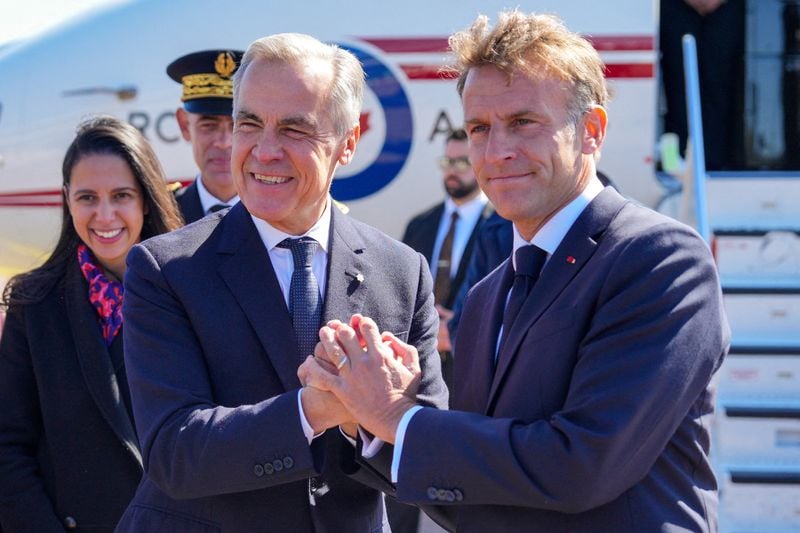
Two leaders stood on a sliver of French sovereign territory in the North Atlantic on Sunday and, with the fog behind them, told a watching world that the post-Cold-War vocabulary of Western solidarity no longer fits the moment. Mark Carney, prime minister of Canada, and Emmanuel Macron, president of France, met on Saint Pierre and Miquelon, a French archipelago off the coast of Newfoundland, and announced a programme of deeper cooperation on energy, artificial intelligence and a closer Canada–EU alignment. The subtext, in two languages and on two coasts, was the same: the United States, under President Donald Trump, has become a less reliable anchor for the Atlantic democracies, and the smaller allies intend to organise around that fact. (France 24, 20 September 2026, 18:05 UTC and 18:24 UTC; Investing.com, 17:48 UTC.)
The argument is that Canada and France share something more specific than values rhetoric: a stake in building sovereign capacity in the technologies that increasingly determine national weight. Carney put the framing in direct terms. Sovereignty, he said in remarks relayed from the joint appearance, no longer means only the ability to feed, fuel and defend a country; it requires secure access to artificial intelligence, to space, to semiconductors, to critical minerals and to clean energy. (ClashReport relay of Carney remarks, 19:16 UTC.) On AI specifically, Carney named only four countries "at the forefront": France, Canada, China and the United States. The implication, drawn out by the prime minister himself, was that the smaller three have an interest in joining forces "to ensure an appropriate framework so that AI is safe and effective." (ClashReport relay of Carney remarks, 19:14 UTC.)
What was actually announced
The joint programme, as the two leaders described it on Sunday, sits at the intersection of three bilateral workstreams. The first is energy. Macron told the press conference, according to a relay of his remarks, that France and Canada must work together "to secure our energy supplies and keep fuel prices under control," and pointed to Canadian liquefied natural gas as a near-term lever for European supply diversification. (ClashReport relay of Macron remarks, 18:59 UTC.) The second is artificial-intelligence governance, framed by Carney as a regulatory and standards effort that the two countries, plus a small group of peers, would lead. The third is political and trade architecture: Macron publicly endorsed Canada's agenda of closer ties with the European Union, telling reporters that French-Canadian ties are extremely important and that France is "very much in favor of that agenda." (War Frontlines Witness relay of Macron remarks, 18:05 UTC.)
The venue mattered as much as the script. Saint Pierre and Miquelon is a French sovereign archipelago that sits, on the maps, between Newfoundland and the open Atlantic, an artefact of an earlier North Atlantic settlement pattern. Meeting there, rather than in Paris or Ottawa, made the geography do some of the argument: two great independent nations whose nearest points of land are a few kilometres apart, and whose "values are even closer," as Carney put it. (ClashReport relay of Carney remarks, 19:20 UTC; France 24 joint news conference replay, 18:24 UTC.) For Macron, hosting a G7 leader on French soil so close to Canada was also a domestic signal that France retains a sovereign presence in the western Atlantic and intends to keep it. (France 24, 18:05 UTC; France 24 replay, 18:24 UTC.)
The pressure that produced the meeting
This was not a meeting that either leader would have prioritised a year ago. The forcing function is the trade war the United States has been waging, under tariff regimes issued and re-issued by the Trump administration, against a wide range of partners including Canada, the European Union and adjacent economies. (ClashReport relay of Carney remarks on shared threats, 19:16 UTC; Investing.com framing of trip, 17:48 UTC.) For Ottawa, the question is no longer whether to deepen ties with Brussels, but how quickly and on what terms. For Paris, the same trade pressure hits an energy-hungry industrial base whose import bill is exposed both to American LNG volatility and to the broader weaponisation of supply chains. Carney's office framed the trip as a response to "new global threats," a phrase intended to cover the full basket: trade coercion, supply dependence, the contested governance of frontier technologies. (Investing.com, 20 September 2026, 17:48 UTC.)
The bilateral has been in the works at the working level for months. What changed was the political weather. A Canadian government that, twenty-four months ago, would have framed any rapprochement with the EU as an economic file, is now framing it as a sovereignty file, in the precise sense Carney used on Sunday: the capacity to act independently when the principal partner is unreliable. The French side, for its part, has spent two years arguing inside the EU for a more autonomous European industrial capacity in semiconductors, batteries and AI compute. A Canada that brings critical minerals, hydroelectric power, a domestic AI research base centred in Montreal, and a parliamentary system comfortable with regulation is, from Paris's vantage point, a useful ally rather than a peripheral Anglosphere cousin. (France 24, 18:05 UTC.)
A first-party qualifier is worth flagging here. In remarks reported on 14 September 2026 under a Reuters headline, Carney said Canada seeks a "unique alliance" with the European Union but not membership. Monexus analysis: Sunday's announcement should therefore be read as Ottawa pushing for an EU-aligned posture short of accession, with Macron's endorsement functioning as French support for that alliance-grade alignment rather than for full membership. The thread evidence on Sunday itself does not specify the precise legal form Canada is seeking; the 14 September Reuters framing is the cleanest first-party statement available, and it sits one click outside the supplied thread.
What this is, and what it is not
The Monexus assessment is that Sunday's announcement should be read as a coordination pact, not a strategic bloc. The available source items do not specify the existence, absence or content of any treaty-level text; they do not specify any funding envelope attached to the AI or energy workstreams; and they name only Macron and Carney as participants on the leaders' stage at Saint Pierre and Miquelon. The meeting, as described, produced a shared vocabulary, a calendar of working-group activity and an explicit French endorsement of closer Canada–EU ties as a strategic objective. The cited posts do not establish what institutional form, if any, will follow. (France 24, 18:05 UTC; France 24 replay, 18:24 UTC.)
A plausible counter-reading is that the meeting is precisely what it appears to be: two leaders performing the diplomatic minimum required to demonstrate to domestic audiences, and to Washington, that they are no longer operating on the assumption that the transatlantic status quo will hold. Under that read, the substance will follow in EU council meetings, in G7 preparatory tracks and in bilateral working groups that already exist. Carney's reference to AI in the same breath as critical minerals and semiconductors suggests the Canadian government is treating technological sovereignty as a single portfolio rather than a set of separate dossiers, and is looking for partners who will treat it the same way. Macron's explicit endorsement of closer Canada–EU ties is the more durable signal of the two, because it is a position France will be expected to defend inside the European Council. (War Frontlines Witness relay of Macron remarks, 18:05 UTC; ClashReport relays of Carney remarks, 19:14 UTC and 19:16 UTC.)
What to watch next
Three dates will tell whether Sunday was a turning point or a photograph. The first is the next European Council meeting, where Macron's support for closer Canada–EU ties will be tested against the positions of member states that are less enthusiastic about further enlargement. The second is the next G7 finance-track or trade-track meeting, where Carney and Macron will have to decide whether the AI and energy workstreams produce a joint text or a joint communiqué line. The third is any Canadian provincial election cycle, since the constitutional mechanics of deeper EU integration run through provincial competence and will, sooner rather than later, become a federal-provincial argument inside Canada.
The harder question is whether the bilateral can survive contact with the question Carney himself named: how a Canada–France axis positions itself on AI governance in a four-country field that includes the United States and China. Carney's formulation was deliberately inclusive of all four, and Macron did not contradict him. If the partnership produces a regulatory framework that is presented as a transatlantic offer to Washington rather than as a hedge against it, the political logic holds. If it is read in Washington as a hedge, the partnership will absorb friction. The available source items do not specify any official US response to Sunday's announcement.
Desk note: Monexus framed this against the wire's default "values" framing and pushed the analysis toward industrial policy and the AI governance portfolio, where the actual decisions will be made. The wire's read, particularly from French outlets, emphasised the symbolic geography of Saint Pierre and Miquelon; Monexus's read is that the venue mattered less than the explicit French endorsement of closer Canada–EU alignment, which is the concrete policy deliverable of the day, tempered by Carney's own 14 September "unique alliance, not membership" framing reported by Reuters.
Wire provenance
This editorial synthesis draws on the following public wire/social posts:
- https://www.investing.com/news/world-news/canadas-carney-calls-for-stronger-ties-with-france-in-face-of-new-global-threats-4908187
- https://www.france24.com/en/france/20260920-macron-carney-hail-new-chapter-in-france-canada-ties-at-symbolic-archipelago-meeting
- https://www.france24.com/en/replay-macron-carney-hail-new-chapter-on-france-canada-ties-at-st-pierre-and-miquelon-meeting
- https://t.me/ClashReport/97387
- https://t.me/ClashReport/97386
- https://t.me/ClashReport/97385
- https://t.me/ClashReport/97383
- https://t.me/wfwitness/112132
- https://www.aljazeera.com/news/2026/9/20/frances-macron-and-canadas-carney-announce-plans-to-build-stronger-ties?traffic_source=rss
- https://www.investing.com/news/world-news/canadas-carney-calls-for-stronger-ties-with-france-in-face-of-new-global-threats-4908187
- https://www.france24.com/en/france/20260920-macron-carney-hail-new-chapter-in-france-canada-ties-at-symbolic-archipelago-meeting
- https://www.france24.com/en/replay-macron-carney-hail-new-chapter-on-france-canada-ties-at-st-pierre-and-miquelon-meeting
- https://t.me/ClashReport/97387
- https://t.me/ClashReport/97386
- https://t.me/ClashReport/97385
- https://t.me/ClashReport/97383
- https://t.me/wfwitness/112132
- https://www.aljazeera.com/news/2026/9/20/frances-macron-and-canadas-carney-announce-plans-to-build-stronger-ties?traffic_source=rss