Three carriers and an open question: reading the Roosevelt's sortee against the sources
The USS Theodore Roosevelt left San Diego on 1 October 2026, putting a third US carrier in the CENTCOM theatre by the end of November alongside two amphibious groups. Reading the deployment honestly means cataloguing what the sources state, and what they do not.
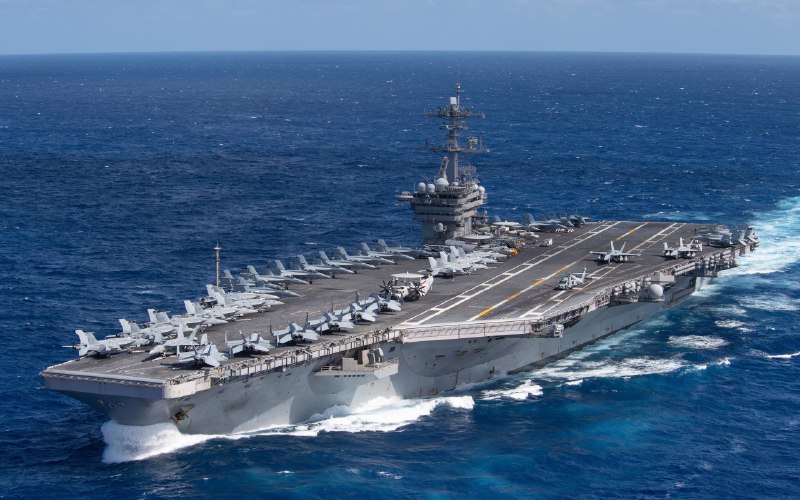
The USS Theodore Roosevelt and its carrier strike group departed Naval Base San Diego on 1 October 2026, bound for the US Central Command area of responsibility, according to a US official speaking to Al Jazeera and relayed by multiple open-source intelligence channels. By mid-November, the Roosevelt is expected to arrive in the CENTCOM area; by the end of November, the same official told Al Jazeera, three US aircraft carriers and two amphibious groups will be deployed around Iran.
That is the verifiable shape of the deployment as captured by the open-source channels reporting on the afternoon of 1 October 2026. Everything beyond those lines, from the political intent behind the move to whether the deployment telegraphs a strike on Iran or a hardening of the tripwire around it, is contested ground. This article reads the deployment as evidence, not as choreography: it catalogues what has been confirmed in the cited channels, names what they leave unspecified, and resists the temptation to treat a carrier sortee as a press release.
The signal value of three carriers in one theatre is real. So is the gap between a signal and an act, and so is the gap between what the US official said on the record and what the Telegram relays then layered on top.
The movement on the water
The headline fact is mundane and precise: a Nimitz-class carrier and its accompanying strike group have left their homeport and are in transit. Six open-source items circulated in the hour between 14:55 and 15:28 UTC on 1 October 2026. Two posts from Middle East Spectator reported the departure, citing a single US source and the same Al Jazeera exchange. The first Middle East Spectator post, at 15:05 UTC, carried both the carrier announcement and the line that Trump has said he is considering continuing the war against Iran after the November 3 midterms; the second Middle East Spectator post, at 15:28 UTC, repeated the carrier announcement without that political line. The channel rnintel carried the same announcement, calling the Roosevelt the third carrier in the region. The channel intelslava attributed the deployment to "a senior US official" speaking to reporters and, in a separate item posted minutes earlier at 14:55 UTC, framed it as the prelude to "a surprise strike on Iran" that is "imminent"; intelslava's later update added that, in its reading, "Trump has again threatened to bomb Iran" and that "preparations are underway for another strike against Iran." ClashReport published the relevant Al Jazeera line in full, including the end-of-November endpoint and the two amphibious groups.
What the cited items agree on:
- The carrier is the USS Theodore Roosevelt, described as the third US carrier moving into the CENTCOM area.
- The strike group departed San Diego on 1 October 2026.
- The Roosevelt is expected to arrive in the CENTCOM area by mid-November.
- By the end of November 2026, three US aircraft carriers and two amphibious groups will be deployed around Iran.
- The announcement came from a US official speaking to Al Jazeera, not from the Pentagon podium or US Central Command's public affairs shop.
- The Roosevelt will probably replace the USS George Washington, in Middle East Spectator's hedged language; the cited items do not specify the George Washington's port of origin or its arrival date.
What the cited items do not specify:
- The strike group's escort composition.
- The transit route.
- Any explicit operational tasking beyond presence.
- Whether the deployment was ordered by the executive alone, requested by CENTCOM, or coordinated with allies.
- The George Washington's port of origin, its arrival date in the CENTCOM area, or any independent confirmation that it is being rotated out.
- A venue or transcript for Trump's statement about considering continuing the war against Iran after the November 3 midterms; the cited items do not specify where or when he said it.
One political framing is also present in the source stream and worth surfacing. Middle East Spectator's first post of the afternoon, at 15:05 UTC, carries the line that Trump has said he is considering continuing the war against Iran after the November 3 midterms. The cited items do not specify the venue or transcript for that statement, and the framing sits adjacent to rather than inside the carrier announcement itself. It is nonetheless part of the political context the deployment lands in.
What we verified and what we could not
This piece is built on six open-source items from four channels, all dated 1 October 2026, and all pointing back to a single US official speaking to a single outlet. The pattern is consistent with a single underlying exchange being relayed across channels, but the cited items do not independently confirm a separate Pentagon or CENTCOM statement.
Verified from the cited items:
- The Roosevelt's departure from San Diego on 1 October 2026.
- The expectation of arrival in the CENTCOM area by mid-November.
- The end-of-November count of three carriers and two amphibious groups deployed around Iran.
- The hedged Middle East Spectator framing that the Roosevelt will probably replace the USS George Washington.
- The US-official-to-Al-Jazeera provenance of the announcement.
- The Trump-attributed statement in Middle East Spectator's first post that he is considering continuing the war against Iran after the November 3 midterms.
- The intelslava framing, in two separate items, that the deployment is the prelude to a "surprise strike on Iran" that is "imminent," that Trump "has again threatened to bomb Iran," and that "preparations are underway for another strike against Iran."
What the cited items do not establish:
- Independent confirmation beyond the single Al Jazeera exchange.
- The carrier's hull number, class designation, or strike-group composition.
- Any operational tasking or rules of engagement.
- Israeli coordination or commentary. The cited items do not contain an Israeli statement on the deployment, and this article has not independently established whether Israel has commented.
- The named origin of the "surprise strike on Iran imminent" framing in intelslava's earlier item, which the channel attributes to its own intel rather than to an on-record source.
- The George Washington's port of origin or the date it arrived in the CENTCOM area, both of which would be needed to confirm the rotation framing on independent evidence.
- A venue, date, or transcript for Trump's statement about considering continuing the war after the midterms.
The signal, read honestly
Monexus assessment: the difference between a deployment and an ultimatum is operational tasking, which has not been disclosed in the cited items. The signal value of three carriers and two amphibious groups in one theatre is real and worth taking seriously. The inference that a strike is therefore imminent is editorialised in two distinct intelslava items, which frame the deployment as "imminent" surprise action, add that Trump "has again threatened to bomb Iran," and assert that "preparations are underway for another strike against Iran." That framing is not supported by the same sourcing elsewhere in the stream. The US official quoted by Al Jazeera and relayed by ClashReport described presence, not intent; Middle East Spectator described the carrier sortee and, separately, the Trump political line; rnintel described the third-carrier headline without an imminent-strike overlay.
The substitution framing matters as well. Middle East Spectator uses hedged language, saying the Roosevelt will "probably" replace the George Washington, and the cited items do not specify when the George Washington arrived in theatre or where it came from. The conservative reading is that the Roosevelt fills a slot the George Washington is vacating, while the total count of three carriers and two amphibious groups by the end of November reflects the steady-state posture around Iran. The cited items do not contain the evidence needed to upgrade that probability from "probably" to "confirmed," and they do not independently corroborate the rotation frame on either side.
That reading does not soften the signal. Three carriers and two amphibious groups around Iran is still a heavy footprint. It simply is not, on the evidence available, an escalation beyond what the cited items describe, and the "imminent strike" framing in the intelslava items is the channel's own layered reading rather than a fact carried by the underlying US-official exchange.
What the alternative reading is
There is a second reading of the deployment that does not require a strike to follow, and it deserves equal airtime.
The Trump statement carried by Middle East Spectator, that he is considering continuing the war against Iran after the November 3 midterms, frames the deployment inside a political calendar. The end-of-November posture arrives after the midterm window. The political reading is that the deployment creates an option set, not an event: the carriers are in place if a decision is taken, and the decision is not yet visibly taken on the basis of the cited items. The tripwire narrows; the trigger is not pulled.
A third reading worth flagging is the simplest one. The cited items describe a steady-state rotation: the George Washington is in theatre, the Roosevelt will probably replace it, and the total count of three carriers and two amphibious groups by the end of November is the planned autumn posture. The intelslava framing of an "imminent" strike, of Trump having "again threatened to bomb Iran," and of "preparations underway for another strike against Iran" is editorial layered on top of the carrier announcement. The US official's framing is presence. The political statement from Trump is about the option to continue a war, not about a strike this week.
Monexus analysis: read together, the cited items describe a US posture that is heavy, deliberate, and contested in interpretation, not a countdown to a single military event. The framing that treats the Roosevelt's departure as the start of a strike sequence is one reading of the evidence. The framing that treats it as the continuation of a rotation is another, and the latter is at least as well supported by the cited items as the former.
What this changes, and what it does not
What it changes is the cost-benefit of any Iranian move against US naval forces in the region. Three carriers and two amphibious groups in the same area of responsibility as Iran's missile force narrows the gap between presence and escalation. Any Iranian action against a US asset, whether a carrier strike group, an amphibious group, or a base in the Gulf, now triggers a response calculus that has to weigh the loss of multiple air wings and embarked Marine units rather than one hull.
What it does not change is the political constraint. The cited items do not specify a US decision to strike, an Israeli decision to strike with US logistical and intelligence support, or a cascading regional event that creates a casus belli. The Trump statement in Middle East Spectator's first post frames his consideration of continuing a war, not a strike this week. None of those decisions are visibly before the US Congress or the White House as of the afternoon of 1 October 2026 on the basis of the cited items.
What it does change is the information environment. Six open-source items from four channels carried the same underlying announcement within roughly half an hour, with intelslava then layering an editorialised imminent-strike reading on top across two separate items. The pattern is a useful object lesson in how a single official exchange gets amplified, narrowed, and reframed as it passes through relays. The wire framing (one US official, one outlet, presence language) and the Telegram-relay framing (imminent strike, preparations underway) describe two different stories, and the cited items do not bridge them.
What to watch by November
Three dates matter in the next sixty days.
The first is mid-November, when the Roosevelt is expected to arrive in the CENTCOM area. Open-source channels that track US Navy movements will publish the transit photos and AIS data that confirm the hull's location.
The second is November 3, the US midterm date referenced in the Trump statement carried by Middle East Spectator. Whether the political framing of the deployment changes after that date is itself a signal.
The third is the end of November, the deadline by which the US official told Al Jazeera three carriers and two amphibious groups will be deployed around Iran. Whether that posture is met on schedule, slipped, or accelerated is the cleanest single signal of whether the US is converging on action or on posture.
Desk note: Monexus framed the Roosevelt's deployment as a posture signal to be read against what the cited items actually state, rather than against the editorialised strike framing that the Telegram relays layered on top. The wire framing, where it exists in the source stream, describes presence and a probable George Washington replacement; the intelslava items describe an imminent strike, restate that Trump has again threatened to bomb Iran, and assert that preparations are underway for another strike. Monexus finds the more defensible read is the harder one: a real signal whose meaning is genuinely unsettled, and whose political context includes a first-party statement from Trump, carried by Middle East Spectator, about continuing a war after the November 3 midterms.
Wire provenance
This editorial synthesis draws on the following public wire/social posts:
- https://t.me/Middle_East_Spectator/37243
- https://t.me/Middle_East_Spectator/37242
- https://t.me/rnintel/67120
- https://t.me/intelslava/95540
- https://t.me/intelslava/95539
- https://t.me/ClashReport/99209