Iran's Khamenei adviser says three Gulf islands 'will remain Iranian,' taunts a younger neighbour
Ali Akbar Velayati, adviser to Supreme Leader Ayatollah Ali Khamenei, publicly reaffirms Iranian sovereignty over Greater Tunb, Lesser Tunb and Abu Musa across six Iranian state-aligned Telegram channels in a half-hour window on 3 October 2026. The line aimed at a country "not even half a century old" is widely read in the regional press as addressed to the United Arab Emirates.
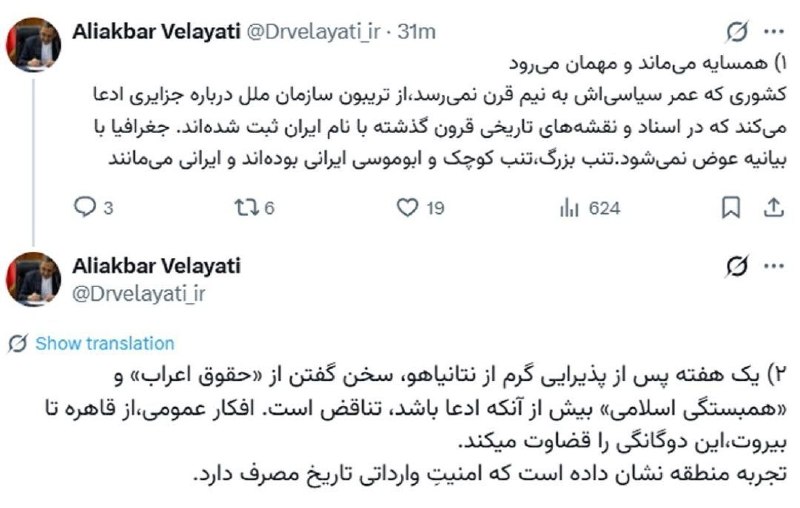
On 3 October 2026, at 15:14 UTC, Iran's Fars News Agency posted a short statement from Ali Akbar Velayati, identified in the post as an adviser to Supreme Leader Ayatollah Ali Khamenei. A country "not even half a century old," Velayati said, is making claims over Iran's historic islands, and those islands "have been Iranian and will remain Iranian." Within four minutes, the same lines appeared, almost verbatim, on the English feed of Tasnim News and on Mehr News. By 15:43 UTC the framing had hardened across six Iranian state-aligned Telegram channels, with al-Alam adding the sharper formulation that "the region's experience has shown that imported security has an expiration date."
The target of Velayati's taunt is not named in any of the six posts reviewed here. Monexus analysis: the arithmetic of the remark, "a country not even half a century old," most naturally points to the United Arab Emirates, founded in 1971 and now in its fifty-fifth year. Iran International, a Persian-language outlet widely read in the Iranian diaspora, has separately reported the same day's statement as addressed to the UAE, which is consistent with the inference but is not stated in the six Telegram posts that anchor this article. The three islands named in every post are Greater Tunb, Lesser Tunb, and Abu Musa. The available source items do not specify the precise UAE action, if any, that prompted Friday's messaging cycle, or whether the foreign ministry in Tehran coordinated the rollout with Velayati's office.
The rollout pattern
The six Telegram posts carry effectively the same three-sentence payload. Fars opens at 15:14 UTC. Jahan Tasnim follows at 15:17 UTC and Tasnim's English feed at 15:18 UTC. Mehr posts at 15:16 UTC. PressTV posts at 15:29 UTC under a slightly different speaker label, calling Velayati "Aide to Leader." Al-Alam closes the cluster at 15:43 UTC with the added line on "imported security." The same verbs recur ("have been, will remain Iranian"), the same historical anchor (Greater Tunb, Lesser Tunb, Abu Musa), and the same temporal taunt aimed at a younger neighbour. The underlying language is identical across the state, semi-official and Arabic-language feeds.
Monexus analysis: a coordinated rollout of this density, inside a single half-hour window, across state, semi-official and Arabic-language feeds, is not the way Tehran handles stray remarks. It is the way Tehran signals that a file has been reopened and that outside powers, regional capitals and trading desks should price the message accordingly. The same three islands, in the same order, with the same verb tense, on the same minute marks, is a message about message discipline, not a story about a single speech.
What the wording does
The "not even half a century old" formulation does most of the work. It reframes the dispute from a cartographic argument into a legitimacy argument: the state now pressing a competing claim is, on the Iranian telling, younger than the islands it claims to inherit, and its post-1971 borders are a contingent fact rather than a permanent one. The al-Alam version extends the argument from sovereignty to security: any external guarantee underwriting the smaller Gulf states is, in Velayati's framing, time-limited.
Monexus assessment: read as a coordinated signal rather than a complaint, Friday's messaging cycle is the opening move in a longer posture. The available source items do not specify whether Tehran plans to follow with an escalation on the water, a renewed diplomatic filing, or further public statements in the same register. What the items do specify is the framing itself, repeated across six channels inside half an hour, in language calibrated to be hard to ignore and harder to take down.
The strategic backdrop the sources only gesture at
The six Telegram posts do not mention the Strait of Hormuz, oil throughput, the International Court of Justice, the 1971 change of control on the islands, or the long tail of bilateral talks that have marked the dispute for decades. A reader relying only on this source set would know that Velayati named three islands, claimed them as historically Iranian, and questioned the legitimacy of a state younger than fifty-five. The structural context that any reader needs to make sense of Velayati's wording is not stated in the thread itself.
The dispute between Iran and a younger Gulf neighbour over Greater Tunb, Lesser Tunb and Abu Musa has produced multiple failed rounds of bilateral talks and intermittent filings at international legal forums. Iran has controlled all three islands since 1971 and has not loosened that control. The broader security architecture Velayati dismisses as "imported" refers, in regional debate, to the US-led framework that has underwritten the smaller Gulf states since the British withdrawal east of Suez. None of those background facts is stated in the six thread posts; this publication treats them as the structural context required to make sense of the language on the page, not as wire-derived fact.
What remains uncertain
The thread does not include a UAE response, a foreign-ministry statement from Tehran, or any reporting from a non-Iranian outlet in the cited set. The available source items do not specify whether the statements were issued in response to a specific UAE action, whether they were coordinated with Iran's foreign-ministry legal division, or whether further statements are planned. This article has not independently established whether Abu Dhabi issued a formal reply within the window covered by the thread, because the cited posts do not include one. Monexus will update if a first-party response from either capital is published.
Desk note: Monexus framed this as a coordinated Iranian messaging cycle rather than a discrete news event. The wire would have led on the Velayati quote; we led on the rollout pattern, because the pattern is what tells you whether the statement is a stray remark or the opening of a longer push. The identification of the unnamed neighbour as the UAE is presented as Monexus analysis grounded in the arithmetic of the remark and consistent with Iran International's same-day framing, not as a fact stated in the six Telegram posts. Historical context on the islands, the Strait and the ICJ track is included as background, not as wire-derived fact.
Wire provenance
This editorial synthesis draws on the following public wire/social posts:
- https://t.me/farsna/466070
- https://t.me/tasnimnews_en/40514
- https://t.me/mehrnews/419000
- https://t.me/JahanTasnim/237883
- https://t.me/presstv/209326
- https://t.me/alalamfa/354519