Kagame announces 10-year Formula One deal, returning Grand Prix racing to Africa
Rwanda signs a 10-year hosting agreement with Formula One on 13 October 2026, ending a 32-year absence of the championship from the continent. Kagame frames the deal as an African moment, with motorsport infrastructure, broadcast rights and regional event policy now in play.
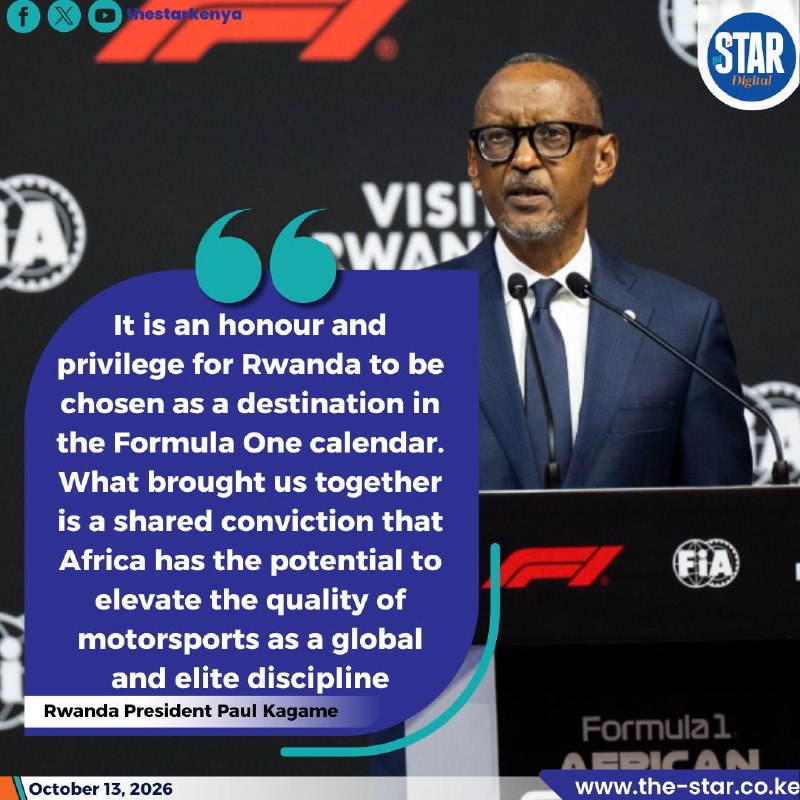
President Paul Kagame announced on 13 October 2026 that Rwanda has signed a ten-year hosting agreement with Formula One, returning the championship to Africa for the first time since the 1993 South African Grand Prix. The deal, disclosed in Kigali and relayed by Rwandan outlets within hours, runs into the early 2030s and positions Rwanda as the venue for a new African Grand Prix on the F1 calendar.
The agreement is more than a sporting fixture. It is a statement about which African states get to host the world's premium global events, and on what terms. Rwanda has spent the past decade positioning itself as the continent's conference-and-sport capital. The contract length is the headline number. Ten years is a generation of infrastructure, a generation of broadcast relationships, and a generation of branding rights for Kigali to monetise.
What Kigali actually signed
Reporting relayed through AllAfrica from The New Times, Nile Post and 263Chat records Kagame's confirmation of a ten-year term for the African Grand Prix, with the race expected to join the Formula One calendar in the early 2030s. The framing across those three outlets is consistent: the agreement is the vehicle for the championship's re-entry to the continent after a 32-year gap that began when the South African Grand Prix last ran in 1993. The Star Kenya's Telegram wire, posted at 10:37 UTC on 13 October, records F1's confirmation of the deal and the calendar intent. Kagame's own characterisation followed later in the day, at 14:04 UTC, calling the hosting consideration "an honour" and asserting that Africa has the potential to elevate motorsport as a global elite discipline.
The available source items do not specify the financial value of the agreement, the identity of the circuit constructor, the planned race location within Rwanda, the broadcasting partner, or whether existing circuits elsewhere in Africa were competing bidders. The published reporting on 13 October does not address those details.
A sovereignty moment, or a sports-laundering one
Read generously, the deal is the predictable next move for a government that has spent two decades building a brand around clean streets, conference security, and English-speaking logistical competence. Read cynically, it is the same playbook that has brought high-profile international sponsorships and tourism partnerships to Kigali: convert soft-power association into hard-currency visibility.
Both readings can be true. The economic case is real. Formula One's host cities now operate inside a tightly choreographed global circuit that monetises ticket sales, hospitality, broadcasting, and time-zone adjacency. Rwanda's location in central Africa is a logistical compromise, neither in the prime European broadcast window nor the Asian one, but the country has shown it can absorb visitor flows for week-long events. The reputational case is harder. Rwanda's hosting of high-profile international sport has long drawn criticism from human-rights organisations that accuse Kagame's government of using events to launder its image abroad, particularly given the legacy of the 1994 genocide and the country's role in the eastern DRC conflict. The deal does not resolve that argument. It will, however, put Kigali in front of F1's broadcast audience every year for a decade.
What this changes structurally
Monexus analysis: the contract length is the most consequential detail, more than the route or the venue. A single-season deal would be a publicity stunt. A ten-year deal obliges Rwanda to build permanent circuit-grade infrastructure, to staff a federation-grade motorsport authority, to negotiate multi-year broadcasting and sponsorship stacks, and to absorb the political cost of holding the event through domestic news cycles, World Cup years, and continental elections.
The wider pattern is that capital-rich, security-stable African states are now beating capital-rich but security-fragile ones to the marquee global fixtures. Egypt has the population and the broadcast adjacency. South Africa has the motorsport heritage and the existing Kyalami circuit. Morocco has the proximity to European logistics. Nigeria has the market size. The available source items do not specify whether any of those markets bid for the same slot, and this publication has not independently established which African circuits were in the running. What the reporting on 13 October does establish is that Rwanda has closed an F1 deal, and that the championship has not been held on the continent since 1993. The competitive lesson other African capitals will draw from the announcement, based on the available reporting, is that hosting announcements follow the announcement of a signed agreement rather than market size alone.
The continental precedent matters too. The African Continental Free Trade Area is supposed to make intra-African services trade easier. A Grand Prix that runs in Kigali for a decade creates a regional supply chain for hospitality, broadcasting, and event security that other AfCFTA members can plug into. If F1's travel-year renewal triggers a circuit-grade construction project, the procurement pipeline for engineering, signage, and logistics becomes a regional question, not just a Rwandan one. That is Monexus analysis, not a statement sourced from the 13 October reporting.
What to watch over the next twelve months
Three markers will tell us whether the deal is real or performative. First, the FIA's official publication of the African Grand Prix on the F1 calendar. The available source items do not specify a calendar date. Second, the Rwandan government's publication of a host-city agreement and an environmental and land-use impact assessment for the circuit footprint, again not specified in the available reporting. Third, the first broadcast-rights partner announcement, which will tell us whether Rwanda is selling the rights itself, sharing them through a regional consortium, or routing them through an existing African broadcaster.
Kagame's framing of the deal as "an honour" is the political line. The structural question is whether Kigali can convert a ten-year contract into a decade of receipts. Formula One does not return to a market that fails to deliver. Africa has now given the championship its second chance. The continent's credibility as a host for premium global sport will be set, race by race, at whatever venue Rwanda builds.
This article is built entirely from the 13 October 2026 source cluster on the Rwanda-Formula One announcement. Where the reporting converged on a specific figure or statement, that figure has been used. Where the sources did not address a detail, that absence has been named in the body rather than smoothed over.
Wire provenance
This editorial synthesis draws on the following public wire/social posts:
- https://allafrica.com/stories/202610130387.html
- https://allafrica.com/stories/202610130376.html
- https://allafrica.com/stories/202610130372.html
- https://t.me/TheStarKenya/39552
- https://t.me/TheStarKenya/39559
- https://t.me/allafrica/54247